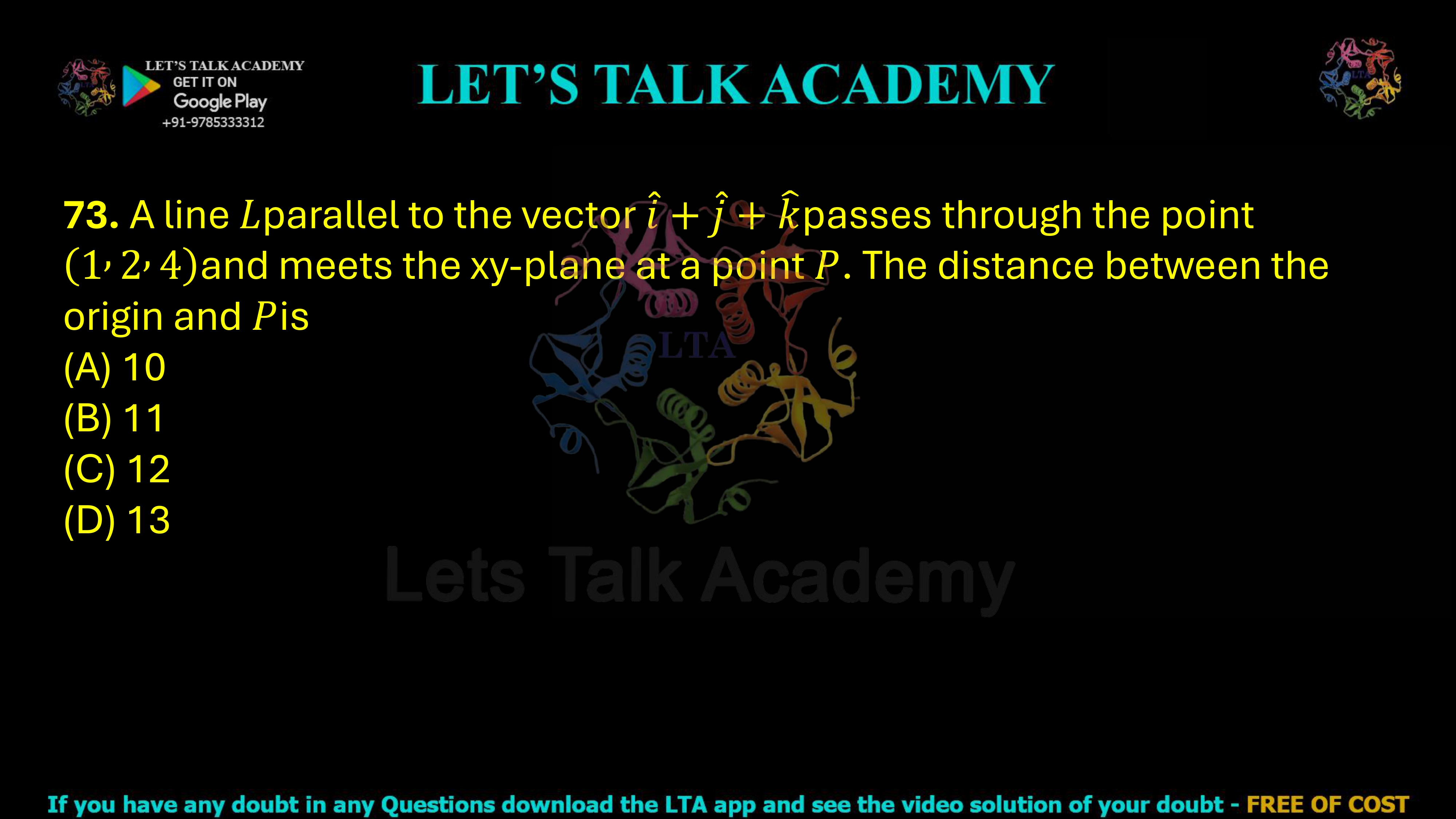
73. A line parallel to the vector passes through the point and meets the xy-plane at a point . The distance between the origin and is
(A) 10
(B) 11
(C) 12
(D) 13
Line Parallel to Vector i + j + k Passing Through (1,2,4) Meets the XY-Plane
Understanding the Problem
The line is parallel to the vector i + j + k, which means its direction vector is (1,1,1). Since the line passes through the point (1,2,4), we can easily form its parametric equation. The most important observation is that every point lying on the xy-plane has a z-coordinate equal to zero. Therefore, by setting the z-coordinate of the line equal to zero, we can find the intersection point. Finally, the three-dimensional distance formula is used to calculate the required distance from the origin.
Step 1: Form the Equation of the Line
Direction Vector
The given direction vector is
d = (1,1,1).
The line passes through the point
A(1,2,4).
Therefore, the vector equation of the line is
r = (1,2,4) + t(1,1,1)
where t is the parameter.
The corresponding parametric equations are
x = 1 + t
y = 2 + t
z = 4 + t
Step 2: Find the Point Where the Line Meets the XY-Plane
The equation of the xy-plane is
z = 0.
Using the parametric equation of the line, we obtain
4 + t = 0
Therefore,
t = -4.
Substituting this value into the parametric equations gives
x = 1 – 4 = -3
y = 2 – 4 = -2
z = 0
Hence, the coordinates of point P are
P = (-3,-2,0).
Step 3: Calculate the Distance from the Origin
The coordinates of the origin are
O = (0,0,0).
The distance formula in three-dimensional geometry is
Distance = √[(x₂ − x₁)² + (y₂ − y₁)² + (z₂ − z₁)²].
Substituting the coordinates of the origin and point P gives
OP = √[(-3)² + (-2)² + 0²]
= √(9 + 4)
= √13
Final Answer
Distance between the origin and point P = √13.
Why This Method Works
The direction vector determines the direction of the line, while the given point fixes its position in three-dimensional space. Since every point on the xy-plane satisfies the condition z = 0, substituting this condition into the parametric equation immediately provides the value of the parameter corresponding to the point of intersection. After obtaining the coordinates of the intersection point, the Euclidean distance formula is applied to calculate the shortest distance from the origin. This logical approach is commonly used in vector geometry problems and is highly useful for competitive examinations.
Key Concepts Covered
Parametric Equation of a Line
A line passing through a point (x₁,y₁,z₁) with direction vector (a,b,c) can be represented as
x = x₁ + at
y = y₁ + bt
z = z₁ + ct
Equation of the XY-Plane
The equation of the xy-plane is simply
z = 0.
Every point lying on this plane has a zero z-coordinate.
Distance Formula in Three Dimensions
If two points are (x₁,y₁,z₁) and (x₂,y₂,z₂), then the distance between them is given by
d = √[(x₂ − x₁)² + (y₂ − y₁)² + (z₂ − z₁)²].
When one of the points is the origin, the formula becomes even simpler and is frequently used in vector algebra.
Conclusion
This problem demonstrates a straightforward application of vector algebra and analytical geometry. By first writing the parametric equation of the line, then applying the condition for the xy-plane, and finally using the three-dimensional distance formula, we obtain the required answer efficiently.
Answer: √13


