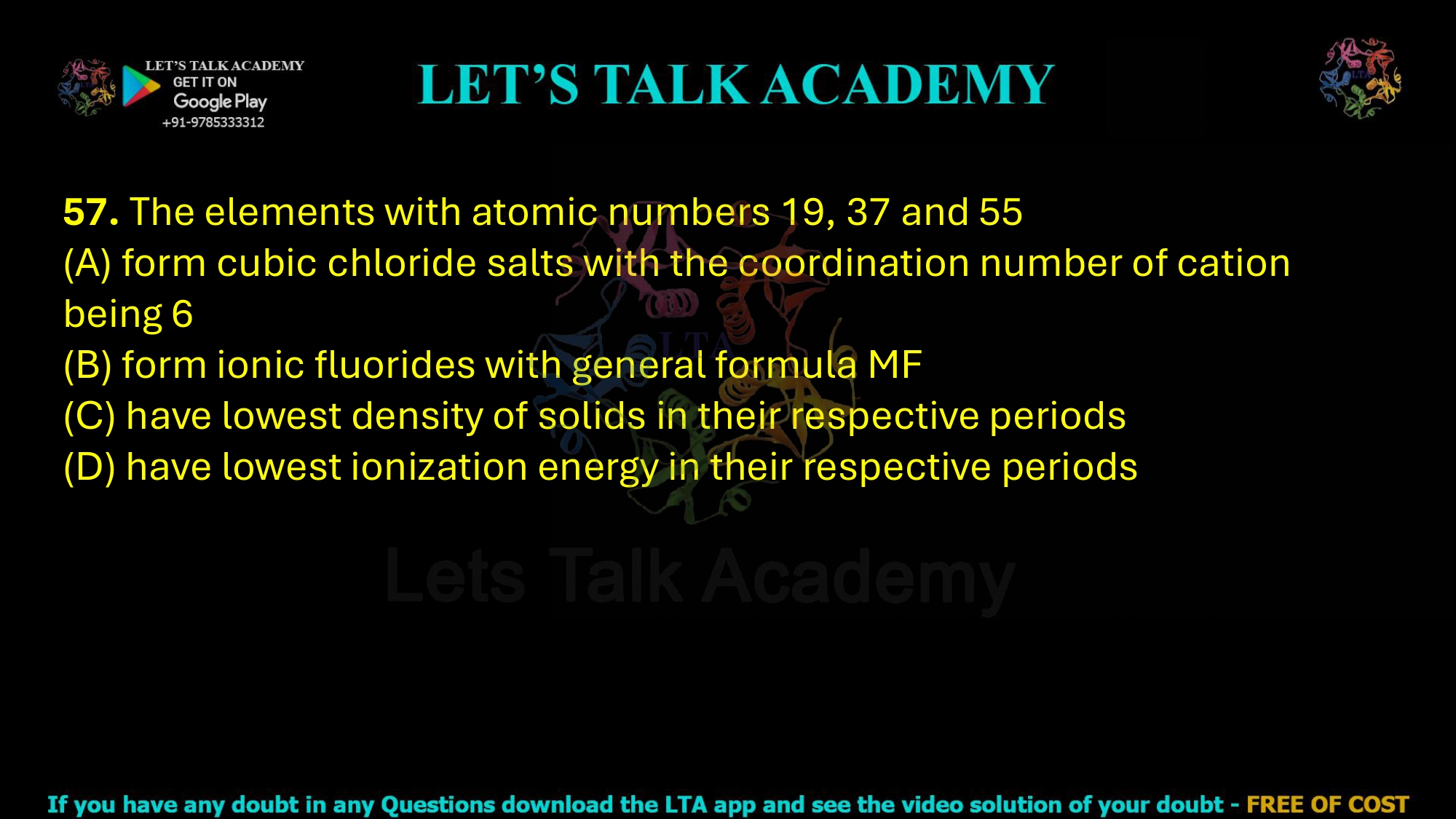
57. The elements with atomic numbers 19, 37 and 55
(A) form cubic chloride salts with the coordination number of cation being 6
(B) form ionic fluorides with general formula MF
(C) have lowest density of solids in their respective periods
(D) have lowest ionization energy in their respective periods
Elements with Atomic Numbers 19, 37, and 55 – Periodic Properties and Correct Answer Explained
In this question, the elements with atomic numbers 19, 37, and 55 are given. These correspond to Potassium (K), Rubidium (Rb), and Cesium (Cs), respectively. All three belong to Group 1 (alkali metals) and therefore exhibit similar chemical properties. However, only one of the given statements is universally correct.
Identifying the Elements
The atomic numbers correspond to the following elements:
- 19 → Potassium (K)
- 37 → Rubidium (Rb)
- 55 → Cesium (Cs)
These elements are members of the alkali metal family. Their outer electronic configuration is ns1, meaning each possesses a single valence electron that is easily removed during chemical reactions.
Periodic Trend Responsible for the Correct Answer
Across a period, the effective nuclear charge increases from left to right, causing atoms to hold their valence electrons more strongly. Consequently, ionization energy generally increases across a period.
Since alkali metals occupy the extreme left side of the periodic table, they experience the weakest attraction between the nucleus and the outermost electron. Therefore, they require the least amount of energy to remove that electron.
As a result, potassium, rubidium, and cesium possess the lowest first ionization energy in their respective periods.
Explanation of Every Option
Option (A): Form Cubic Chloride Salts with Coordination Number of Cation Being 6
This option is incorrect. Although potassium chloride crystallizes in the sodium chloride (NaCl) structure having a coordination number of 6, heavier alkali metal chlorides such as cesium chloride crystallize in the CsCl structure, where the coordination number is 8. Since all three elements do not necessarily form chloride salts with coordination number 6, this statement is not universally correct.
Option (B): Form Ionic Fluorides with General Formula MF
This statement is chemically true because alkali metals form ionic fluorides of the type MF. However, this property is not unique to only the given elements; it is common to all Group 1 metals, including lithium and sodium. In many competitive examinations, the expected distinguishing property among the given options is the periodic trend of ionization energy rather than a general chemical formula.
Option (C): Have Lowest Density of Solids in Their Respective Periods
This option is incorrect. Although alkali metals generally have low densities, they are not always the least dense solids in their respective periods. Density depends on both atomic mass and crystal packing, so this statement is not consistently true for potassium, rubidium, and cesium.
Option (D): Have Lowest Ionization Energy in Their Respective Periods
This is the correct answer. Potassium, rubidium, and cesium are the first elements in Periods 4, 5, and 6, respectively. Because they possess a single valence electron and the largest atomic radii in their periods, they exhibit the lowest first ionization energies among all elements in those periods.
Why Alkali Metals Have Low Ionization Energy
Alkali metals contain only one electron in their outermost shell. This electron is located far from the nucleus and is strongly shielded by inner electron shells. As a result, the effective nuclear attraction experienced by the valence electron is relatively weak.
Consequently, very little energy is required to remove this electron, allowing alkali metals to form stable +1 ions easily. This property explains their high chemical reactivity and strong reducing nature.
Final Answer
Correct Option: (D)
Potassium, Rubidium, and Cesium have the lowest first ionization energy in their respective periods.


