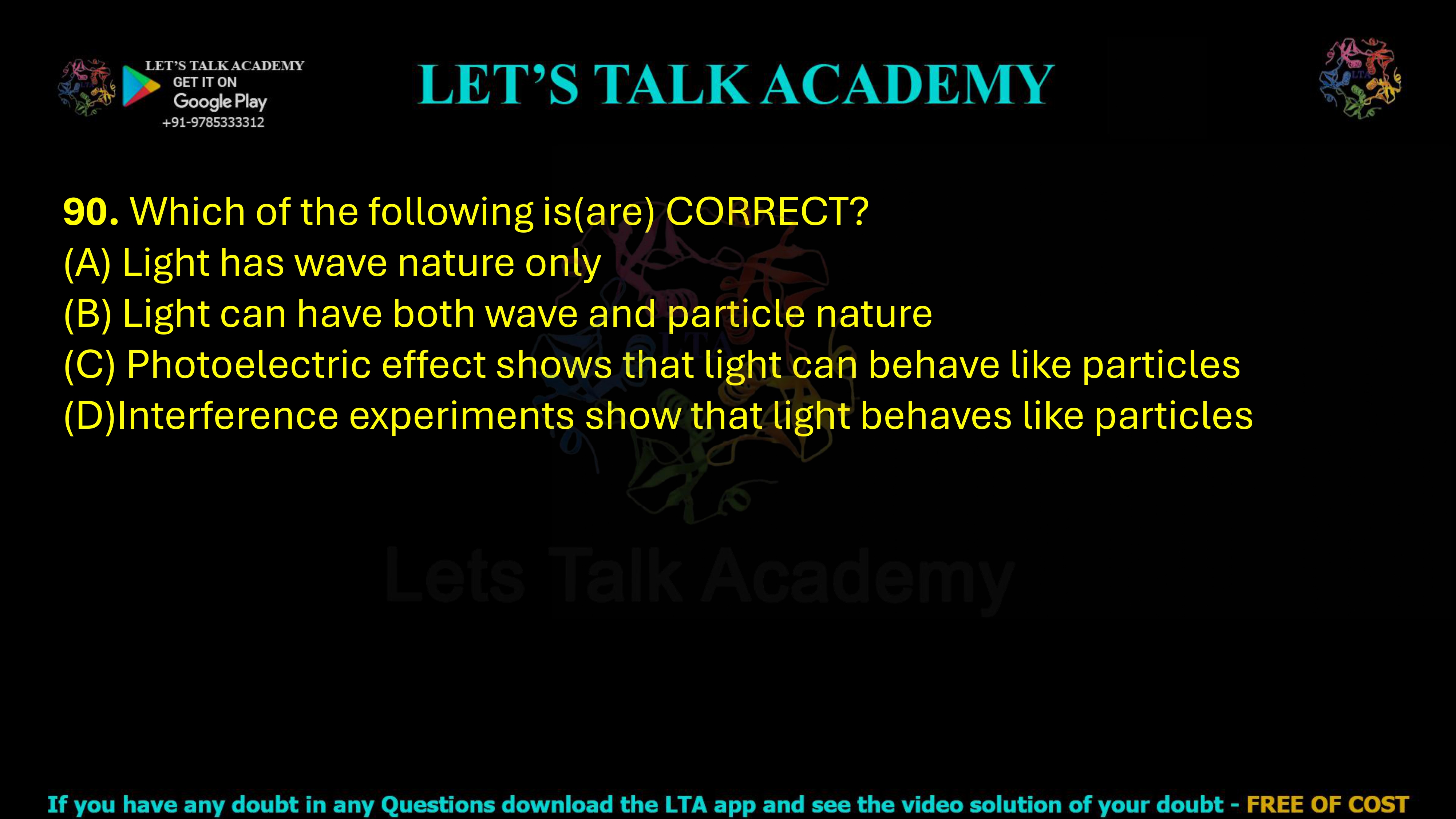
90. Which of the following is(are) CORRECT?
(A) Light has wave nature only
(B) Light can have both wave and particle nature
(C) Photoelectric effect shows that light can behave like particles
(D)Interference experiments show that light behaves like particles
Wave-Particle Duality of Light – Complete Theory, Photoelectric Effect, Interference
Correct Answer
(B) and (C)
Understanding the Nature of Light
For a long time, scientists debated whether light is a wave or a stream of particles. Different experiments seemed to support different theories.
In the seventeenth century, Isaac Newton proposed the corpuscular theory, according to which light consists of tiny particles called corpuscles. This theory successfully explained reflection and refraction but failed to explain interference and diffraction.
Later, Christiaan Huygens proposed the wave theory of light. This theory explained interference, diffraction, and polarization very successfully. James Clerk Maxwell further strengthened the wave theory by showing that light is an electromagnetic wave.
However, at the beginning of the twentieth century, experiments such as the photoelectric effect could not be explained using classical wave theory. To solve this problem, Albert Einstein proposed that light is made up of discrete packets of energy called photons.
This marked the birth of the concept of wave-particle duality.
What is Wave-Particle Duality?
Wave-particle duality states that light possesses both wave-like and particle-like characteristics. The observed behavior depends on the nature of the experiment.
When experiments involve interference, diffraction, or polarization, light behaves as a wave.
When experiments involve the transfer of energy to matter, such as the photoelectric effect or Compton scattering, light behaves as a stream of particles called photons.
Thus, neither the wave theory nor the particle theory alone is sufficient to explain all experimental observations.
Photoelectric Effect and the Particle Nature of Light
The photoelectric effect is one of the strongest pieces of evidence for the particle nature of light.
When light of sufficiently high frequency falls on a metal surface, electrons are emitted from the surface almost instantaneously. Classical wave theory could not explain several important observations, such as the existence of a threshold frequency and the immediate emission of electrons.
Einstein explained the phenomenon by assuming that light consists of photons. Each photon carries energy equal to
E = hf
where
- h = Planck’s constant
- f = Frequency of light
An electron absorbs the energy of one photon. If this energy exceeds the work function of the metal, the electron is emitted. This explanation successfully accounted for all experimental observations and earned Einstein the Nobel Prize in Physics.
Interference and the Wave Nature of Light
Interference is a phenomenon that occurs when two or more coherent light waves overlap.
Depending on the phase relationship between the waves, they may reinforce each other to produce bright fringes or cancel each other to produce dark fringes.
This phenomenon can only be explained if light behaves as a wave. The famous Young’s Double Slit Experiment provided convincing evidence for the wave nature of light.
Therefore, interference is considered one of the strongest demonstrations of the wave nature of light.
Detailed Option-Wise Analysis
Option (A): Light has wave nature only.
This statement is incorrect.
Although many experiments demonstrate the wave nature of light, several other experiments, such as the photoelectric effect and Compton scattering, clearly show that light also behaves as a stream of particles.
Therefore, light cannot be described as having only wave nature.
Option (A) is Incorrect.
Option (B): Light can have both wave and particle nature.
This statement correctly describes the principle of wave-particle duality.
Light exhibits wave properties in experiments involving interference, diffraction, and polarization, while it exhibits particle properties in experiments involving energy transfer, such as the photoelectric effect.
Thus, light possesses both wave-like and particle-like characteristics.
Option (B) is Correct.
Option (C): Photoelectric effect shows that light can behave like particles.
This statement is correct.
The photoelectric effect demonstrates that light transfers energy in discrete packets called photons. Each photon interacts with one electron, proving that light behaves as a collection of particles during this process.
This experiment provided one of the strongest confirmations of Einstein’s photon theory.
Option (C) is Correct.
Option (D): Interference experiments show that light behaves like particles.
This statement is incorrect.
Interference is a wave phenomenon. It occurs because light waves overlap and combine according to the principle of superposition.
Therefore, interference provides evidence for the wave nature of light, not its particle nature.
Option (D) is Incorrect.
Wave Nature vs Particle Nature of Light
The wave nature of light is demonstrated by phenomena such as interference, diffraction, polarization, and reflection. These phenomena require light to behave as an electromagnetic wave.
On the other hand, the particle nature of light is demonstrated by the photoelectric effect, Compton scattering, blackbody radiation, and pair production. These phenomena require light to be treated as a stream of photons carrying discrete packets of energy.
Together, these observations establish the dual nature of light, which forms one of the foundations of quantum mechanics.
Real-Life Applications
The wave nature of light is utilized in interferometers, holography, fiber-optic communication, optical instruments, and diffraction gratings. The particle nature of light is essential for the operation of solar cells, photodiodes, LEDs, laser technology, digital cameras, night vision devices, medical imaging systems, and numerous modern electronic and communication technologies.
Exam-Oriented Key Concepts
Students should remember that no single classical theory can completely explain the behavior of light. Interference, diffraction, and polarization demonstrate the wave nature of light, whereas the photoelectric effect and Compton effect demonstrate its particle nature. The equation E = hf is the fundamental relation describing the energy of a photon. Questions based on identifying which experiment demonstrates which nature of light are extremely common in competitive examinations.
Final Answer
Light exhibits both wave-like and particle-like properties depending on the experimental conditions. The photoelectric effect demonstrates the particle nature of light, whereas interference demonstrates its wave nature.
Correct Options: (B) and (C)


