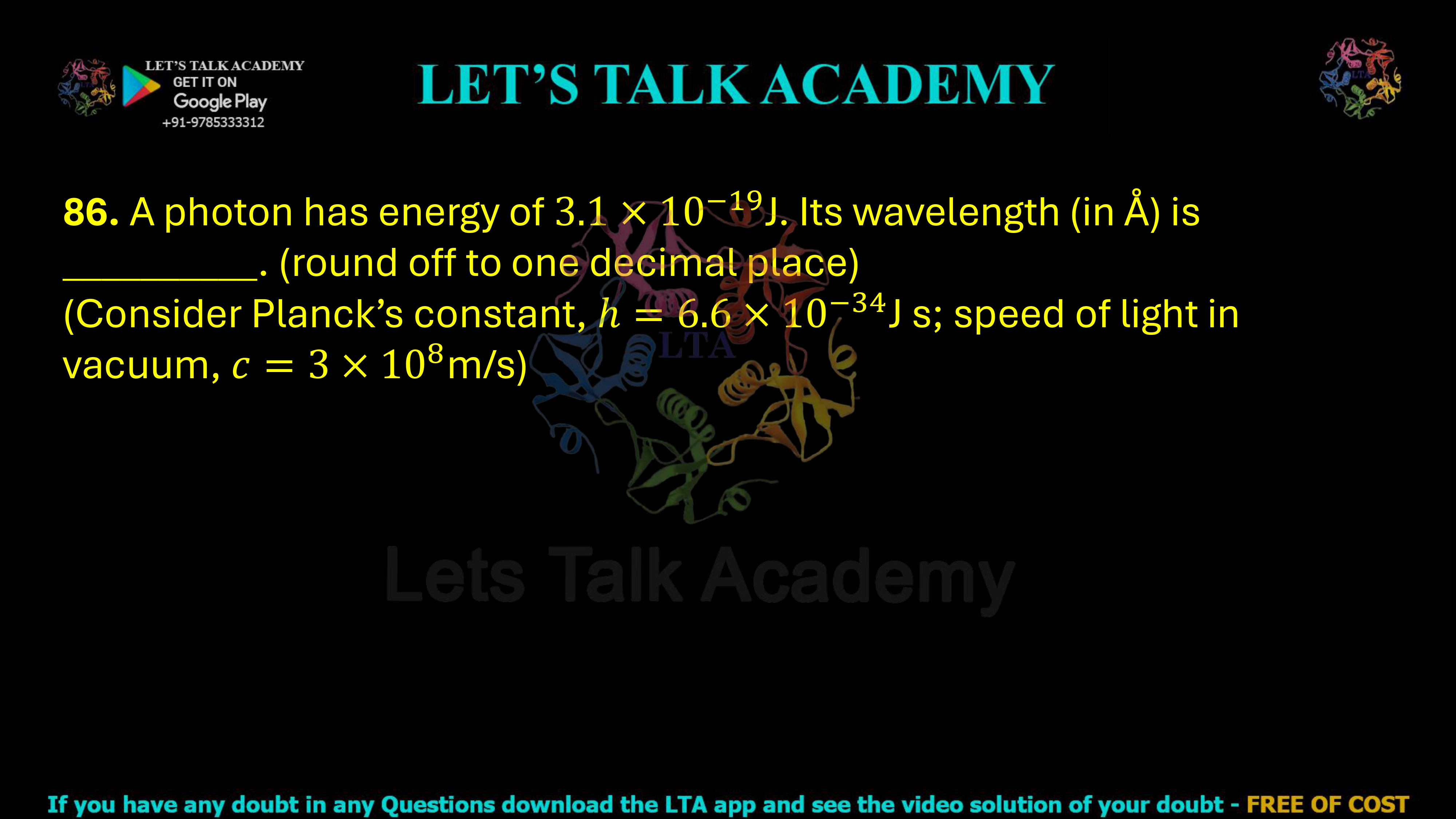
86. A photon has energy of 3.1 × 10⁻¹⁹ J. Its wavelength (in Å) is ________ (round off to one decimal place).
(Consider Planck’s constant, J s; speed of light in vacuum, m/s)
Photon Wavelength from Energy – Complete Theory, Derivation
Correct Answer
6387.1 Å
Understanding the Concept of Photon Energy
A photon is the smallest discrete packet of electromagnetic radiation. Unlike ordinary particles that possess rest mass, a photon has zero rest mass and always travels with the speed of light in vacuum.
Although photons have no rest mass, they carry both energy and momentum. The energy of a photon depends only on its frequency and is given by Planck’s quantum equation.
The fundamental relationship is
E = hf
where
- E = Energy of the photon
- h = Planck’s constant
- f = Frequency of the photon
Since the speed of light is related to frequency and wavelength by
c = fλ
substituting this relation into Planck’s equation gives
E = hc/λ
This equation is one of the most frequently used formulas in Modern Physics.
Formula Used
The wavelength of a photon is obtained using
λ = hc / E
where
- λ = Wavelength
- h = Planck’s constant
- c = Speed of light
- E = Energy of the photon
The equation clearly shows that wavelength is inversely proportional to energy. A photon with greater energy always has a shorter wavelength, while a photon with lower energy has a longer wavelength.
Given Data
Energy of photon
E = 3.1 × 10⁻¹⁹ J
Planck’s constant
h = 6.6 × 10⁻³⁴ J s
Speed of light
c = 3 × 10⁸ m/s
Step-by-Step Solution
Using the equation
λ = hc / E
Substitute the given values.
λ = (6.6 × 10−34) × (3 × 108) / (3.1 × 10⁻¹⁹)
First, multiply the numerator.
6.6 × 3 = 19.8
10−34 × 108 = 10−26
Therefore,
Numerator = 19.8 × 10⁻²⁶
Now divide by the denominator.
λ = (19.8 × 10⁻²⁶) / (3.1 × 10⁻¹⁹)
λ = 6.387 × 10⁻⁷ m
Convert Metres into Angstrom
The question asks for the answer in Angstrom (Å).
We know that
1 Å = 10−10 m
Therefore,
λ = 6.387 × 10−7 × 1010 Å
λ = 6.387 × 10³ Å
λ = 6387.1 Å
Rounded to one decimal place,
λ = 6387.1 Å
Physical Interpretation of the Result
The calculated wavelength of approximately 6387 Å lies in the visible region of the electromagnetic spectrum, specifically in the red portion. Visible light generally has wavelengths ranging from about 4000 Å (violet) to 7000 Å (red). Therefore, the given photon corresponds to red light.
This demonstrates the inverse relationship between photon energy and wavelength. Red light has a longer wavelength and lower energy than blue or violet light.
Why is the Wavelength Inversely Proportional to Energy?
From the equation
E = hc/λ
it is evident that Planck’s constant and the speed of light are constants. Therefore, if the wavelength decreases, the energy must increase to keep the product constant. Conversely, a longer wavelength always corresponds to a lower-energy photon.
This principle explains why X-rays and gamma rays, which have extremely short wavelengths, possess much higher energies than visible light or radio waves.
Real-Life Applications
The relationship between photon energy and wavelength is widely used in spectroscopy, astronomy, lasers, optical communication, medical imaging, semiconductor devices, and quantum computing. It also explains the working of solar cells, LEDs, and the photoelectric effect, for which Albert Einstein received the Nobel Prize in Physics.
Exam-Oriented Key Concepts
Students should remember the three most important equations in photon physics:
- E = hf
- c = fλ
- E = hc/λ
Questions may ask you to calculate energy, wavelength, frequency, or momentum of a photon. Always convert the final answer into the units requested in the question, such as metres, nanometres, or Angstroms.
Final Answer
The wavelength of the photon is
6387.1 Å
Final Answer: 6387.1 Å


