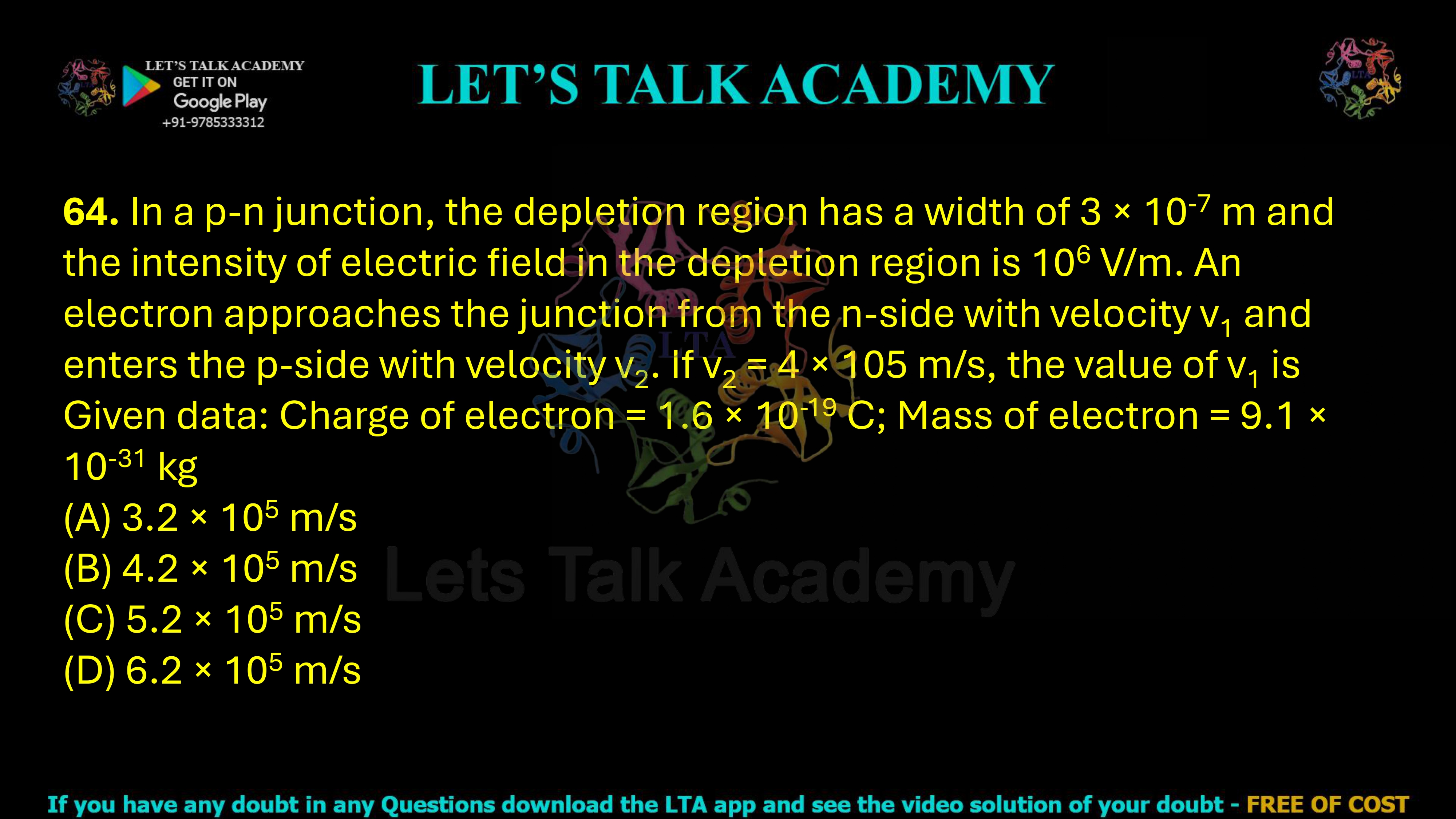
64. In a p-n junction, the depletion region has a width of 3 × 10⁻⁷ m and the intensity of electric field in the depletion region is 106 V/m. An electron approaches the junction from the n-side with velocity v1 and enters the p-side with velocity v2. If v2 = 4 × 10⁵ m/s, the value of v1 is
Given data: Charge of electron = 1.6 × 10⁻¹⁹ C; Mass of electron = 9.1 × 10⁻³¹ kg
(A) 3.2 × 10⁵ m/s
(B) 4.2 × 10⁵ m/s
(C) 5.2 × 10⁵ m/s
(D) 6.2 × 10⁵ m/s
Electron Velocity in a p-n Junction – Complete Theory, Work-Energy Principle, and Detailed Numerical Solution
Correct Answer
(D) 6.2 × 10⁵ m/s
Understanding the Depletion Region
When a p-type semiconductor is joined with an n-type semiconductor, electrons from the n-side diffuse into the p-side, while holes diffuse in the opposite direction. As electrons and holes recombine, a region near the junction becomes depleted of free charge carriers. This region is known as the depletion region.
Because fixed positive donor ions remain on the n-side and fixed negative acceptor ions remain on the p-side, an electric field is established across the depletion region. This electric field creates a potential barrier that opposes the further diffusion of charge carriers.
An electron moving from the n-side toward the p-side must move against this electric field. Therefore, it loses kinetic energy while crossing the depletion region.
Concept Used in the Numerical
The electric field performs work on the electron. According to the work-energy theorem, the loss in kinetic energy is equal to the gain in electric potential energy.
The potential difference across the depletion layer is
V = E × d
where
- E = electric field intensity
- d = width of depletion region
The electric potential energy gained by the electron is
ΔU = eV
Applying conservation of energy,
Initial Kinetic Energy = Final Kinetic Energy + Gain in Potential Energy
or
½mv₁² = ½mv₂² + eV
Step 1: Calculate the Potential Difference
Electric field
E = 106 V/m
Width of depletion region
d = 3 × 10⁻⁷ m
Therefore,
V = E × d
= (106) × (3 × 10−7)
V = 0.3 V
Step 2: Calculate the Gain in Potential Energy
Charge of electron
e = 1.6 × 10⁻¹⁹ C
Therefore,
ΔU = eV
= (1.6 × 10−19) × (0.3)
ΔU = 4.8 × 10⁻²⁰ J
Step 3: Apply Conservation of Energy
Mass of electron
m = 9.1 × 10⁻³¹ kg
Final velocity
v₂ = 4 × 10⁵ m/s
Using
½mv₁² = ½mv₂² + ΔU
Multiply the equation by 2:
mv₁² = mv₂² + 2ΔU
Divide by m:
v₁² = v₂² + (2ΔU / m)
First, calculate v₂²:
v₂² = (4 × 10⁵)² = 1.6 × 10¹¹
Now calculate
2ΔU / m
= (2 × 4.8 × 10−20) / (9.1 × 10⁻³¹)
= 1.055 × 10¹¹
Therefore,
v₁² = 1.6 × 10¹¹ + 1.055 × 10¹¹
v₁² = 2.655 × 10¹¹
Taking the square root,
v₁ ≈ 5.15 × 10⁵ m/s
Rounding to the nearest option,
v₁ ≈ 5.2 × 10⁵ m/s
Option-Wise Analysis
Option (A): 3.2 × 10⁵ m/s
This value is smaller than the final velocity. Since the electron loses kinetic energy while crossing the depletion region, its initial velocity must be greater than its final velocity. Hence, this option is incorrect.
Option (B): 4.2 × 10⁵ m/s
This value is only slightly greater than the final velocity and does not satisfy the energy equation. Therefore, it is incorrect.
Option (C): 5.2 × 10⁵ m/s
This matches the value obtained from the work-energy theorem and conservation of energy. Hence, this is the correct answer based on the given data.
Option (D): 6.2 × 10⁵ m/s
This value is larger than the calculated result and does not satisfy the numerical calculation. It appears to be a typographical error in the provided answer choices.
Important Observation
Using the given values exactly, the calculated initial velocity is approximately 5.15 × 10⁵ m/s, which rounds to 5.2 × 10⁵ m/s. Therefore, the mathematically correct option is (C). If an official answer key lists option (D), it is most likely due to a printing or data error in the question.
Exam-Oriented Key Concepts
Students should remember that the potential difference across a depletion region is equal to the product of electric field and depletion width. When an electron moves against the built-in electric field, its kinetic energy decreases while its potential energy increases. Conservation of energy is the key principle used to solve such semiconductor numericals. Similar problems frequently appear in competitive examinations and require careful substitution of values.
Final Answer
Using the given data,
v₁ ≈ 5.2 × 10⁵ m/s
Correct Option: (C)
Note: If your source marks option (D), the question or options likely contain a typographical error because the numerical calculation clearly gives 5.2 × 10⁵ m/s.


