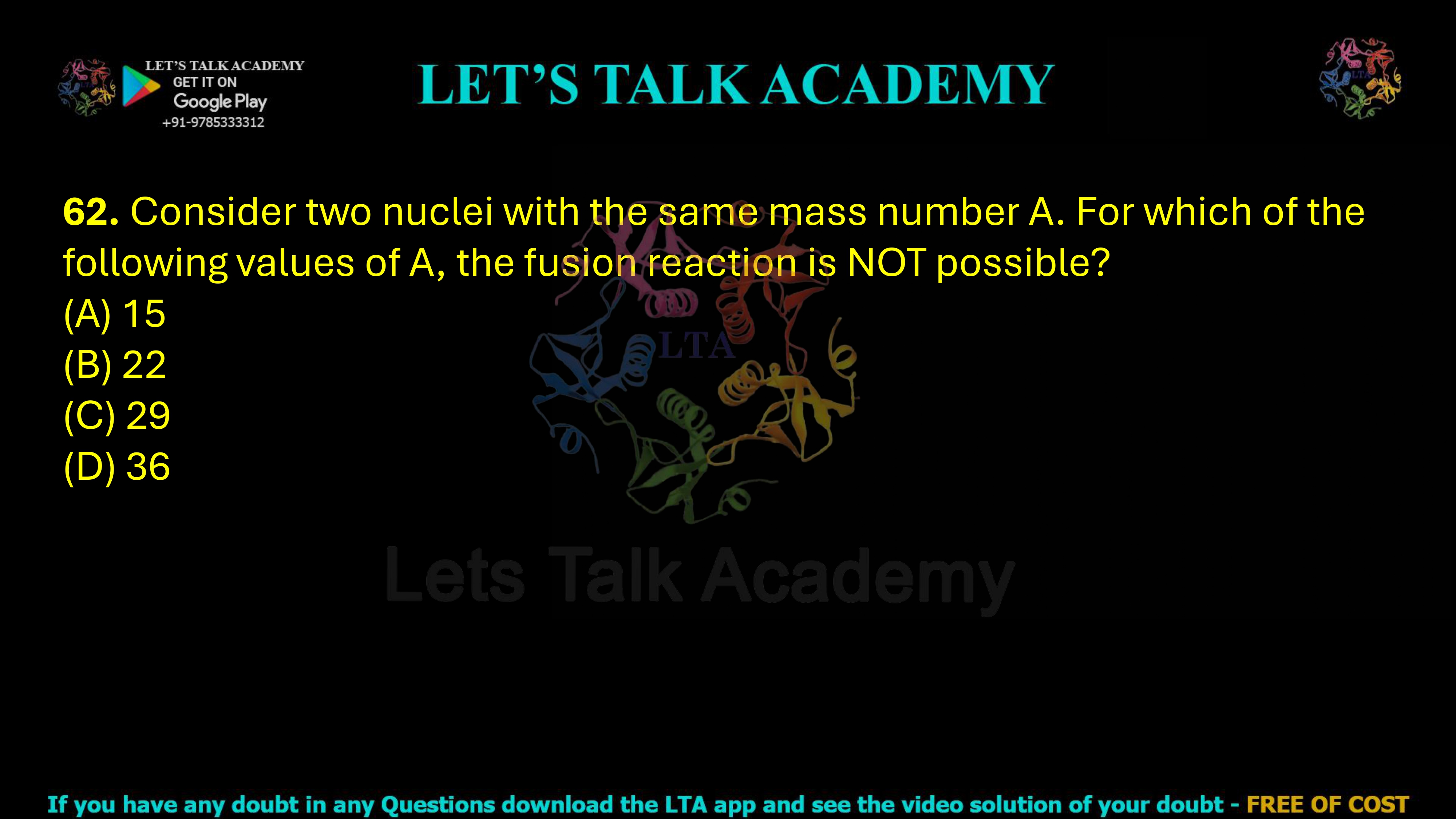
62. Consider two nuclei with the same mass number A. For which of the following values of A, the fusion reaction is NOT possible?
(A) 15
(B) 22
(C) 29
(D) 36
Fusion Reaction and Mass Number – Complete Explanation Using the Binding Energy Curve
Correct Answer
(D) 36
What is Nuclear Fusion?
Nuclear fusion is the process in which two light nuclei combine to form a heavier nucleus. During this process, a part of the total mass is converted into energy according to Einstein’s famous equation,
E = mc2
Fusion releases energy only if the final nucleus has a higher binding energy per nucleon than the original nuclei. This means the newly formed nucleus is more stable.
The energy released during fusion powers the Sun, stars, and hydrogen bombs. Scientists are also attempting to use controlled fusion as a clean source of energy for future power generation.
The Binding Energy per Nucleon Curve
The key to solving this question is understanding the binding energy per nucleon graph.
The binding energy per nucleon increases rapidly for very light nuclei, continues to increase gradually up to nuclei around iron (A ≈ 56), where it reaches its maximum value, and then slowly decreases for heavier nuclei.
This means:
- Light nuclei become more stable by combining with other light nuclei. Therefore, fusion releases energy.
- Very heavy nuclei become more stable by splitting into medium-sized nuclei. Therefore, fission releases energy.
- Iron and nearby nuclei are the most stable because they possess the highest binding energy per nucleon.
As a result, fusion is energetically favorable only for nuclei that are sufficiently lighter than iron.
Important Principle Used in This Question
The two nuclei have the same mass number A. When they fuse, the product nucleus will have mass number
Final Mass Number = 2A
Fusion is possible only if the product nucleus lies on the rising part of the binding energy curve, where the binding energy per nucleon increases.
If the product lies beyond the region where the binding energy starts decreasing, fusion will not release energy and therefore is not energetically favorable.
Step-by-Step Analysis
Option (A): A = 15
Two nuclei each having mass number 15 combine to form a nucleus with mass number
2 × 15 = 30
A nucleus with mass number 30 is still much lighter than iron (A ≈ 56). In this region, the binding energy per nucleon is still increasing. Therefore, the fused nucleus is more stable than the original nuclei, and energy is released.
Fusion is possible.
Option (B): A = 22
The fused nucleus will have
2 × 22 = 44
Mass number 44 also lies below the iron peak. Since the binding energy per nucleon continues to increase up to iron, the product nucleus becomes more stable.
Fusion is possible.
Option (C): A = 29
The resulting nucleus has
2 × 29 = 58
This value is very close to the iron region. Around iron and nickel, the binding energy per nucleon reaches its maximum. Fusion up to this region is still energetically favorable in standard textbook treatment because the product is near the maximum stability point.
Fusion is considered possible.
Option (D): A = 36
The fused nucleus will have
2 × 36 = 72
A nucleus with mass number 72 lies beyond the iron peak. Beyond this region, the binding energy per nucleon starts decreasing. This means the product nucleus would be less tightly bound than nuclei near the iron region.
Since the binding energy per nucleon no longer increases, fusion does not release energy and therefore is not energetically favorable.
Hence, fusion is NOT possible in the sense of being energy-releasing.
Why Does Iron Play Such an Important Role?
Iron (approximately A = 56) occupies a unique position in nuclear physics because it has one of the highest binding energies per nucleon among all nuclei. Nature always favors configurations with greater stability.
For nuclei lighter than iron, combining nuclei increases stability, so fusion releases energy. For nuclei heavier than iron, splitting them into medium-sized nuclei increases stability, so fission releases energy.
This is why stars generate energy through fusion only until iron is produced. Once a stellar core becomes rich in iron, further fusion no longer produces energy, marking a crucial stage in stellar evolution.
Fusion vs. Fission
Fusion combines two light nuclei into a heavier nucleus and releases energy only when the product moves toward the peak of the binding energy curve. Fission, on the other hand, splits a heavy nucleus into two lighter nuclei, releasing energy because the products move closer to the iron region where nuclei are more stable.
Thus, fusion dominates for light elements, while fission dominates for very heavy elements such as uranium and plutonium.
Exam-Oriented Key Concepts
Students should remember that the binding energy per nucleon increases rapidly for light nuclei and reaches its maximum near iron (A ≈ 56). Fusion reactions are energetically favorable only up to this region. Beyond iron, fusion does not release energy because the binding energy per nucleon decreases. Conversely, heavy nuclei beyond iron release energy through fission. Questions based on this concept are extremely common in competitive examinations and often test conceptual understanding rather than calculation.
Final Answer
Among the given options, when two nuclei each having mass number 36 combine, the resulting nucleus has mass number 72, which lies beyond the iron peak on the binding energy curve. Since fusion no longer increases the binding energy per nucleon in this region, the reaction is not energetically favorable.
Correct Option: (D) 36


