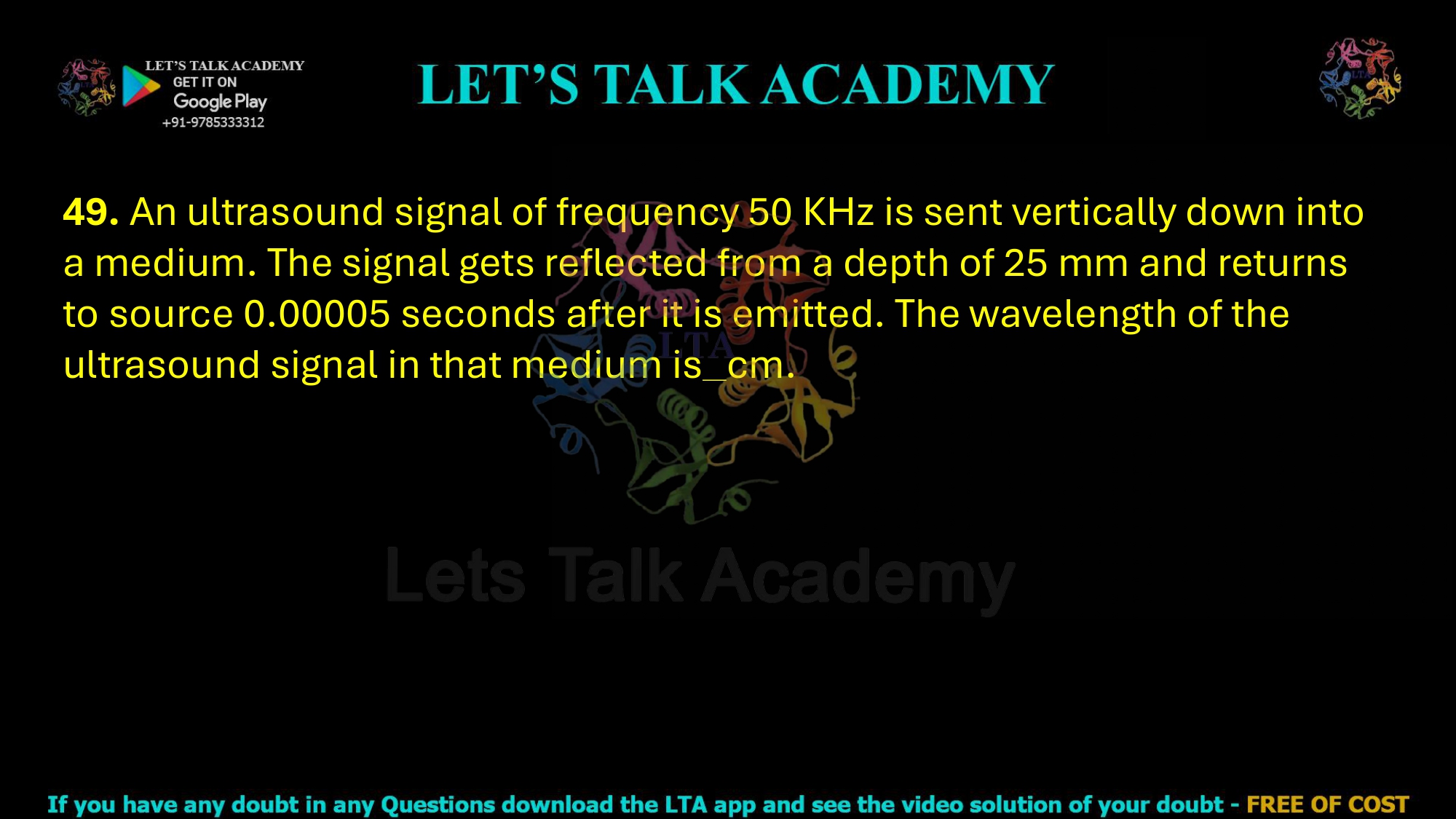
49. An ultrasound signal of frequency 50 KHz is sent vertically down into a medium. The signal gets reflected from a depth of 25 mm and returns to source 0.00005 seconds after it is emitted. The wavelength of the ultrasound signal in that medium is cm.
Wavelength of a 50 kHz Ultrasound Signal Reflected From a Depth of 25 mm
Understanding the Ultrasound Reflection Problem
This question combines two important concepts of wave motion: the echo or reflection method used to calculate wave speed and the relationship between wave speed, frequency, and wavelength. An ultrasound signal is sent vertically downward into a medium, reflects from a point located at a depth of 25 mm, and then returns to the source.
The most important point is that the given time of 0.00005 seconds is the total time taken by the ultrasound signal to travel downward to the reflecting point and then return upward to the source. Therefore, the ultrasound travels twice the given depth during this time.
Once the total distance traveled by the signal is determined, its speed in the medium can be calculated. The wavelength can then be found using the standard wave relation between speed, frequency, and wavelength.
Given Information
The frequency of the ultrasound signal is:
f = 50 kHz
The depth of the reflecting point is:
d = 25 mm
The total time taken by the signal to return to the source is:
t = 0.00005 s
The required quantity is the wavelength λ of the ultrasound signal in centimetres.
Step 1: Convert the Frequency Into Hertz
The frequency is given in kilohertz. Since the SI unit of frequency is hertz, it must be converted before using the wave equation.
We know that:
1 kHz = 103 Hz
Therefore:
50 kHz = 50 × 103 Hz
f = 5 × 10⁴ Hz
Thus, the frequency of the ultrasound signal is 50,000 Hz.
Step 2: Calculate the Total Distance Traveled by the Ultrasound Signal
The ultrasound signal travels from the source to a depth of 25 mm and then returns from the reflecting point to the source. Therefore, the total distance traveled is twice the depth.
Total distance = 2 × depth
Total distance = 2 × 25 mm
Total distance = 50 mm
Converting millimetres into metres:
50 mm = 50 × 10−3 m
Total distance = 0.05 m
Therefore, the ultrasound signal travels a total distance of 0.05 m during the given time interval.
Why Is the Distance Twice the Given Depth?
The depth of 25 mm represents only the one-way distance from the source to the reflecting point. However, the given time is measured from the moment the signal is emitted until the reflected signal returns to the source.
Therefore, the signal completes two equal parts of its journey. It first travels 25 mm downward and then travels another 25 mm upward. Hence:
Total distance = 25 mm + 25 mm = 50 mm
This round-trip distance must be used when calculating the speed of the ultrasound signal.
Step 3: Calculate the Speed of Ultrasound in the Medium
Speed is defined as the total distance traveled divided by the time taken:
v = Distance/Time
Substituting the calculated total distance and the given time:
v = 0.05/0.00005
Writing the time in scientific notation:
0.00005 s = 5 × 10⁻⁵ s
Therefore:
v = (5 × 10⁻²)/(5 × 10−5)
v = 103 m s−1
v = 1000 m s−1
Thus, the speed of the ultrasound signal in the given medium is 1000 m/s.
Step 4: Calculate the Wavelength of the Ultrasound Signal
The speed, frequency, and wavelength of a wave are related by the equation:
v = fλ
Rearranging the equation to calculate wavelength:
λ = v/f
Substituting v = 1000 m/s and f = 50,000 Hz:
λ = 1000/50000
λ = 0.02 m
Therefore, the wavelength of the ultrasound signal is 0.02 m.
Step 5: Convert the Wavelength From Metres to Centimetres
The question asks for the answer in centimetres. We know that:
1 m = 100 cm
Therefore:
λ = 0.02 × 100 cm
λ = 2 cm
Hence, the wavelength of the ultrasound signal in the medium is 2 cm.
Direct Calculation Method
The complete solution can also be performed by combining the speed and wavelength equations. The speed of the reflected ultrasound signal is:
v = 2d/t
Since wavelength is given by λ = v/f:
λ = 2d/(ft)
Substituting d = 25 × 10−3 m, f = 50 × 103 Hz, and t = 5 × 10⁻⁵ s:
λ = [2 × (25 × 10−3)]/[(50 × 103) × (5 × 10−5)]
λ = 0.02 m
λ = 2 cm
This direct method gives exactly the same result.
Physical Meaning of the Calculated Wavelength
A wavelength of 2 cm means that the distance between two successive points of the ultrasound wave that are in the same phase, such as two consecutive compressions, is 2 cm in this particular medium.
The wavelength of a wave depends on both its frequency and its speed in the medium. The frequency of the ultrasound signal is fixed by the source at 50 kHz, while its speed is determined by the physical properties of the medium. Therefore, once the speed of 1000 m/s is known, the wavelength follows directly from λ = v/f.
Role of Round-Trip Time in Ultrasound Measurements
Ultrasound systems frequently determine depth by measuring the time taken for a pulse to travel to a reflecting surface and return. Since the measured time represents a round trip, the one-way depth is related to the speed and total travel time by:
d = vt/2
The factor of 2 appears because the signal travels the same distance twice. This principle is widely used in ultrasound imaging, sonar, and non-destructive testing of materials.
Final Answer
Wavelength of the ultrasound signal = 2 cm
The ultrasound signal travels 25 mm downward and 25 mm back to the source, giving a total distance of 50 mm or 0.05 m. Since this distance is covered in 0.00005 s, the wave speed is 1000 m/s. Using λ = v/f with f = 50,000 Hz gives λ = 0.02 m, which is equal to 2 cm.


