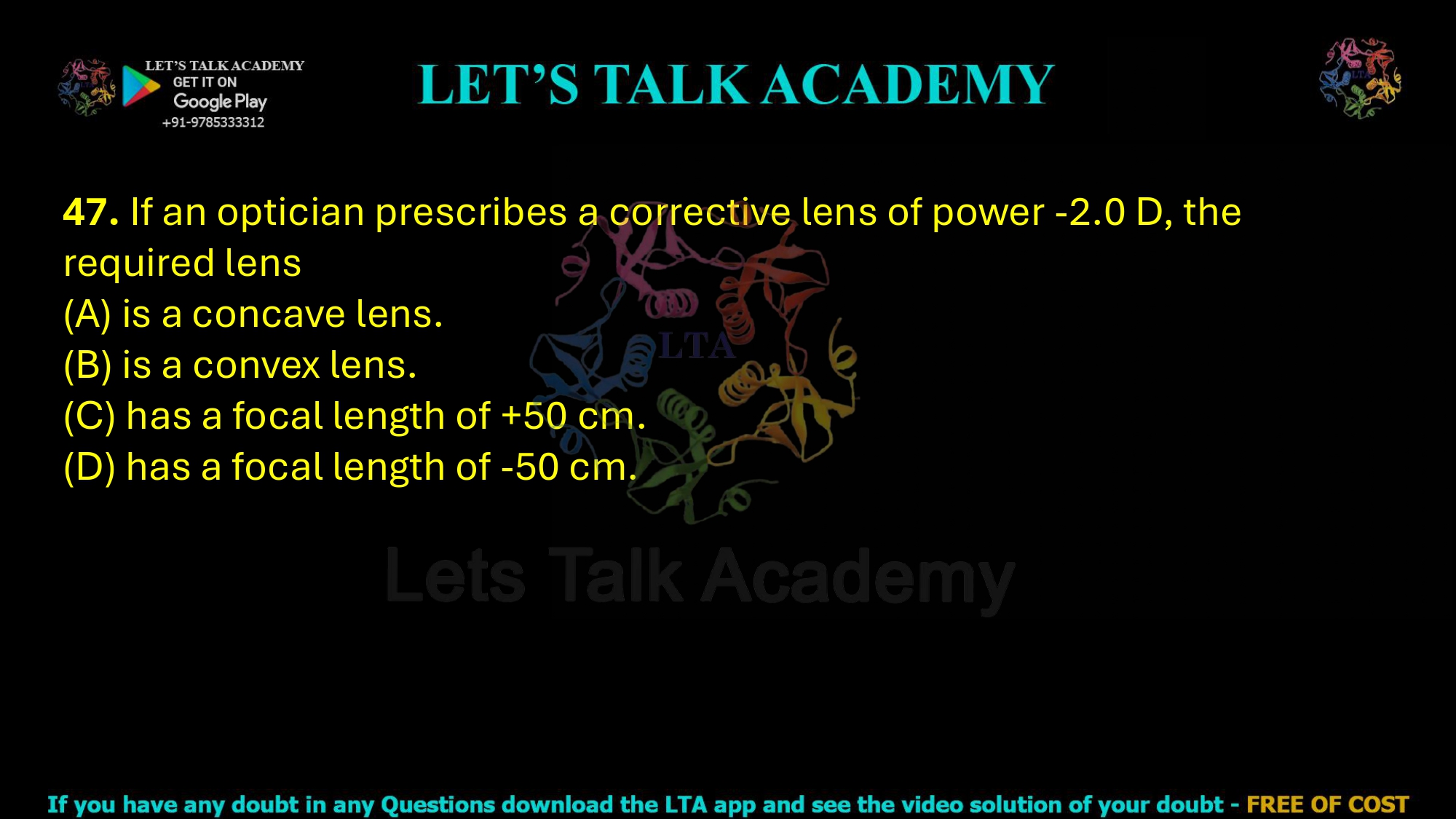
47. If an optician prescribes a corrective lens of power -2.0 D, the required lens
(A) is a concave lens.
(B) is a convex lens.
(C) has a focal length of +50 cm.
(D) has a focal length of -50 cm.
Corrective Lens of Power −2.0 D: Lens Type and Focal Length Explained
Correct Answer: (A) and (D)
Understanding the Given Corrective Lens Problem
This question asks us to determine both the type and the focal length of a corrective lens whose power is given as −2.0 diopters. The sign of the power immediately provides important information about whether the lens is converging or diverging, while the numerical value of the power allows us to calculate its focal length.
A lens with positive power is a converging or convex lens, whereas a lens with negative power is a diverging or concave lens. Since the prescribed lens has a power of −2.0 D, it must be a concave lens. Using the relationship between lens power and focal length, its focal length is found to be −0.50 m, which is equal to −50 cm.
Therefore, both statements (A) and (D) are correct.
What Is the Power of a Lens?
The power of a lens is a measure of its ability to converge or diverge light rays. A lens with a shorter focal length bends light more strongly and therefore has a greater magnitude of power. A lens with a longer focal length bends light less strongly and has a smaller magnitude of power.
The power of a lens is represented by the symbol P and is defined as the reciprocal of its focal length in metres:
P = 1/f
where P is the power of the lens in diopters and f is the focal length in metres.
The SI-related practical unit of lens power is the diopter, represented by D. One diopter is the power of a lens whose focal length has a magnitude of one metre.
Given Value of Lens Power
The prescribed power of the corrective lens is:
P = −2.0 D
The negative sign is extremely important. It indicates that the lens has a negative focal length and therefore behaves as a diverging lens.
A diverging lens is a concave lens. Hence, even before calculating the focal length, we can conclude that option (A) is correct and option (B) is incorrect.
Determining the Type of Lens from the Sign of Power
The sign of lens power depends on the sign of its focal length. According to the Cartesian sign convention, a convex lens has a positive focal length because its principal focus for parallel incident rays lies on the opposite side of the lens.
Therefore, for a convex lens:
f > 0 and P > 0
A concave lens causes parallel rays of light to diverge. The backward extensions of these rays appear to meet at a principal focus on the same side as the incident light. Therefore, the focal length of a concave lens is negative.
Hence, for a concave lens:
f < 0 and P < 0
Since the prescribed power is −2.0 D, the required corrective lens must be a concave lens.
Calculating the Focal Length of the Lens
The relationship between power and focal length is:
P = 1/f
Rearranging the formula:
f = 1/P
Substituting the given power:
f = 1/(−2.0)
Therefore:
f = −0.5 m
Thus, the focal length of the prescribed corrective lens is −0.5 metre.
Converting the Focal Length from Metres to Centimetres
The focal length obtained from the power formula is:
f = −0.5 m
We know that:
1 m = 100 cm
Therefore:
−0.5 m = −0.5 × 100 cm
Hence:
f = −50 cm
Therefore, the lens has a focal length of −50 cm, making option (D) correct.
Why the Negative Sign of Focal Length Matters
The negative sign in the focal length is not simply a mathematical symbol that can be ignored. It provides physical information about the optical behavior of the lens.
A focal length of −50 cm means that the lens is diverging. When parallel rays of light pass through the lens, they spread apart after refraction. Their backward extensions appear to meet at a point 50 cm from the optical center on the same side from which the light entered.
This behavior is characteristic of a concave lens. Therefore, the negative power and negative focal length both independently confirm that the required corrective lens is concave.
Direct Relationship Between Lens Type, Power and Focal Length
The type of a lens can be identified directly from the signs of its power and focal length.
For a convex lens:
Power is positive
Focal length is positive
The lens is converging
For a concave lens:
Power is negative
Focal length is negative
The lens is diverging
Since the given power is −2.0 D, the lens belongs to the second category. It is a concave lens with a negative focal length.
Detailed Analysis of Each Option
Option (A): Is a Concave Lens
Option (A) is correct. The prescribed power is negative:
P = −2.0 D
A negative lens power indicates a negative focal length. A lens with a negative focal length is a diverging or concave lens.
Therefore, the required corrective lens is a concave lens.
Option (B): Is a Convex Lens
Option (B) is incorrect. A convex lens is a converging lens and has a positive focal length. Consequently, its power is also positive.
Since the prescribed lens has a negative power of −2.0 D, it cannot be a convex lens. The negative sign identifies it as a concave lens.
Option (C): Has a Focal Length of +50 cm
Option (C) is incorrect. The magnitude of the focal length is indeed 50 cm, but its sign must be negative because the given power is negative.
Using:
f = 1/P
we get:
f = 1/(−2.0) = −0.5 m = −50 cm
Therefore, +50 cm is not the correct focal length.
Option (D): Has a Focal Length of −50 cm
Option (D) is correct. The focal length is calculated as:
f = 1/(−2.0) m
Therefore:
f = −0.5 m
Converting into centimetres:
f = −50 cm
Hence, option (D) correctly gives the focal length of the prescribed lens.
Why Both Options (A) and (D) Are Correct
This is a multiple-correct statement question. The negative power tells us that the lens is concave, making statement (A) true. The numerical calculation gives a focal length of −50 cm, making statement (D) true.
The two correct statements describe the same lens in different ways. Option (A) identifies the type of lens, while option (D) gives its focal length.
Therefore:
Lens type = Concave
Focal length = −50 cm
Hence, the correct combination is (A) and (D).
Physical Meaning of a Power of −2.0 D
A lens power of −2.0 D means that the lens has a diverging strength of 2 diopters. The negative sign shows the direction of its optical action, while the magnitude 2.0 indicates the strength of the lens.
Since power is inversely proportional to focal length, a lens with a larger magnitude of power has a shorter focal length. In this case, a power magnitude of 2 D corresponds to a focal length magnitude of 0.5 m or 50 cm.
The complete focal length, including the sign, is therefore −50 cm.
Corrective Use of a Negative-Power Lens
A negative-power lens is a concave or diverging lens. Such lenses are commonly prescribed for the correction of myopia or short-sightedness.
In a myopic eye, light from a distant object tends to focus in front of the retina. A concave corrective lens diverges the incoming light rays before they enter the eye. This allows the eye’s optical system to focus the rays correctly on the retina.
Therefore, a prescription containing a negative power generally indicates the use of a concave corrective lens.
Final Answer
The power of the prescribed lens is:
P = −2.0 D
Since the power is negative, the required lens is a concave lens. Therefore, option (A) is correct.
Using the relation:
P = 1/f
we get:
f = 1/P
f = 1/(−2.0)
f = −0.5 m
Converting into centimetres:
f = −50 cm
Therefore, option (D) is also correct.
Hence, the correct answers are (A) and (D).


