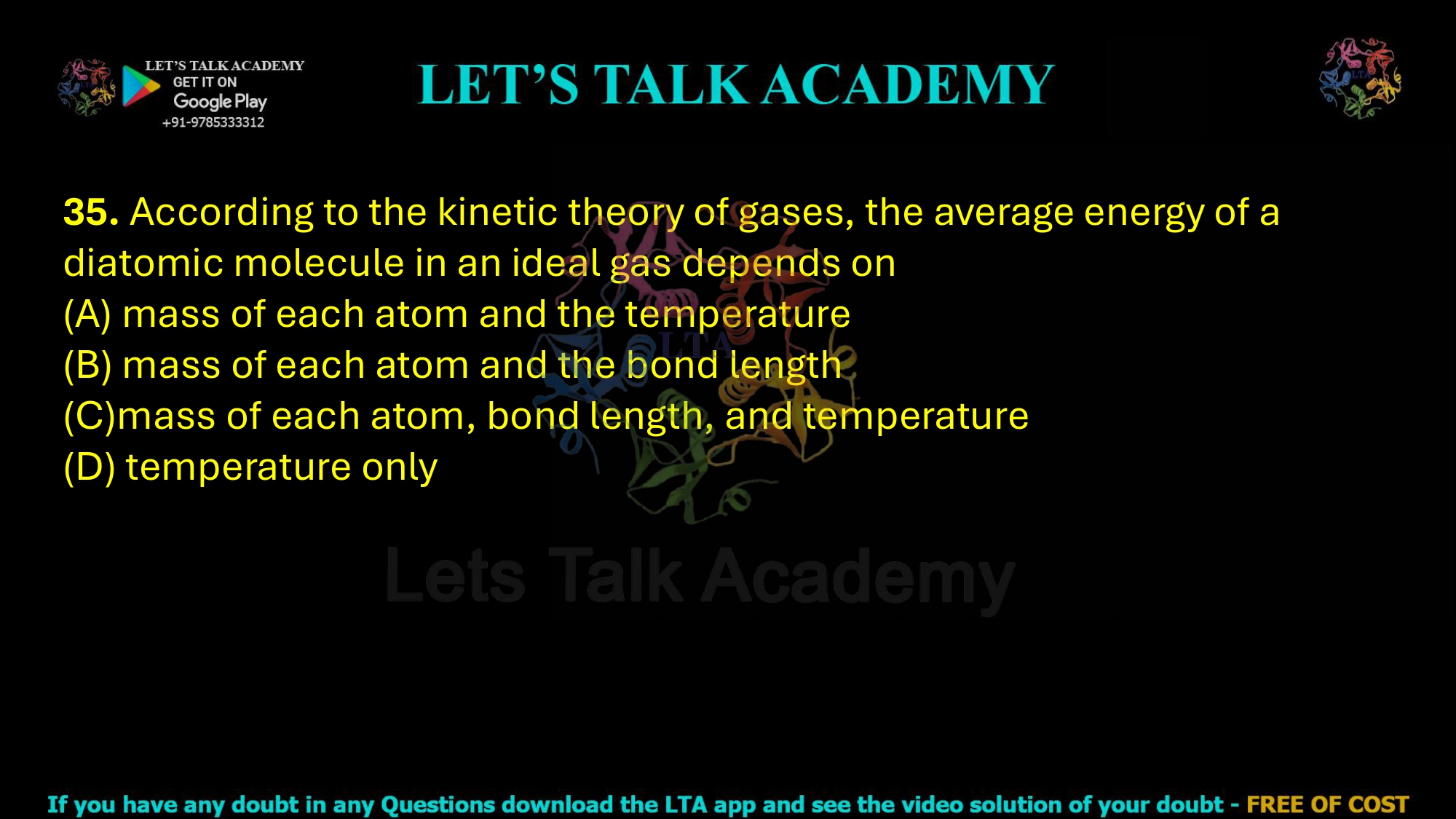
35. According to the kinetic theory of gases, the average energy of a diatomic molecule in an ideal gas depends on
(A) mass of each atom and the temperature
(B) mass of each atom and the bond length
(C)mass of each atom, bond length, and temperature
(D) temperature only
According to Kinetic Theory of Gases, the Average Energy of a Diatomic Molecule in an Ideal Gas Depends On
Correct Answer: (D) Temperature Only
According to the kinetic theory of gases and the law of equipartition of energy, the average energy of a molecule in an ideal gas is determined by the absolute temperature of the gas. Therefore, the correct answer is Option (D) temperature only. The average molecular energy does not directly depend on the mass of the atoms or the bond length of the diatomic molecule.
This result is one of the most important conclusions of the kinetic theory of gases. Although the mass of a molecule affects its average speed and the molecular structure determines the possible degrees of freedom, the average energy associated with each active degree of freedom depends only on the absolute temperature.
Understanding the Kinetic Theory of Gases
The kinetic theory of gases explains the macroscopic properties of gases by studying the microscopic motion of their molecules. In an ideal gas, molecules are assumed to be in continuous random motion. They undergo perfectly elastic collisions with one another and with the walls of the container.
The theory connects molecular motion with measurable physical quantities such as temperature and pressure. Temperature is especially important because it represents the average energy associated with the random motion and other active degrees of freedom of the gas molecules.
For an ideal gas in thermal equilibrium, molecules continuously exchange energy through collisions. As a result, the average energy of the molecules is governed by the temperature of the system.
Role of the Equipartition Theorem
The law of equipartition of energy states that every independent quadratic degree of freedom contributes an average energy of
(1/2)kBT
per molecule, where kB is the Boltzmann constant and T is the absolute temperature measured in kelvin.
This equation clearly shows that the average energy contributed by each active degree of freedom depends only on temperature. Neither the mass of the atoms nor the bond length appears in this expression.
If a molecule has f active degrees of freedom, its average energy can be written as
E = (f/2)kBT
Thus, once the number of active degrees of freedom is known, the average energy is directly proportional to the absolute temperature.
Degrees of Freedom of a Diatomic Molecule
A diatomic molecule consists of two atoms bonded together. Examples include nitrogen, oxygen, and hydrogen molecules. Such a molecule can possess translational, rotational, and vibrational motion.
Translational Degrees of Freedom
A diatomic molecule can move independently along the x, y, and z directions. Therefore, it has three translational degrees of freedom.
Each translational degree of freedom contributes an average energy of (1/2)kBT. Hence, the total average translational energy is
Etrans = (3/2)kBT
This translational energy depends only on temperature.
Rotational Degrees of Freedom
At ordinary temperatures, a linear diatomic molecule generally has two active rotational degrees of freedom. Rotation about the molecular axis contributes negligibly because the moment of inertia about that axis is extremely small.
The two active rotational degrees of freedom contribute a total average energy of
Erot = kBT
Therefore, when translational and rotational degrees of freedom are active, the total average energy of a diatomic molecule becomes
E = (3/2)kBT + kBT = (5/2)kBT
Again, the final expression depends only on the absolute temperature.
Vibrational Degrees of Freedom
At sufficiently high temperatures, vibrational motion may also become active. A vibrational mode contributes energy through both kinetic and potential energy terms.
When the vibrational mode is fully active according to the classical equipartition theorem, the total average energy of a diatomic molecule can become
E = (7/2)kBT
Even in this case, the average energy is expressed in terms of temperature. The important conclusion for this question remains unchanged: the average energy of a diatomic molecule in an ideal gas depends on temperature.
Why Does Molecular Mass Not Determine the Average Energy?
It may appear that a heavier molecule should have more energy because the classical expression for kinetic energy contains mass:
K.E. = (1/2)mv2
However, molecules of different masses at the same temperature have the same average translational kinetic energy. The difference appears in their average speeds rather than in their average energies.
A lighter molecule moves faster, while a heavier molecule moves more slowly at the same temperature. The changes in mass and speed compensate for each other so that the average translational kinetic energy remains
(3/2)kBT
Therefore, the mass of each atom does not independently determine the average energy of the molecule in thermal equilibrium.
Why Does Bond Length Not Determine the Average Energy?
The bond length of a diatomic molecule affects structural properties such as its moment of inertia and rotational energy level spacing. However, according to the classical equipartition theorem, the average energy associated with each active quadratic degree of freedom is fixed by temperature.
Therefore, although bond length can influence the detailed rotational behaviour and microscopic energy levels of a molecule, it does not appear as an independent variable in the classical expression for the average energy of an ideal gas molecule.
Detailed Explanation of Each Option
Option (A): Mass of Each Atom and the Temperature
This option is incorrect. The mass of each atom influences the molecular speed required to produce a particular kinetic energy, but it does not independently determine the average energy of molecules at thermal equilibrium.
At the same temperature, lighter molecules generally move faster and heavier molecules move more slowly. Despite this difference in speed, their average translational kinetic energy depends only on temperature.
Option (B): Mass of Each Atom and the Bond Length
This option is incorrect because it does not include temperature, which is the fundamental thermodynamic quantity controlling the average molecular energy of an ideal gas.
Mass and bond length may influence molecular properties such as the moment of inertia and rotational energy level spacing, but they do not determine the average thermal energy according to the classical kinetic theory of gases.
Option (C): Mass of Each Atom, Bond Length, and Temperature
This option is also incorrect. Although mass and bond length are important for describing the detailed structure and rotational properties of a diatomic molecule, the average energy predicted by the classical equipartition theorem is determined by temperature and the number of active degrees of freedom.
For a given molecular type and a given set of active degrees of freedom, the average energy is directly proportional to the absolute temperature.
Option (D): Temperature Only
This is the correct option. According to the kinetic theory of gases and the equipartition theorem, the average energy associated with the active degrees of freedom of a molecule is proportional to the absolute temperature.
For a diatomic ideal gas with three translational and two rotational degrees of freedom active, the average energy per molecule is (5/2)kBT. Since this expression contains temperature but not atomic mass or bond length, the correct answer is temperature only.
Final Answer
The average energy of a diatomic molecule in an ideal gas is governed by the absolute temperature according to the kinetic theory of gases and the law of equipartition of energy. Atomic mass can affect molecular speed, while bond length can affect rotational properties, but neither independently determines the average thermal energy of the molecule.
Therefore, the correct answer is (D) temperature only.


