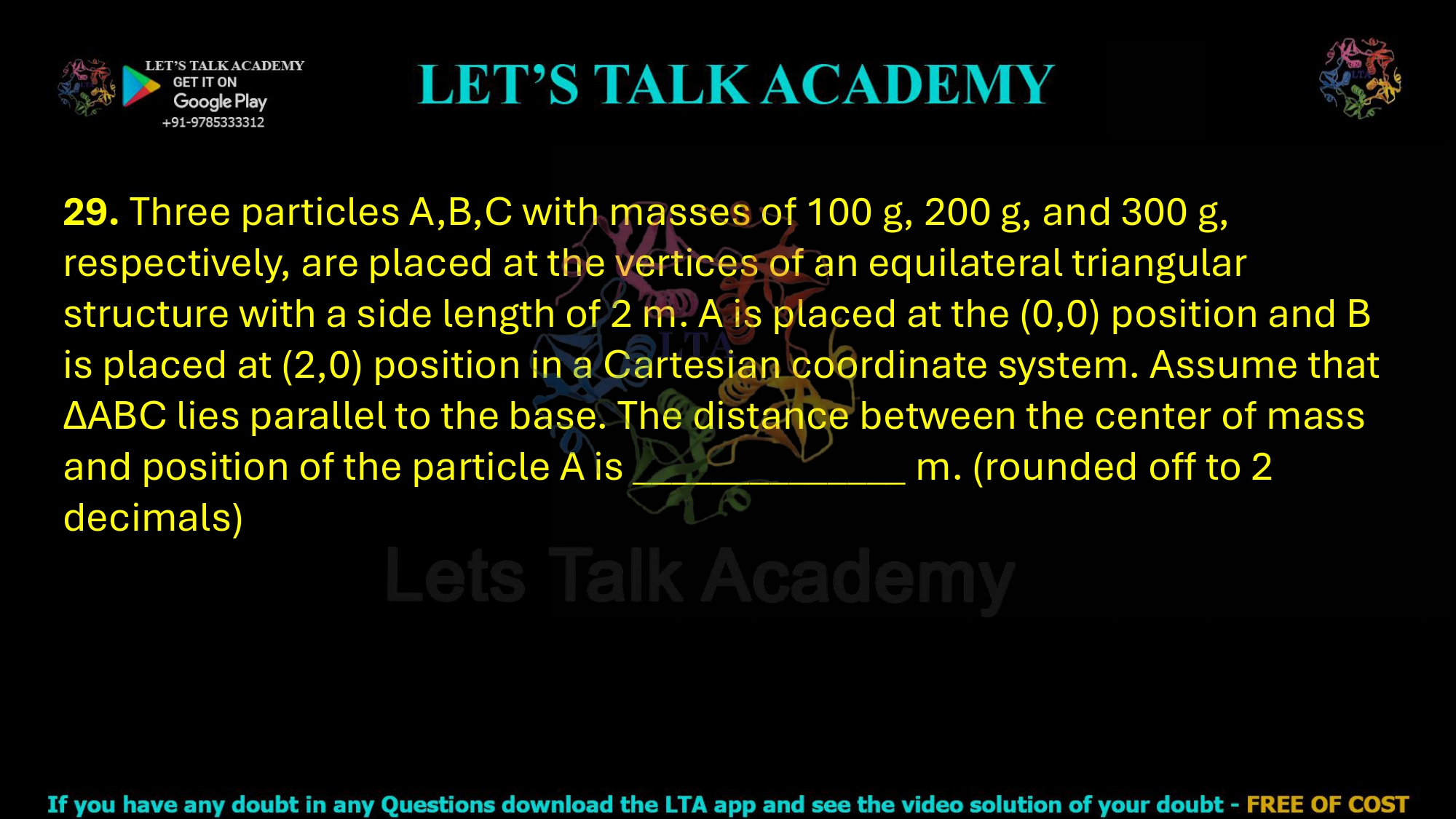
29. Three particles A,B,C with masses of 100 g, 200 g, and 300 g, respectively, are placed at the vertices of an equilateral triangular structure with a side length of 2 m. A is placed at the (0,0) position and B is placed at (2,0) position in a Cartesian coordinate system. Assume that ΔABC lies parallel to the base. The distance between the center of mass and position of the particle A is ______________ m. (rounded off to 2 decimals)
Center of Mass of Three Particles at the Vertices of an Equilateral Triangle
Correct Answer: 1.45 m
Understanding the Center of Mass Problem
This problem involves three particles of different masses placed at the vertices of an equilateral triangle. Since the masses are unequal, the center of mass will not coincide with the geometrical center or centroid of the triangle. Instead, its position must be calculated by taking the mass-weighted average of the coordinates of all three particles.
The particles have masses of 100 g, 200 g and 300 g. Particle A is located at the origin (0, 0), while particle B is located at (2, 0). Because the three particles occupy the vertices of an equilateral triangle of side 2 m, we first need to determine the coordinates of particle C. After finding the center of mass coordinates, we can calculate its distance from particle A using the distance formula.
Given Information
The mass of particle A is:
mA = 100 g
The mass of particle B is:
mB = 200 g
The mass of particle C is:
mC = 300 g
The coordinates of particle A are:
A = (0, 0)
The coordinates of particle B are:
B = (2, 0)
The side length of the equilateral triangle is:
a = 2 m
The required quantity is the distance between particle A and the center of mass of the three-particle system.
Determining the Coordinates of Particle C
Since A and B form the horizontal base of an equilateral triangle, particle C lies vertically above the midpoint of AB. The midpoint of the line joining A(0, 0) and B(2, 0) has the x-coordinate:
xC = (0 + 2)/2 = 1
Therefore, the x-coordinate of particle C is 1 m.
The height of an equilateral triangle of side a is:
h = (√3/2)a
For a = 2 m:
h = (√3/2) × 2
Therefore:
h = √3 m
Hence, the coordinates of particle C are:
C = (1, √3)
Thus, the three particles are located at A(0, 0), B(2, 0) and C(1, √3).
Formula for the Center of Mass of a System of Particles
For particles located in a two-dimensional coordinate system, the coordinates of the center of mass are calculated separately along the x-axis and y-axis.
The x-coordinate of the center of mass is:
xCM = (mAxA + mBxB + mCxC)/(mA + mB + mC)
The y-coordinate of the center of mass is:
yCM = (mAyA + mByB + mCyC)/(mA + mB + mC)
These expressions show that the center of mass is a mass-weighted average of the positions of all the particles. A particle with greater mass has a stronger influence on the location of the center of mass.
Calculating the Total Mass of the System
The total mass of the three-particle system is:
M = 100 + 200 + 300
Therefore:
M = 600 g
There is no need to convert the masses from grams into kilograms because all the masses are expressed in the same unit. The common mass unit cancels when calculating the center of mass coordinates.
Calculating the x-Coordinate of the Center of Mass
The x-coordinates of particles A, B and C are 0, 2 and 1, respectively. Therefore:
xCM = [(100 × 0) + (200 × 2) + (300 × 1)]/600
Simplifying the numerator:
xCM = (0 + 400 + 300)/600
Therefore:
xCM = 700/600
Hence:
xCM = 7/6 m
In decimal form:
xCM ≈ 1.167 m
Calculating the y-Coordinate of the Center of Mass
The y-coordinates of particles A and B are both zero, while the y-coordinate of particle C is √3. Therefore:
yCM = [(100 × 0) + (200 × 0) + (300 × √3)]/600
This simplifies to:
yCM = 300√3/600
Therefore:
yCM = √3/2 m
In decimal form:
yCM ≈ 0.866 m
Hence, the coordinates of the center of mass are:
CM = (7/6, √3/2)
Calculating the Distance Between Particle A and the Center of Mass
Particle A is located at the origin:
A = (0, 0)
The center of mass is located at:
CM = (7/6, √3/2)
The distance between two points (x1, y1) and (x2, y2) is:
d = √[(x2 − x1)2 + (y2 − y1)2]
Since particle A is at the origin, the distance becomes:
d = √[(7/6)2 + (√3/2)2]
Squaring both terms:
d = √[49/36 + 3/4]
Writing 3/4 with denominator 36:
3/4 = 27/36
Therefore:
d = √[(49 + 27)/36]
d = √(76/36)
Simplifying:
d = √19/3
Using √19 ≈ 4.3589:
d ≈ 4.3589/3
Therefore:
d ≈ 1.45297 m
Rounded off to two decimal places:
d = 1.45 m
Why the Center of Mass Is Shifted Toward Particle C
If equal masses were placed at all three vertices of the equilateral triangle, the center of mass would coincide with the geometrical centroid of the triangle. However, the masses in this problem are unequal.
Particle C has the greatest mass, 300 g, so it exerts the strongest influence on the position of the center of mass. Particle B has a mass of 200 g, while particle A has the smallest mass of 100 g. As a result, the center of mass is shifted away from particle A and toward the heavier particles B and C.
This illustrates an important physical property of the center of mass: it lies closer to the region containing the greater concentration of mass.
Why Mass Conversion Is Not Required
The masses are given in grams rather than kilograms. However, converting them into kilograms is unnecessary for this calculation because the center of mass formula contains mass in both the numerator and denominator.
If all masses were converted into kilograms, each mass would be multiplied by the same conversion factor. That common factor would cancel from the numerator and denominator, giving exactly the same center of mass coordinates.
Therefore, the values 100 g, 200 g and 300 g can be used directly as long as the same unit is used consistently for all three masses.
Alternative Compact Solution
The vertices of the equilateral triangle are:
A = (0, 0), B = (2, 0), C = (1, √3)
The center of mass coordinates are:
xCM = [100(0) + 200(2) + 300(1)]/600 = 7/6
and:
yCM = [100(0) + 200(0) + 300(√3)]/600 = √3/2
Therefore, the distance from particle A at the origin is:
d = √[(7/6)2 + (√3/2)2]
d = √19/3
d ≈ 1.45297 m
Rounded off to two decimal places:
d = 1.45 m
Final Answer
The coordinates of the three particles are:
A = (0, 0)
B = (2, 0)
C = (1, √3)
The coordinates of the center of mass are:
CM = (7/6, √3/2)
The distance of the center of mass from particle A is:
d = √[(7/6)2 + (√3/2)2]
d = √19/3
d ≈ 1.45297 m
Therefore, rounded off to two decimal places:
Final Answer: 1.45 m


