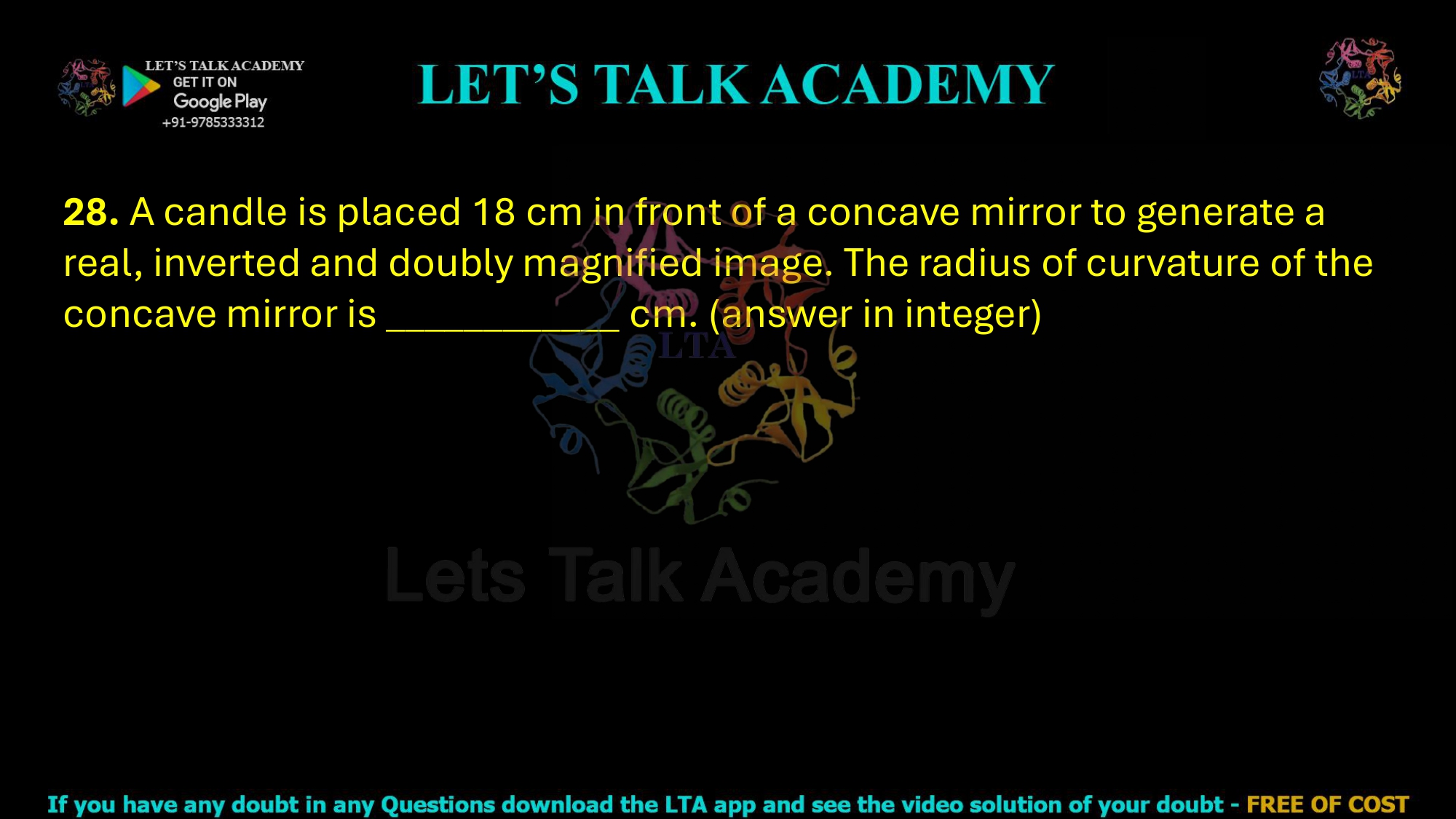
28. A candle is placed 18 cm in front of a concave mirror to generate a real, inverted and doubly magnified image. The radius of curvature of the concave mirror is ____________ cm. (answer in integer)
Radius of Curvature of a Concave Mirror for a Doubly Magnified Real Image
Correct Answer: 24 cm
Understanding the Concave Mirror Problem
This question is based on the formation of images by a concave mirror and requires the use of the magnification formula, mirror formula, and the relationship between focal length and radius of curvature. The key information is that the candle is placed 18 cm in front of the mirror and the image formed is real, inverted, and twice the size of the object.
The phrase doubly magnified means that the magnitude of magnification is 2. Since the image is inverted, the magnification must be negative according to the Cartesian sign convention. Therefore, the magnification is:
m = −2
The object distance is 18 cm. Since the candle is placed in front of the concave mirror, the object distance is negative according to the Cartesian sign convention:
u = −18 cm
Using the Magnification Formula for a Concave Mirror
For a spherical mirror, the linear magnification is given by:
m = −v/u
where m is the magnification, v is the image distance, and u is the object distance.
Substituting the given values:
−2 = −v/(−18)
Simplifying:
−2 = v/18
Therefore:
v = −36 cm
The negative sign of the image distance confirms that the image is formed in front of the mirror. This is consistent with the information given in the question because a real image formed by a concave mirror is produced in front of the mirror.
Applying the Mirror Formula
The mirror formula relates the focal length, object distance, and image distance:
1/f = 1/v + 1/u
where f is the focal length of the mirror.
Substituting:
u = −18 cm
v = −36 cm
Therefore:
1/f = 1/(−36) + 1/(−18)
Taking the common denominator:
1/f = −1/36 − 2/36
1/f = −3/36
1/f = −1/12
Hence:
f = −12 cm
The negative focal length is expected because the mirror is concave. According to the Cartesian sign convention, the principal focus of a concave mirror lies in front of the mirror, so its focal length is negative.
Calculating the Radius of Curvature
For any spherical mirror, the radius of curvature is twice the focal length in magnitude:
R = 2f
Substituting the focal length:
R = 2 × (−12)
R = −24 cm
The negative sign indicates that the centre of curvature lies in front of the mirror according to the Cartesian sign convention. However, the question asks for the radius of curvature as an integer, which is normally reported as its magnitude.
Therefore:
|R| = 24 cm
Final Answer
The radius of curvature of the concave mirror is 24 cm.
Therefore, the required integer answer is 24.
Why Is the Magnification Negative?
The sign of magnification provides important information about the orientation of an image. A positive magnification represents an erect image, whereas a negative magnification represents an inverted image.
The question explicitly states that the image is real and inverted. Therefore, the magnification must be negative. Since the image is also doubly magnified, its size is twice the size of the candle. Combining these two pieces of information gives:
m = −2
Using only the magnitude of magnification and ignoring the negative sign would lead to an incorrect image distance and an incorrect final answer.
Physical Interpretation of the Image Formation
The object is placed 18 cm from the concave mirror, while the focal length has a magnitude of 12 cm. Therefore, the centre of curvature is located 24 cm from the pole of the mirror.
This means that the candle is placed between the principal focus at 12 cm and the centre of curvature at 24 cm. For a concave mirror, an object placed between the focus and the centre of curvature produces an image beyond the centre of curvature.
Such an image is real, inverted, and magnified, which perfectly matches the image description given in the question. The calculated image distance of 36 cm also confirms that the image is formed beyond the centre of curvature.
Relationship Between Focal Length and Radius of Curvature
A concave mirror is a part of a spherical reflecting surface. The centre of the sphere from which the mirror is formed is called the centre of curvature, and the distance between the pole and the centre of curvature is called the radius of curvature.
For a spherical mirror, the principal focus lies midway between the pole and the centre of curvature. Therefore, the magnitude of the radius of curvature is always twice the magnitude of the focal length:
|R| = 2|f|
Since the focal length in this problem has a magnitude of 12 cm, the radius of curvature is:
|R| = 2 × 12 = 24 cm
Alternative Short Method
The result can also be obtained quickly by combining the magnification relation with the mirror formula. Since the real and inverted image is twice the size of the object:
m = −2
For mirrors:
m = −v/u
Therefore, the image distance has twice the magnitude of the object distance:
|v| = 2|u| = 2 × 18 = 36 cm
Using the mirror formula with object and image distances of 18 cm and 36 cm gives a focal length magnitude of 12 cm. The radius of curvature is twice the focal length, giving:
R = 24 cm
Key Concept Behind the Numerical
The complete solution depends on correctly interpreting the terms real, inverted, and doubly magnified. A real and inverted image has negative magnification, while doubly magnified means that the magnitude of magnification is 2. Thus, the magnification is −2.
Using the magnification formula gives the image distance as 36 cm in front of the mirror. The mirror formula then gives the focal length as 12 cm in magnitude. Finally, using the relationship between radius of curvature and focal length gives the required radius of curvature as 24 cm.
Conclusion
A candle placed 18 cm in front of the concave mirror forms a real, inverted, and doubly magnified image. The magnification is therefore −2, which gives an image distance of −36 cm. Applying the mirror formula gives a focal length of −12 cm. Since the magnitude of the radius of curvature is twice the magnitude of the focal length, the radius of curvature is 24 cm.


