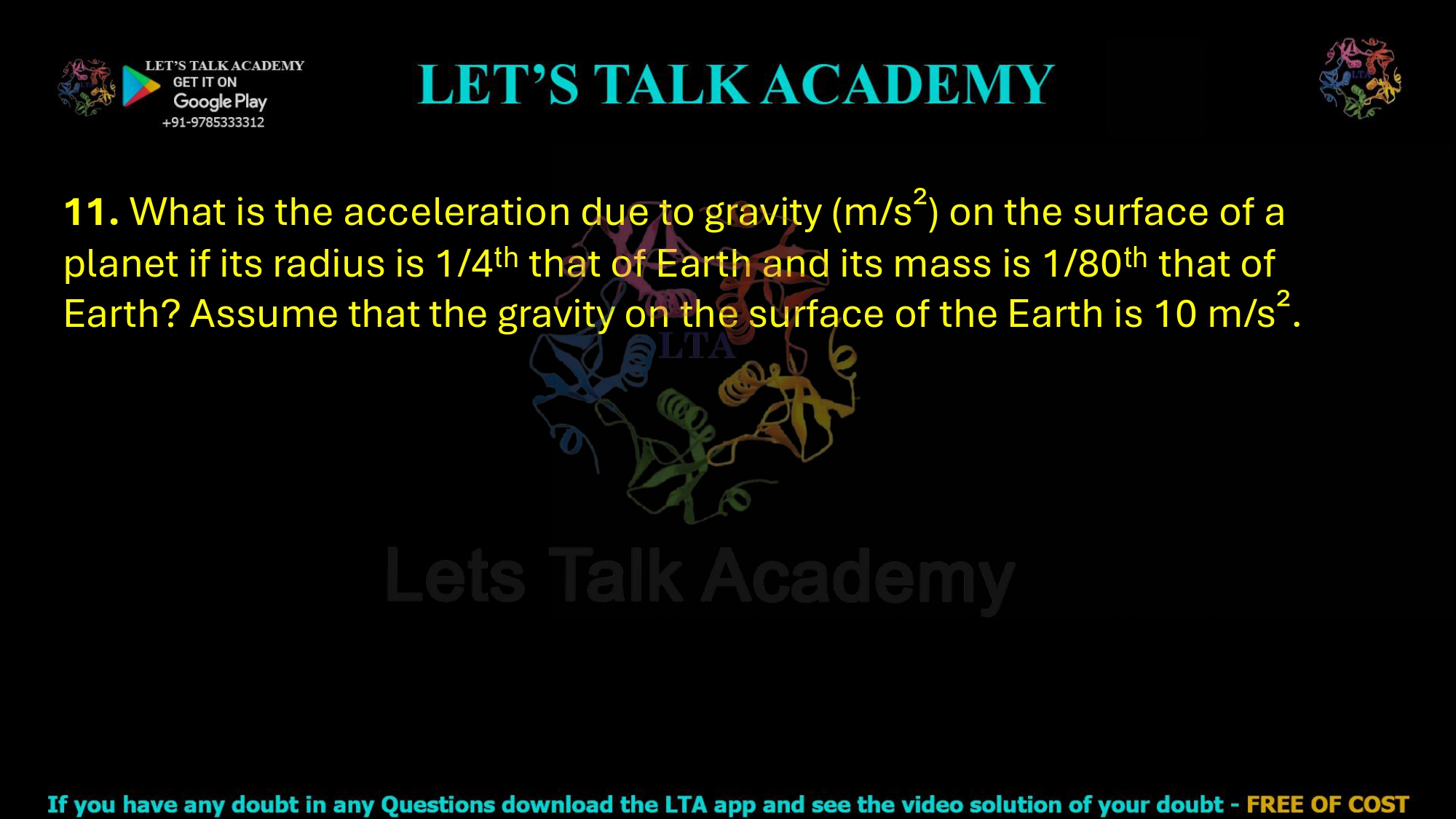
11. What is the acceleration due to gravity (m/s²) on the surface of a planet if its radius is 1/4ᵗʰ that of Earth and its mass is 1/80ᵗʰ that of Earth? Assume that the gravity on the surface of the Earth is 10 m/s².
Acceleration Due to Gravity on a Planet with Different Mass and Radius
Correct Answer: 2 m/s2
Understanding the Given Problem
This question asks us to calculate the acceleration due to gravity on the surface of another planet by comparing its mass and radius with those of Earth. The planet has a much smaller mass than Earth, but it also has a much smaller radius. Both factors affect the value of gravitational acceleration at the surface.
The mass of the planet is given as 1/80th of the mass of Earth, while its radius is 1/4th of the radius of Earth. The acceleration due to gravity on Earth is given as 10 m/s2. To find the gravity on the planet, we use the relationship between gravitational acceleration, mass and radius.
Formula for Acceleration Due to Gravity
The acceleration due to gravity on the surface of a spherical planet is given by:
g = GM/R2
where G is the universal gravitational constant, M is the mass of the planet and R is the radius of the planet.
This formula shows that surface gravity is directly proportional to the mass of a planet and inversely proportional to the square of its radius. Therefore, increasing the mass increases surface gravity, whereas increasing the radius decreases surface gravity.
Given Values for the Planet
Let the mass and radius of Earth be represented by ME and RE, respectively. The mass of the planet is 1/80th of Earth’s mass. Therefore:
MP = ME/80
The radius of the planet is 1/4th of Earth’s radius. Therefore:
RP = RE/4
The acceleration due to gravity on Earth is:
gE = 10 m/s2
We need to calculate the acceleration due to gravity on the planet, represented by gP.
Comparing the Gravity of the Planet with Earth
For Earth, the acceleration due to gravity is:
gE = GME/RE2
For the planet, the acceleration due to gravity is:
gP = GMP/RP2
Dividing the gravity of the planet by the gravity of Earth gives:
gP/gE = (MP/ME) × (RE/RP)2
This ratio method is especially useful because the universal gravitational constant G cancels out, allowing us to solve the problem directly using the given relative mass and radius.
Substituting the Mass and Radius Ratios
The mass ratio is:
MP/ME = 1/80
The radius of the planet is one-fourth of Earth’s radius. Therefore:
RE/RP = 4
Substituting these values into the gravity ratio:
gP/gE = (1/80) × (4)2
Since:
42 = 16
we get:
gP/gE = 16/80
Simplifying:
gP/gE = 1/5
Therefore, the acceleration due to gravity on the planet is one-fifth of the acceleration due to gravity on Earth.
Calculating the Acceleration Due to Gravity on the Planet
We know that the gravity on Earth is:
gE = 10 m/s2
Since the planet’s gravity is one-fifth of Earth’s gravity:
gP = (1/5) × 10
Therefore:
gP = 2 m/s2
Hence, the acceleration due to gravity on the surface of the planet is 2 m/s2.
Why the Radius Has a Strong Effect on Surface Gravity
The radius appears as a squared term in the denominator of the gravitational acceleration formula. This means that even a moderate change in radius can produce a significant change in surface gravity.
In this problem, the planet has only 1/80th of Earth’s mass. If the radius were the same as Earth’s radius, its surface gravity would also be only 1/80th of Earth’s gravity. However, the radius of the planet is only 1/4th of Earth’s radius.
Since the radius is squared in the formula, reducing the radius to one-fourth produces a factor of:
(1/4)2 = 1/16
in the denominator. As a result, the smaller radius increases the surface gravity by a factor of 16 compared with what it would be if the planet had Earth’s radius.
The combined effect of the smaller mass and smaller radius is therefore:
Relative gravity = 16/80 = 1/5
This is why the final gravitational acceleration is 2 m/s2, rather than simply 1/80th of Earth’s gravity.
Relationship Between Mass, Radius and Surface Gravity
The formula g = GM/R2 provides an important understanding of how planetary properties determine surface gravity. If two planets have the same radius, the planet with the greater mass has stronger surface gravity. If two planets have the same mass, the smaller planet has stronger surface gravity because its surface is closer to the planet’s center of mass.
Therefore, the surface gravity of a planet cannot be determined from its mass alone. Both the mass and the radius must be considered. A low-mass planet can still have significant surface gravity if its radius is sufficiently small.
Alternative Direct Calculation
The calculation can also be written directly using the proportional relationship:
g ∝ M/R2
Therefore:
gP = gE × (MP/ME) × (RE/RP)2
Substituting the values:
gP = 10 × (1/80) × 42
Therefore:
gP = 10 × 16/80
gP = 10 × 1/5
gP = 2 m/s2
This direct method gives the same result and is particularly useful for quickly solving comparative gravity questions.
Final Answer
The acceleration due to gravity on the surface of a planet is proportional to its mass and inversely proportional to the square of its radius.
For the given planet:
Mass = 1/80 of Earth’s mass
Radius = 1/4 of Earth’s radius
Therefore:
gP/gE = (1/80)/(1/4)2
= (1/80) × 16
= 1/5
Since Earth’s gravity is 10 m/s2:
gP = (1/5) × 10 = 2 m/s2
Final Answer: 2 m/s2


