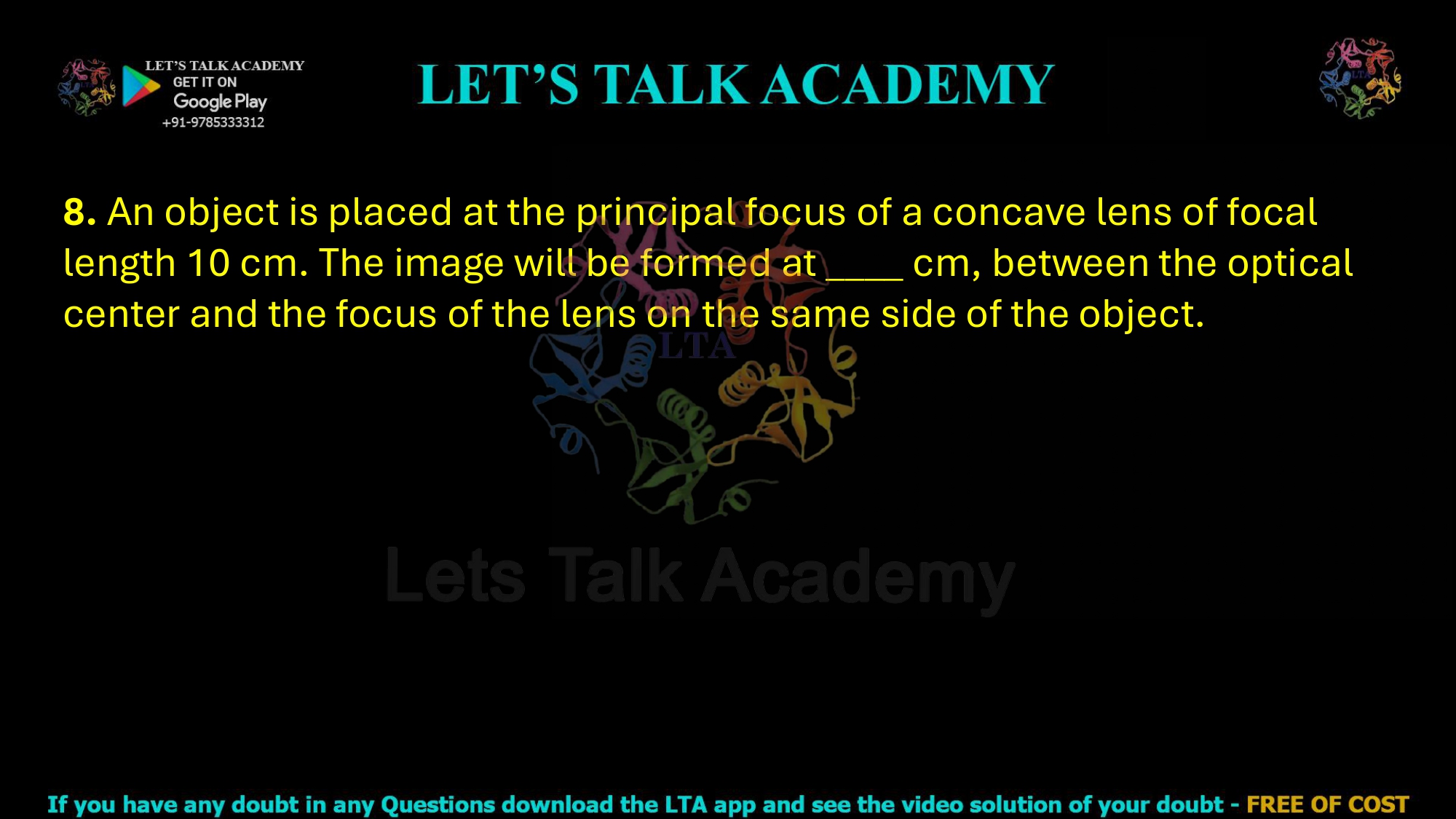
8. An object is placed at the principal focus of a concave lens of focal length 10 cm. The image will be formed at ____ cm, between the optical center and the focus of the lens on the same side of the object.
Image Formation by a Concave Lens When the Object Is Placed at the Principal Focus
Correct Answer: 5 cm
Understanding the Given Concave Lens Problem
This question deals with image formation by a concave lens when an object is placed at its principal focus. A concave lens is a diverging lens because it causes parallel rays of light to spread out after refraction. The refracted rays do not actually meet on the other side of the lens. Instead, their backward extensions appear to meet on the same side of the lens as the object, producing a virtual image.
The focal length of the concave lens is given as 10 cm, and the object is placed exactly at the principal focus. The task is to calculate the image distance from the optical center of the lens. To solve the problem accurately, we must apply the lens formula along with the Cartesian sign convention.
Given Information
The focal length of the concave lens is:
Magnitude of focal length = 10 cm
Since the lens is concave, its focal length is negative according to the Cartesian sign convention. Therefore:
f = −10 cm
The object is placed at the principal focus of the lens. Therefore, the object is also located 10 cm from the optical center on the left side of the lens. Since object distances measured opposite to the direction of incident light are taken as negative:
u = −10 cm
We need to determine the image distance v.
Using the Lens Formula
The standard thin lens formula is:
1/f = 1/v − 1/u
Substituting the known values:
1/(−10) = 1/v − 1/(−10)
Since subtracting a negative quantity is equivalent to addition:
−1/10 = 1/v + 1/10
Moving 1/10 to the left-hand side:
1/v = −1/10 − 1/10
Therefore:
1/v = −2/10
or:
1/v = −1/5
Hence:
v = −5 cm
The negative sign indicates that the image is formed on the same side of the lens as the object. Therefore, the image is located 5 cm from the optical center, between the optical center and the principal focus.
Why Is the Answer 5 cm?
The object is placed 10 cm away from the optical center because it lies at the principal focus of a concave lens whose focal length has a magnitude of 10 cm. After applying the lens formula, the image distance is found to be −5 cm. The magnitude of this distance is 5 cm, which means the image is formed exactly halfway between the optical center and the principal focus.
Since the principal focus is 10 cm from the optical center, any image formed at a distance of 5 cm on the object side lies between the optical center and the focus. This agrees with the standard image-forming behavior of a concave lens.
Understanding the Sign of the Image Distance
The calculated image distance is:
v = −5 cm
In the Cartesian sign convention, a negative image distance means that the image is formed on the same side of the lens as the incident light and the object. Such an image is called a virtual image.
The question asks for the distance in the blank rather than the signed value. Therefore, the required numerical answer is 5 cm. The phrase “on the same side of the object” already describes the location of the image.
Nature of the Image Formed by the Concave Lens
A concave lens always forms a virtual, erect and diminished image for a real object, regardless of the object’s position. In this particular case, the object is placed at the principal focus, and the image is formed between the optical center and the principal focus on the same side as the object.
The image is virtual because the refracted rays do not actually meet. It is erect because it has the same upright orientation as the object, and it is diminished because its size is smaller than that of the object.
Calculating the Magnification
The magnification produced by a lens is given by:
m = v/u
Substituting the values:
m = (−5)/(−10)
Therefore:
m = 1/2 = 0.5
The positive value of magnification confirms that the image is erect, while the magnitude 0.5 indicates that the image is half the size of the object.
Ray-Based Explanation of Image Formation
To understand the result visually, consider two rays originating from the top of the object. A ray travelling parallel to the principal axis passes through the concave lens and diverges in such a way that its backward extension appears to come from the principal focus on the object side.
Another ray passing through the optical center of the thin lens continues approximately without deviation. The actual refracted rays diverge and do not meet. However, when these rays are extended backward, their extensions meet at a point located 5 cm from the optical center. This point represents the virtual image.
General Result for an Object at the Focus of a Concave Lens
This result can also be understood in a general form. Suppose a concave lens has a focal length of magnitude F. According to the Cartesian sign convention:
f = −F
Since the object is placed at the principal focus:
u = −F
Using the lens formula:
1/f = 1/v − 1/u
we get:
−1/F = 1/v + 1/F
Therefore:
1/v = −2/F
Hence:
v = −F/2
This means that whenever an object is placed at the principal focus of a concave lens, the image is formed at a distance equal to half the magnitude of the focal length from the optical center on the same side as the object.
For the given focal length of 10 cm:
|v| = 10/2 = 5 cm
Final Answer
For the concave lens:
f = −10 cm
Since the object is placed at the principal focus:
u = −10 cm
Using the lens formula:
1/f = 1/v − 1/u
we obtain:
v = −5 cm
The negative sign shows that the image is formed on the same side as the object. Therefore, the image is formed 5 cm from the optical center, between the optical center and the principal focus of the concave lens.
Final Answer: 5 cm


