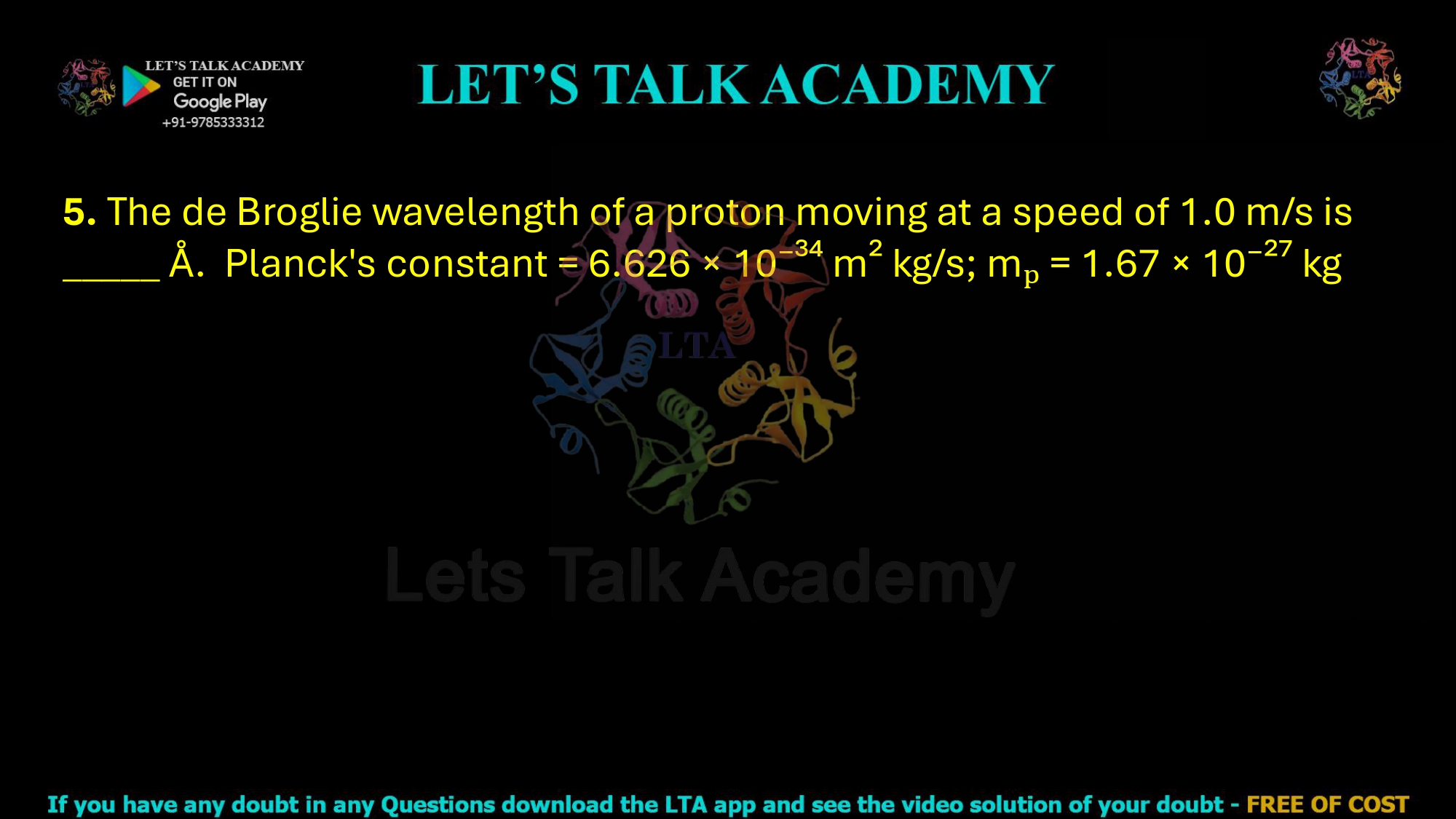
5. The de Broglie wavelength of a proton moving at a speed of 1.0 m/s is _____ Å. Planck’s constant = 6.626 × 10⁻³⁴ m² kg/s; mₚ = 1.67 × 10⁻²⁷ kg
De Broglie Wavelength of a Proton Moving at a Speed of 1.0 m/s
Correct Answer: 3968.86 Å (approximately 3969 Å)
Understanding the de Broglie Wavelength
According to the de Broglie hypothesis, every moving material particle is associated with a wave known as a matter wave or de Broglie wave. The wavelength associated with a moving particle depends on its momentum. A particle with greater momentum has a shorter wavelength, while a particle with smaller momentum has a longer wavelength.
The de Broglie wavelength of a particle is calculated using the following relation:
λ = h / p
For a non-relativistic particle, momentum is given by:
p = mv
Therefore, the de Broglie wavelength can be written as:
λ = h / mv
Here, λ represents the de Broglie wavelength, h represents Planck’s constant, m represents the mass of the particle, and v represents the speed of the particle.
Given Values in the Question
The mass of the proton is:
m = 1.67 × 10⁻²⁷ kg
The speed of the proton is:
v = 1.0 m/s
Planck’s constant is:
h = 6.626 × 10⁻³⁴ m2 kg/s
Step-by-Step Calculation of the de Broglie Wavelength
Step 1: Apply the de Broglie Equation
Using the de Broglie wavelength formula:
λ = h / mv
Substituting the given values:
λ = (6.626 × 10⁻³⁴) / [(1.67 × 10−27) × 1.0]
Step 2: Simplify the Numerical Values
Since the speed of the proton is 1.0 m/s, the denominator becomes:
mv = 1.67 × 10⁻²⁷ kg m/s
Therefore:
λ = (6.626 × 10⁻³⁴) / (1.67 × 10⁻²⁷)
Dividing the numerical values and simplifying the powers of ten:
λ = (6.626 / 1.67) × 10−7 m
λ = 3.9689 × 10⁻⁷ m
Step 3: Convert the Wavelength from Metres to Angstrom
The question asks for the answer in angstrom (Å). We know that:
1 Å = 10−10 m
Therefore:
1 m = 1010 Å
Converting the calculated wavelength into angstrom:
λ = 3.9689 × 10−7 × 1010 Å
λ = 3.9689 × 10³ Å
λ = 3968.86 Å
Why Does a Slow-Moving Proton Have Such a Large Wavelength?
The de Broglie wavelength is inversely proportional to the momentum of a particle. In this question, the proton is moving at a very low speed of only 1.0 m/s. As a result, its momentum is extremely small, which produces a comparatively large de Broglie wavelength.
If the speed of the proton were increased, its momentum would increase and its de Broglie wavelength would decrease. This inverse relationship between momentum and wavelength is one of the fundamental concepts of wave-particle duality in quantum mechanics.
Verification Using Units
The unit of Planck’s constant is m2 kg/s, while the unit of momentum is kg m/s. Therefore:
λ = (m2 kg/s) / (kg m/s)
After cancelling the common units, we obtain:
λ = m
This confirms that the de Broglie equation correctly gives wavelength in metres. The result is then converted from metres to angstrom according to the requirement of the question.
Final Answer
The de Broglie wavelength of the proton is 3968.86 Å, or approximately 3969 Å.
The calculation is based on the de Broglie relation λ = h/mv. Substituting the mass of the proton, its speed, and Planck’s constant gives a wavelength of 3.9689 × 10⁻⁷ m, which is equal to approximately 3969 Å.


