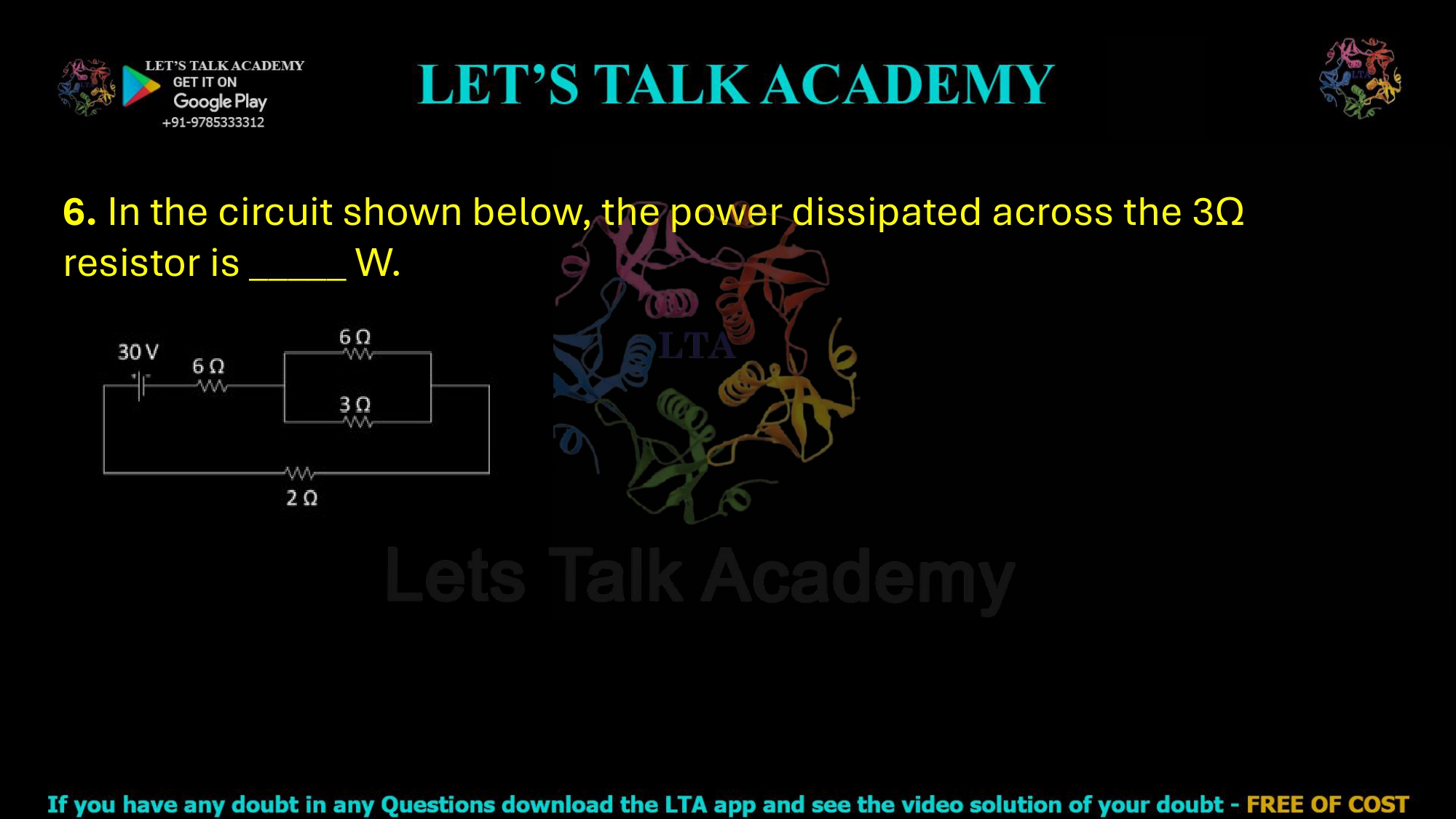
6. In the circuit shown below, the power dissipated across the 3Ω resistor is _____ W.
Power Dissipated Across the 3Ω Resistor in the Given Circuit: Detailed Solution
Understanding the Given Series-Parallel Circuit
This electrical circuit is a combination of series and parallel resistors. To calculate the power dissipated across the 3Ω resistor, we cannot directly use the total battery voltage of 30 V in the power formula. The 3Ω resistor is connected in parallel with the 6Ω resistor, so we first need to determine the equivalent resistance of this parallel combination.
After finding the parallel equivalent resistance, the entire circuit can be simplified into a series circuit. This allows us to calculate the total current supplied by the 30 V battery. Once the total current is known, we can calculate the voltage across the parallel combination. Since resistors connected in parallel have the same potential difference, this voltage will also be the voltage across the 3Ω resistor.
Step 1: Identify the Parallel Combination
The 6Ω resistor and the 3Ω resistor inside the rectangular section of the circuit are connected in parallel. For two resistors connected in parallel, the equivalent resistance is given by:
Rp = (R1 × R2)/(R1 + R2)
Substituting R1 = 6Ω and R2 = 3Ω:
Rp = (6 × 3)/(6 + 3)
Rp = 18/9
Rp = 2Ω
Therefore, the parallel combination of the 6Ω and 3Ω resistors has an equivalent resistance of 2Ω.
Step 2: Calculate the Total Resistance of the Circuit
After replacing the parallel combination by its equivalent resistance of 2Ω, the circuit contains three resistances connected in series. These are the first 6Ω resistor, the 2Ω equivalent resistance of the parallel combination, and the 2Ω resistor at the bottom of the circuit.
For resistors connected in series, the total resistance is equal to the sum of all individual resistances. Therefore:
Rtotal = 6Ω + 2Ω + 2Ω
Rtotal = 10Ω
Thus, the total equivalent resistance connected across the 30 V battery is 10Ω.
Step 3: Calculate the Total Current in the Circuit
According to Ohm’s law, the current flowing through a circuit is equal to the applied voltage divided by the total resistance:
I = V/R
Substituting the battery voltage V = 30 V and the total resistance R = 10Ω:
I = 30/10
I = 3 A
Therefore, the total current flowing through the series part of the circuit is 3 A. This current reaches the parallel combination and then divides between the 6Ω and 3Ω branches.
Step 4: Calculate the Voltage Across the Parallel Combination
The equivalent resistance of the parallel combination is 2Ω, and the total current entering this combination is 3 A. Using Ohm’s law, the potential difference across the parallel section is:
Vp = I × Rp
Vp = 3 × 2
Vp = 6 V
Since the 6Ω and 3Ω resistors are connected in parallel, the potential difference across each resistor is the same. Therefore, the voltage across the 3Ω resistor is also 6 V.
Step 5: Calculate the Power Dissipated Across the 3Ω Resistor
The electrical power dissipated by a resistor when the voltage across it is known can be calculated using the formula:
P = V2/R
For the 3Ω resistor, the voltage across it is 6 V. Therefore:
P = (6)2/3
P = 36/3
P = 12 W
Therefore, the power dissipated across the 3Ω resistor is 12 watts.
Alternative Method Using Current Through the 3Ω Resistor
The answer can also be verified by first calculating the current flowing specifically through the 3Ω resistor. Since the voltage across the resistor is 6 V, Ohm’s law gives:
I3Ω = V/R
I3Ω = 6/3 = 2 A
The power dissipated by a resistor can also be calculated using:
P = I2R
Substituting I = 2 A and R = 3Ω:
P = (2)2 × 3
P = 4 × 3
P = 12 W
This alternative calculation confirms that the power dissipated across the 3Ω resistor is 12 W.
Verification of Current Distribution in the Parallel Branches
The total current entering the parallel combination is 3 A. The voltage across both parallel resistors is 6 V. Therefore, the current through the 6Ω resistor is:
I6Ω = 6/6 = 1 A
The current through the 3Ω resistor is:
I3Ω = 6/3 = 2 A
The sum of the branch currents is:
1 A + 2 A = 3 A
This is exactly equal to the total current entering the parallel combination, confirming that the circuit analysis is correct.
Final Answer
Power dissipated across the 3Ω resistor = 12 W
The 6Ω and 3Ω resistors form a parallel combination with an equivalent resistance of 2Ω. The total resistance of the complete circuit is 10Ω, giving a total current of 3 A. The voltage across the parallel combination is therefore 6 V. Using P = V2/R for the 3Ω resistor gives the required power dissipation as 12 W.


