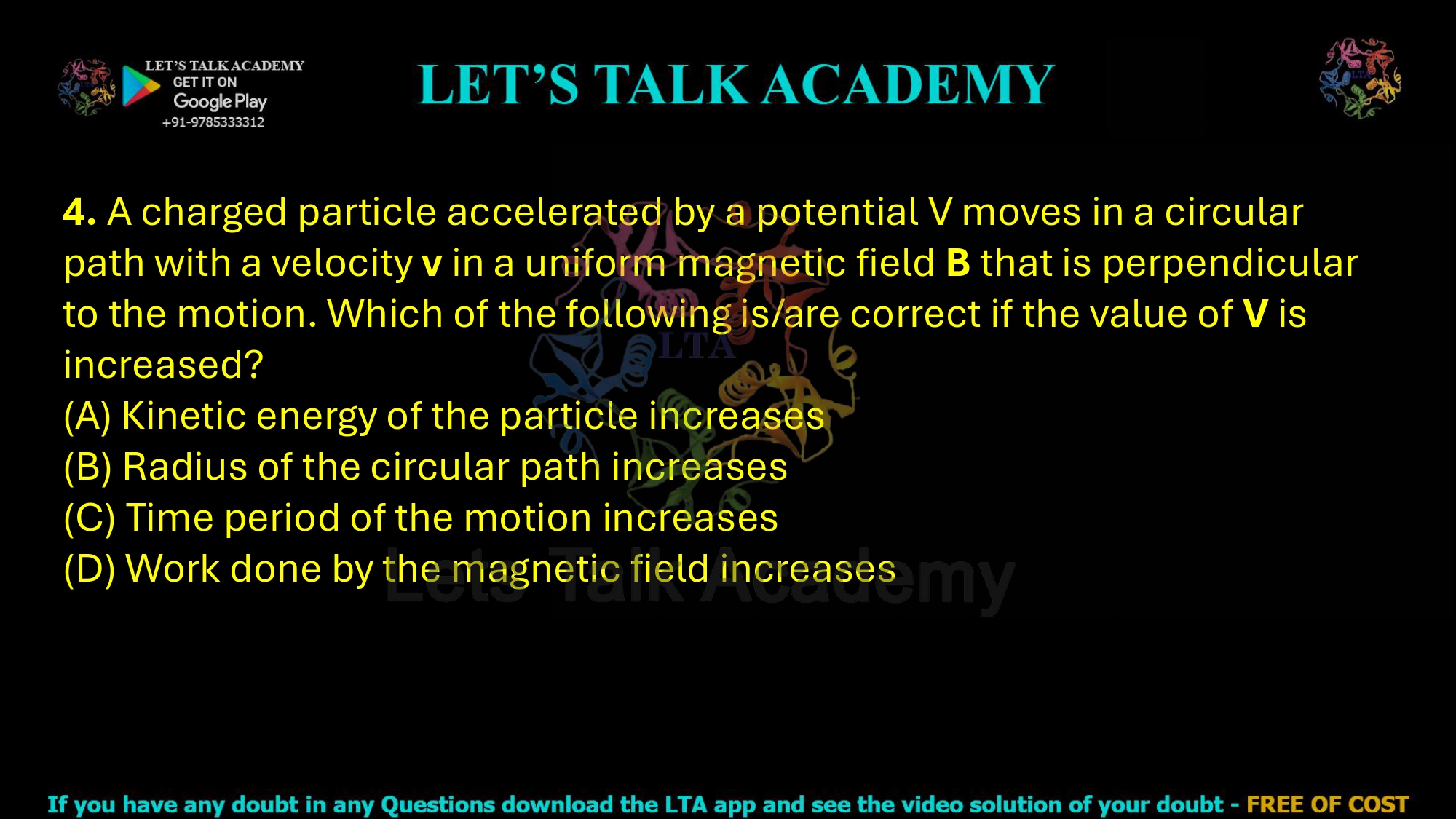
4. A charged particle accelerated by a potential V moves in a circular path with a velocity v in a uniform magnetic field B that is perpendicular to the motion. Which of the following is/are correct if the value of V is increased?
(A) Kinetic energy of the particle increases
(B) Radius of the circular path increases
(C) Time period of the motion increases
(D) Work done by the magnetic field increases
Charged Particle in a Magnetic Field: Effect of Increasing the Accelerating Potential V
Correct Answer: (A) and (B)
Understanding the Motion of a Charged Particle in a Magnetic Field
When a charged particle moves through a uniform magnetic field with its velocity perpendicular to the magnetic field, it experiences a magnetic force. This magnetic force always acts perpendicular to the instantaneous direction of motion of the particle. As a result, the force continuously changes the direction of velocity without changing its magnitude and makes the particle move in a circular path.
In this question, the charged particle is first accelerated through a potential difference V. Therefore, electrical energy is converted into the kinetic energy of the particle. When the value of the accelerating potential V is increased, the particle gains more kinetic energy and consequently moves with a greater speed. This increase in speed affects the radius of the circular path, but it does not change the time period of revolution in the non-relativistic case.
Relationship Between Accelerating Potential and Kinetic Energy
When a particle of charge q is accelerated through a potential difference V, the electrical work done on the particle is converted into kinetic energy. Therefore:
Kinetic energy = qV
Hence,
K = qV
For a non-relativistic particle, kinetic energy is also given by:
K = ½mv2
Therefore:
qV = ½mv2
If the accelerating potential V is increased while the charge q and mass m of the particle remain constant, the kinetic energy qV increases. Since kinetic energy is proportional to the square of velocity, the speed of the particle also increases.
Dependence of Velocity on Accelerating Potential
Starting with:
qV = ½mv2
Rearranging the equation:
v2 = 2qV/m
Therefore:
v = √(2qV/m)
For a given particle, q and m are constant. Hence:
v ∝ √V
This means that increasing the accelerating potential increases the speed of the charged particle. For example, if the potential difference becomes four times its original value, the speed becomes two times its original value.
Effect of Increasing Potential on the Radius of the Circular Path
When the charged particle enters a uniform magnetic field perpendicular to its velocity, the magnetic force provides the necessary centripetal force for circular motion.
The magnitude of the magnetic force is:
FB = qvB
The centripetal force required for circular motion is:
Fc = mv2/r
Equating the magnetic force and centripetal force:
qvB = mv2/r
After cancelling one factor of v:
qB = mv/r
Therefore, the radius of the circular path is:
r = mv/qB
For a given particle moving in a constant magnetic field, m, q and B remain constant. Therefore:
r ∝ v
Since the velocity of the particle increases when the accelerating potential V is increased, the radius of the circular path also increases.
Direct Relationship Between Radius and Accelerating Potential
We know that:
v = √(2qV/m)
Substituting this value into the radius formula:
r = (m/qB) √(2qV/m)
On simplification:
r = (1/B) √(2mV/q)
Therefore, for a given particle and a constant magnetic field:
r ∝ √V
Thus, an increase in accelerating potential causes an increase in the radius of the circular path. This confirms that option (B) is correct.
Effect of Increasing Potential on the Time Period
The time period of circular motion is the time taken by the charged particle to complete one full revolution. It can be calculated by dividing the circumference of the circular path by the speed of the particle:
T = 2πr/v
We know that:
r = mv/qB
Substituting this value of r into the time period equation:
T = (2π/v) × (mv/qB)
The velocity v cancels from the numerator and denominator, giving:
T = 2πm/qB
This equation shows that the time period depends only on the mass m, charge q and magnetic field B. It does not depend on the velocity of the particle, the radius of the circular path or the accelerating potential V.
Therefore, even though increasing V increases both the velocity and the radius of the circular path, the time period remains unchanged. Hence, option (C) is incorrect.
Work Done by the Magnetic Field
The magnetic force acting on a charged particle is always perpendicular to the instantaneous velocity and displacement of the particle. The work done by a force is given by:
W = Fs cos θ
For magnetic force, the angle θ between the force and the instantaneous displacement is 90°. Therefore:
W = Fs cos 90°
Since:
cos 90° = 0
we obtain:
W = 0
Thus, a magnetic field does no work on a moving charged particle. It can change the direction of the particle’s velocity but cannot change its speed or kinetic energy. Increasing the accelerating potential V does not change this fundamental property. Therefore, the work done by the magnetic field remains zero, and option (D) is incorrect.
Detailed Analysis of Each Option
Option (A): Kinetic Energy of the Particle Increases
Option (A) is correct. A charged particle accelerated through a potential difference V gains kinetic energy equal to qV. Therefore, the kinetic energy is directly proportional to the accelerating potential:
K = qV
When V increases, the kinetic energy of the particle also increases. The additional kinetic energy is supplied by the electric field responsible for accelerating the particle before it enters the magnetic field.
Option (B): Radius of the Circular Path Increases
Option (B) is correct. The radius of the circular path of a charged particle moving perpendicular to a magnetic field is:
r = mv/qB
An increase in accelerating potential increases the velocity of the particle. Since the radius is directly proportional to velocity, the radius increases. More specifically, because v ∝ √V, the radius also follows the relationship r ∝ √V.
Option (C): Time Period of the Motion Increases
Option (C) is incorrect. The time period of a charged particle moving in a uniform magnetic field is:
T = 2πm/qB
This expression does not contain the accelerating potential V or the velocity v. Therefore, increasing V does not increase the time period. The particle moves faster, but at the same time it travels along a larger circular path, and these two effects exactly compensate each other. Consequently, the time period remains constant.
Option (D): Work Done by the Magnetic Field Increases
Option (D) is incorrect. The magnetic force always acts perpendicular to the instantaneous displacement of the charged particle. Therefore, the work done by the magnetic field is always zero. Increasing the potential V increases the particle’s kinetic energy before it enters the magnetic field, but the magnetic field itself does no work on the particle.
Summary of the Effect of Increasing the Potential V
When the accelerating potential V is increased, the kinetic energy of the charged particle increases because K = qV. The particle’s velocity also increases according to v ∝ √V. Since the radius of the circular path is proportional to velocity, the radius increases according to r ∝ √V.
However, the time period remains unchanged because T = 2πm/qB and is independent of the accelerating potential. The magnetic field also continues to do zero work because the magnetic force is always perpendicular to the motion of the charged particle.
Final Answer
On increasing the accelerating potential V:
Kinetic energy increases: K = qV
Velocity increases: v ∝ √V
Radius increases: r ∝ √V
Time period remains constant: T = 2πm/qB
Work done by the magnetic field remains zero: W = 0
Therefore, the correct options are (A) and (B).


