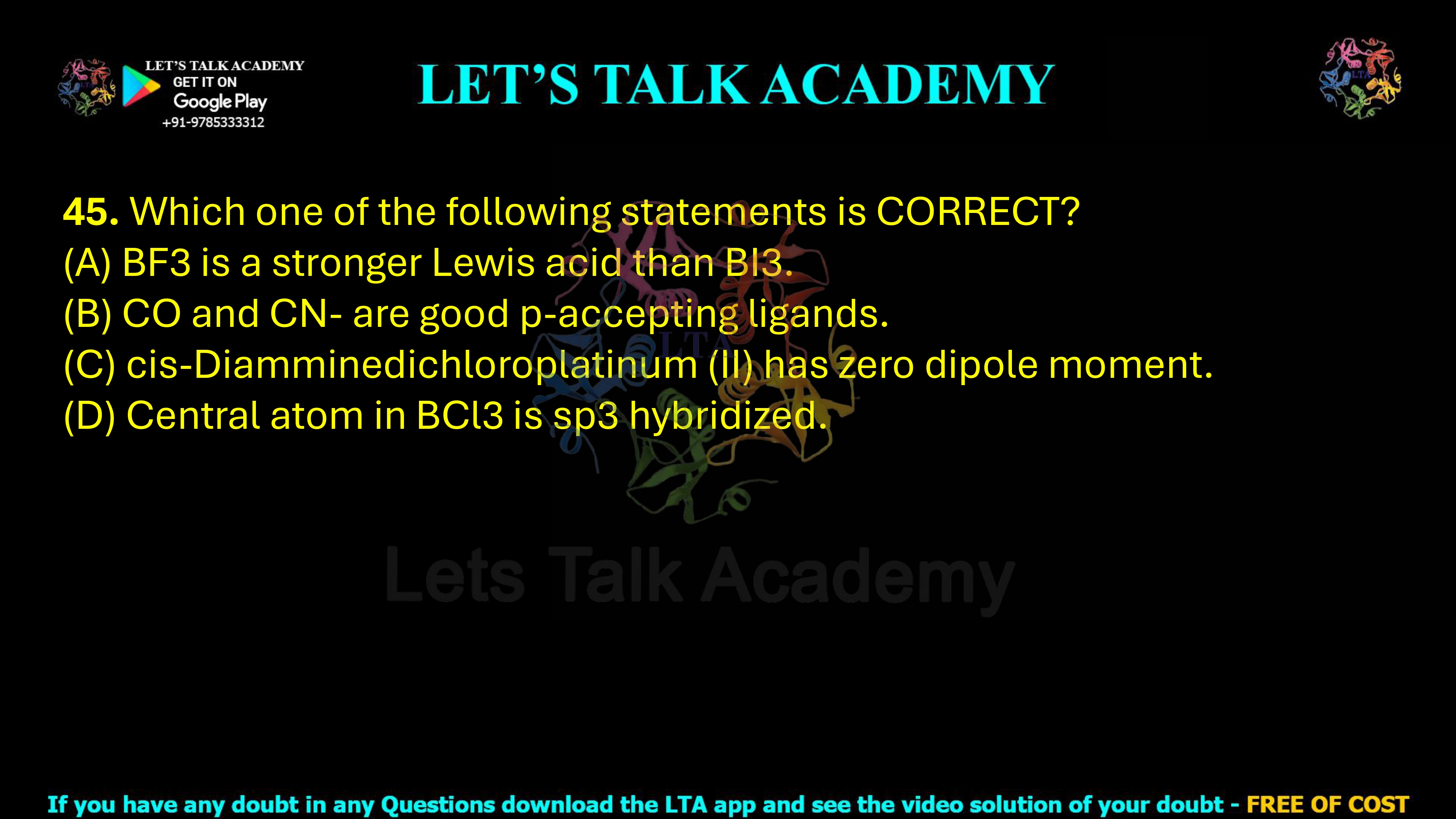
45. Which one of the following statements is correct?
(A) BF3 is a stronger Lewis acid than BI3.
(B) CO and CN− are good π-accepting ligands.
(C) cis-Diamminedichloroplatinum(II) has zero dipole moment.
(D) Central atom in BCl3 is sp3 hybridized.
Which One of the Following Statements Is Correct?
Correct Answer: (B) CO and CN− Are Good π-Accepting Ligands
Among the four given statements, only option (B) is correct. Both carbon monoxide, CO, and cyanide ion, CN−, can act as strong π-accepting ligands in coordination compounds. These ligands possess suitable vacant π* antibonding orbitals that can accept electron density from filled metal d orbitals through metal-to-ligand π back-bonding.
Option (A) is incorrect because the Lewis acidity of boron trihalides increases from BF3 to BI3, making BI3 a stronger Lewis acid than BF3. Option (C) is incorrect because the bond dipoles in the cis isomer of [Pt(NH3)2Cl2] do not cancel completely, so it has a nonzero dipole moment. Option (D) is incorrect because the central boron atom in BCl3 is sp2 hybridized and has trigonal planar geometry.
Detailed Analysis of Each Statement
Option (A): BF3 Is a Stronger Lewis Acid Than BI3
This statement is incorrect. A Lewis acid is a species that accepts an electron pair. Boron trihalides, BX3, behave as Lewis acids because the central boron atom is electron deficient and possesses an empty p orbital capable of accepting an electron pair from a Lewis base.
At first glance, one might expect BF3 to be the strongest Lewis acid because fluorine is highly electronegative and strongly withdraws electron density from boron. However, the experimentally observed Lewis acidity order of the boron trihalides is:
BF3 < BCl3 < BBr3 < BI3
Therefore, BI3 is a stronger Lewis acid than BF3, and the statement given in option (A) is incorrect.
Why BF3 Is a Weaker Lewis Acid Than BI3
Role of pπ–pπ Back-Bonding
The unusual Lewis acidity order of boron trihalides is explained mainly by π back-bonding between the filled p orbitals of the halogen atoms and the empty p orbital of boron. In BF3, the fluorine atoms possess compact 2p orbitals, while boron also has a compact empty 2p orbital.
Because the 2p orbitals of fluorine and boron have similar sizes and suitable energies, they overlap effectively. Electron density from a filled fluorine 2p orbital can be donated into the empty boron 2p orbital. This interaction is commonly described as pπ–pπ back-bonding.
The back-donation of electron density reduces the electron deficiency of boron. As a result, the boron atom in BF3 becomes less eager to accept an additional electron pair from an external Lewis base.
In BI3, iodine uses much larger 5p orbitals, while boron still uses a compact 2p orbital. The large difference in orbital size causes poor overlap between the iodine 5p and boron 2p orbitals. Therefore, π back-bonding is much weaker in BI3.
Since the boron atom in BI3 receives less electron density through back-bonding, it remains more electron deficient and is therefore a stronger Lewis acid.
Thus:
Strength of back-bonding: BF3 > BCl3 > BBr3 > BI3
but:
Lewis acidity: BF3 < BCl3 < BBr3 < BI3
Therefore, option (A) is incorrect.
Option (B): CO and CN− Are Good π-Accepting Ligands
This statement is correct. Carbon monoxide and cyanide ion are important ligands in coordination and organometallic chemistry. Both can form strong bonds with transition-metal centers through a combination of σ donation and π acceptance.
In the σ-donation component of bonding, the ligand donates an electron pair to an empty orbital of the metal. At the same time, a filled metal d orbital can transfer electron density into a vacant π* antibonding orbital of the ligand. This second interaction is called metal-to-ligand π back-bonding or π back-donation.
The bonding can therefore be represented conceptually as:
Ligand → Metal: σ donation
Metal → Ligand: π back-donation
Because CO and CN− possess suitable low-lying vacant π* orbitals, they can accept electron density from metal d orbitals and are classified as π-accepting ligands.
Therefore, option (B) is correct.
Why CO Is a Good π-Acceptor Ligand
Carbon monoxide binds to many transition metals through the carbon atom. The carbon atom donates a lone pair into an empty orbital of the metal, producing a metal–carbon σ bond. This is the σ-donation component of metal–CO bonding.
CO also contains vacant π* antibonding molecular orbitals. Filled d orbitals of a transition metal can donate electron density into these π* orbitals. This creates the metal-to-ligand π back-bonding interaction.
The two bonding interactions reinforce each other. Greater σ donation from CO can increase electron density on the metal, which can promote stronger π back-donation from the metal into the ligand. The combined effect produces strong metal–CO bonds in many metal carbonyl complexes.
Thus, CO is both a σ-donor and a π-acceptor ligand.
Why CN− Is a π-Acceptor Ligand
Cyanide ion is also capable of participating in metal-to-ligand π back-bonding. Like CO, it contains suitable π* antibonding orbitals that can receive electron density from filled metal d orbitals.
CN− is an especially strong-field ligand in the spectrochemical series. Its strong interaction with transition-metal d orbitals often produces a large crystal-field splitting and can favor low-spin electronic configurations in suitable metal complexes.
Therefore, both CO and CN− are commonly treated as ligands capable of significant π-acceptor interactions, making statement (B) the correct answer.
Effect of π Back-Bonding on Metal–Ligand Bonds
When a metal donates electron density into the π* antibonding orbital of a ligand such as CO, the metal–ligand bond becomes stronger because additional bonding interaction develops between the metal and ligand.
At the same time, occupation of the ligand’s antibonding orbital weakens the internal bond within the ligand. For example, increased metal-to-CO back-bonding strengthens the metal–carbon bond but weakens the C–O bond.
This synergic combination of ligand-to-metal σ donation and metal-to-ligand π back-donation is one of the most important bonding concepts in coordination and organometallic chemistry.
Option (C): cis-Diamminedichloroplatinum(II) Has Zero Dipole Moment
This statement is incorrect. Diamminedichloroplatinum(II), [Pt(NH3)2Cl2], is a square-planar Pt(II) complex that can exist as cis and trans geometrical isomers.
In the cis isomer, the two NH3 ligands occupy adjacent positions, and the two chloride ligands also occupy adjacent positions. Because the different bond dipoles are arranged at approximately 90° to one another, they do not cancel completely.
Therefore:
Dipole moment of cis-[Pt(NH3)2Cl2] ≠ 0
Hence, option (C) is incorrect.
Dipole Moment of cis and trans Isomers
cis-[Pt(NH3)2Cl2]
In the cis isomer, identical ligands are located next to each other. The Pt–Cl bond dipoles and Pt–NH3 bond dipoles are not positioned directly opposite to identical bond dipoles.
Consequently, the vector sum of all bond dipole moments is nonzero. The cis isomer therefore has a net molecular dipole moment.
The cis isomer is also widely known as cisplatin, an important platinum coordination compound.
trans-[Pt(NH3)2Cl2]
In the trans isomer, the two chloride ligands are opposite each other, and the two ammonia ligands are also opposite each other. The corresponding bond dipoles can cancel because of the symmetric arrangement.
Therefore, the trans isomer has zero net dipole moment under the idealized molecular symmetry description.
Thus:
cis isomer → nonzero dipole moment
trans isomer → zero dipole moment
Since option (C) assigns zero dipole moment to the cis isomer, the statement is incorrect.
Option (D): Central Atom in BCl3 Is sp3 Hybridized
This statement is incorrect. In BCl3, the central boron atom forms three sigma bonds with three chlorine atoms and has no lone pair.
Therefore, the number of electron domains around the central boron atom is three. A steric number of three corresponds to sp2 hybridization.
Thus:
Hybridization of B in BCl3 = sp2
and not sp3. Therefore, option (D) is incorrect.
Hybridization and Geometry of BCl3
The valence-shell electronic configuration of boron is 2s22p1. In the bonding description of BCl3, one s orbital and two p orbitals combine to form three equivalent sp2 hybrid orbitals.
Each sp2 hybrid orbital forms one sigma bond with a chlorine atom. The three hybrid orbitals arrange themselves in one plane with bond angles of approximately 120°.
Therefore, BCl3 has:
Number of sigma bonds around B = 3
Number of lone pairs on B = 0
Steric number = 3
Hybridization = sp2
Geometry = trigonal planar
Bond angle = approximately 120°
Hence, the claim that boron is sp3 hybridized is incorrect.
Comparison of All Four Statements
Option (A): BF3 is a stronger Lewis acid than BI3 → Incorrect
Option (B): CO and CN− are good π-accepting ligands → Correct
Option (C): cis-[Pt(NH3)2Cl2] has zero dipole moment → Incorrect
Option (D): Central B atom in BCl3 is sp3 hybridized → Incorrect
Therefore, only statement (B) is correct.
Why Option (A) and Option (B) Involve Different Types of Back-Bonding
This question includes two different applications of π interactions. In boron trihalides, electron density is donated from a filled p orbital of a halogen atom into the empty p orbital of boron. This reduces the Lewis acidity of the boron center, especially in BF3.
In metal complexes containing CO or CN−, the direction of the important π interaction is different. Electron density is donated from filled metal d orbitals into vacant π* orbitals of the ligand. This process is called metal-to-ligand π back-bonding.
Therefore, the question connects two important chemical concepts: pπ–pπ back-bonding in electron-deficient main-group compounds and dπ–pπ back-bonding in transition-metal complexes.
Final Answer
BF3 is not a stronger Lewis acid than BI3 because effective pπ–pπ back-bonding in BF3 reduces the electron deficiency of boron. The Lewis acidity order is BF3 < BCl3 < BBr3 < BI3.
The cis isomer of [Pt(NH3)2Cl2] has a nonzero dipole moment because its bond dipoles do not cancel completely. The central boron atom in BCl3 is sp2 hybridized and has trigonal planar geometry.
CO and CN− possess suitable vacant π* orbitals and can accept electron density from filled metal d orbitals through π back-bonding. Therefore, they are good π-accepting ligands.
Correct Answer: (B) CO and CN− are good π-accepting ligands.


