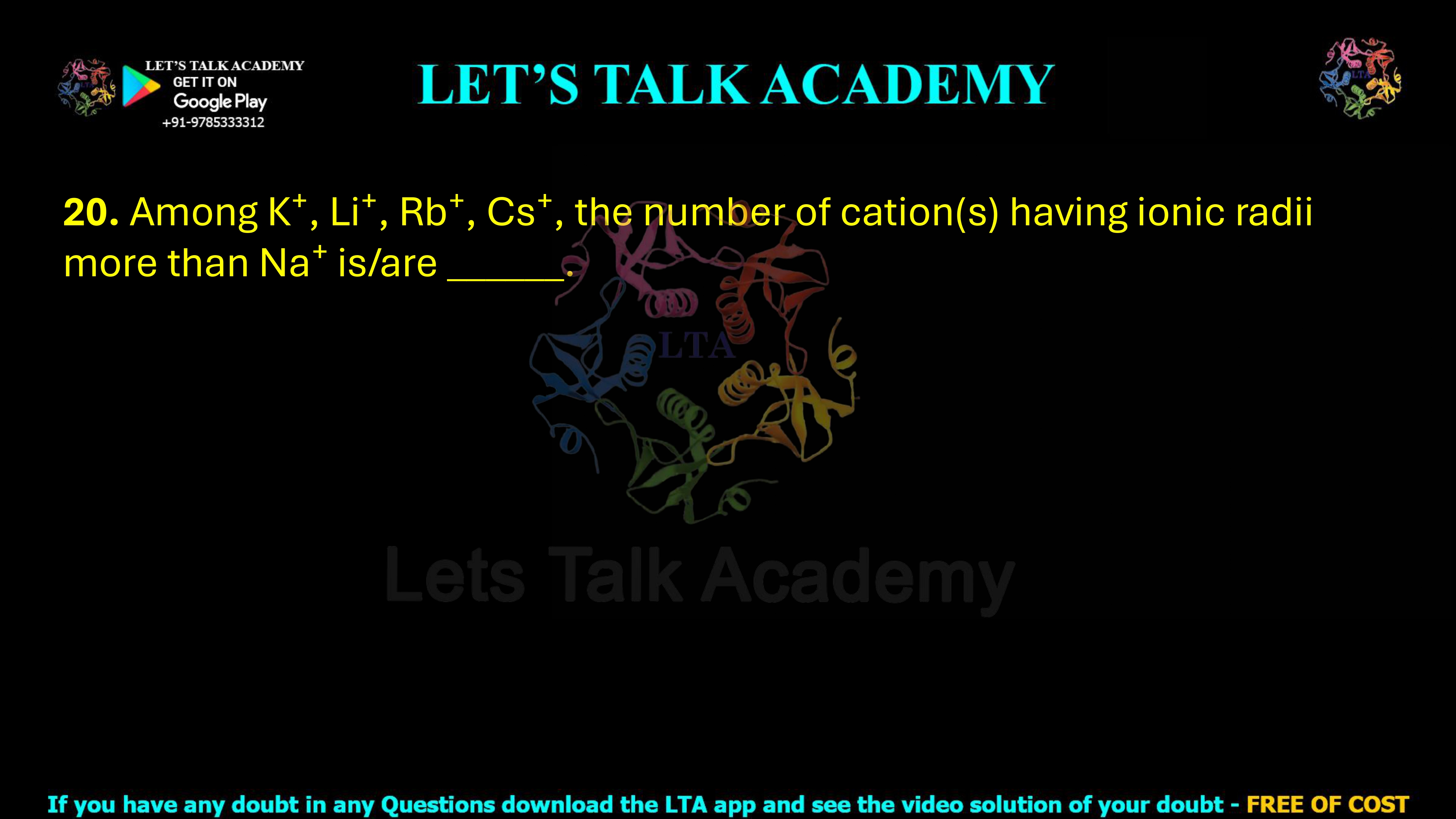
20. Among K+, Li+, Rb+, and Cs+, the number of cation(s) having ionic radii more than Na+ is _____.
How Many Cations Have Ionic Radii Greater Than Na+?
Correct Answer: 3
Among the given alkali metal cations, K+, Rb+, and Cs+ have ionic radii greater than Na+, whereas Li+ has a smaller ionic radius than Na+. Therefore, the total number of cations having ionic radii greater than Na+ is 3.
This question can be solved directly by applying the periodic trend of ionic radius in Group 1 of the periodic table. As we move down the alkali metal group from lithium to cesium, a new principal electron shell is added at each successive step. The number of occupied electron shells therefore increases, and the size of the corresponding unipositive ion also increases.
Understanding the Ionic Radius Trend in Alkali Metal Cations
Why Ionic Radius Increases Down Group 1
Lithium, sodium, potassium, rubidium, and cesium belong to Group 1 of the periodic table. Each neutral alkali metal atom contains one electron in its outermost shell. When the atom forms a +1 cation, it loses this valence electron and acquires a stable noble-gas-like electronic configuration.
Although all these ions carry the same positive charge of +1, their sizes are not the same. Moving down the group increases the principal quantum number of the outermost occupied shell. Each new element has one additional electron shell compared with the element above it.
Consequently, the general order of ionic radii is:
Li+ < Na+ < K+ < Rb+ < Cs+
This order immediately shows that three of the given cations, namely K+, Rb+, and Cs+, are larger than Na+.
Step-by-Step Comparison of Each Cation with Na+
Comparison of Li+ with Na+
Lithium is located above sodium in Group 1. The electronic configuration of neutral lithium is 1s22s1. After losing one electron, Li+ has the electronic configuration 1s2.
Therefore, Li+ has only one occupied principal electron shell. In comparison, Na+ has two occupied principal shells. Because Li+ has fewer electron shells, its electron cloud is more compact and its ionic radius is smaller than that of Na+.
Li+ < Na+
Therefore, Li+ is not counted.
Comparison of K+ with Na+
Potassium is located below sodium in Group 1. Neutral potassium has the electronic configuration [Ar]4s1. When it loses the outermost 4s electron, K+ acquires the electronic configuration [Ar].
The potassium ion has three occupied principal electron shells, whereas Na+ has only two occupied principal shells. The additional electron shell makes K+ larger than Na+.
K+ > Na+
Therefore, K+ is counted.
Comparison of Rb+ with Na+
Rubidium lies further below sodium in Group 1. After losing its outermost electron, Rb+ has the stable electronic configuration [Kr]. The ion contains more occupied electron shells than Na+.
The increased number of shells and greater shielding place the outer electrons farther from the nucleus. As a result, Rb+ has a considerably larger ionic radius than Na+.
Rb+ > Na+
Therefore, Rb+ is counted.
Comparison of Cs+ with Na+
Cesium is located much lower than sodium in Group 1. When a cesium atom loses its outermost electron, it forms Cs+ with the electronic configuration [Xe]. The cesium ion contains substantially more occupied electron shells than Na+.
Due to the greater number of electron shells and increased shielding effect, Cs+ has a much larger ionic radius than Na+.
Cs+ > Na+
Therefore, Cs+ is counted.
Complete Order of Ionic Radii
The complete increasing order of ionic radii for the relevant Group 1 cations is:
Li+ < Na+ < K+ < Rb+ < Cs+
Taking Na+ as the reference ion, only the ions appearing to its right in this increasing order have larger ionic radii. These ions are K+, Rb+, and Cs+.
Counting the Cations Larger Than Na+
The comparison can be summarized as follows:
K+ > Na+ → Yes
Li+ < Na+ → No
Rb+ > Na+ → Yes
Cs+ > Na+ → Yes
Therefore:
Total number = 1 + 0 + 1 + 1 = 3
Role of Electron Shells in Determining Ionic Size
The increase in ionic radius down Group 1 is mainly caused by the addition of new principal electron shells. Although the nuclear charge also increases down the group, the outer electrons are located progressively farther from the nucleus and experience greater shielding from the inner electrons.
This shielding reduces the effective attraction experienced by the outermost occupied electron shell. The addition of a new shell has a much greater influence on ionic size than the increase in nuclear charge. Therefore, the ionic radius increases steadily from Li+ to Cs+.
Why All +1 Cations Do Not Have the Same Ionic Radius
It may appear that all the given ions should have similar sizes because each carries a +1 charge. However, ionic charge alone does not determine ionic radius. The number of occupied electron shells, effective nuclear charge, shielding effect, and electronic configuration also influence the size of an ion.
Li+, Na+, K+, Rb+, and Cs+ all carry the same charge, but they have different numbers of occupied electron shells. Therefore, their ionic radii increase systematically down the group.
Final Answer
The ionic radius of alkali metal cations increases down Group 1 because the number of occupied electron shells increases. The correct order is:
Li+ < Na+ < K+ < Rb+ < Cs+
Therefore, K+, Rb+, and Cs+ have ionic radii greater than Na+, while Li+ has a smaller ionic radius.
Correct Answer: 3


