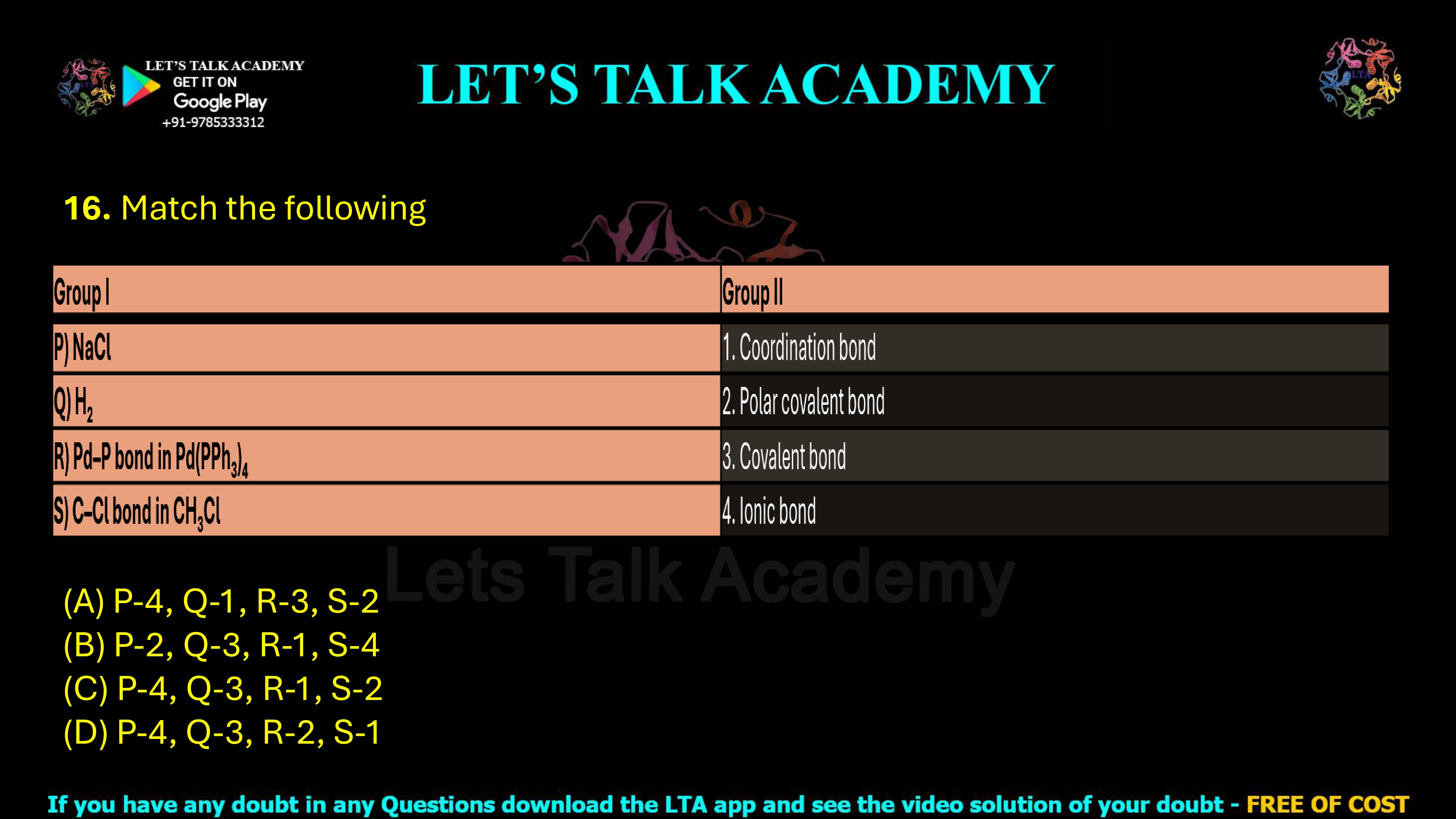
16. Match the following compounds and bonds in Group I with the correct type of chemical bond given in Group II.
P) NaCl
Q) H2
R) Pd–P bond in Pd(PPh3)4
S) C–Cl bond in CH3Cl
Group II:
1. Coordination bond
2. Polar covalent bond
3. Covalent bond
4. Ionic bond
(A) P–4, Q–1, R–3, S–2
(B) P–2, Q–3, R–1, S–4
(C) P–4, Q–3, R–1, S–2
(D) P–4, Q–3, R–2, S–1
Match the Following Chemical Bonds – Detailed Explanation of NaCl, H₂, Pd–P and C–Cl Bonds
Correct Answer: Option (C) P–4, Q–3, R–1, S–2
How to Match the Different Types of Chemical Bonds
To solve this match the following chemical bonds question correctly, each compound or individual bond must be analysed according to the way electrons are transferred, shared or donated between the participating atoms. The four types of bonding involved in this question are ionic bonding, ordinary covalent bonding, coordination bonding and polar covalent bonding.
In NaCl, electrons are transferred from one atom to another, producing oppositely charged ions. In H2, two identical hydrogen atoms share electrons equally. In Pd(PPh3)4, the phosphine ligand donates an electron pair to the palladium centre. In CH3Cl, the carbon and chlorine atoms share electrons unequally because of their difference in electronegativity. These bonding characteristics provide the correct matching.
Detailed Explanation of Each Match
P) NaCl Matches with 4. Ionic Bond
Sodium chloride, NaCl, is a classic example of an ionic compound. Sodium is an electropositive metal belonging to Group 1, whereas chlorine is an electronegative non-metal belonging to Group 17. Sodium has one electron in its outermost shell and tends to lose this electron to achieve a stable electronic configuration.
Chlorine requires one electron to complete its valence shell. Therefore, sodium transfers one electron to chlorine. As a result, sodium forms a positively charged Na+ ion and chlorine forms a negatively charged Cl− ion.
Na → Na+ + e−
Cl + e− → Cl−
The electrostatic force of attraction between Na+ and Cl− produces an ionic bond. Therefore, NaCl is correctly matched with 4. Ionic bond.
P → 4
Q) H₂ Matches with 3. Covalent Bond
The H2 molecule consists of two identical hydrogen atoms. Each hydrogen atom has one electron and requires one additional electron to attain the stable duplet electronic configuration. Instead of transferring electrons, the two hydrogen atoms share a pair of electrons.
Because the two atoms are identical, they have the same electronegativity. Therefore, the shared electron pair is distributed equally between the two hydrogen atoms. The H–H bond is consequently an ordinary non-polar covalent bond.
H· + ·H → H–H
Among the bond types provided in Group II, H2 must therefore be matched with 3. Covalent bond.
Q → 3
R) Pd–P Bond in Pd(PPh₃)₄ Matches with 1. Coordination Bond
In the complex Pd(PPh3)4, PPh3 represents triphenylphosphine, which acts as a ligand. The phosphorus atom in each triphenylphosphine ligand possesses a lone pair of electrons that can be donated to the palladium centre.
During the formation of the Pd–P bond, the shared pair of electrons is initially supplied by the phosphorus atom of the PPh3 ligand. A covalent bond in which both electrons of the shared pair are donated by the same atom is described as a coordinate covalent bond or coordination bond.
Therefore, the Pd–P bond in Pd(PPh3)4 is matched with 1. Coordination bond.
R → 1
S) C–Cl Bond in CH₃Cl Matches with 2. Polar Covalent Bond
In chloromethane, CH3Cl, carbon and chlorine are joined by sharing a pair of electrons. However, the electron pair is not shared equally because chlorine is more electronegative than carbon.
Chlorine attracts the shared electron density more strongly toward itself. Consequently, chlorine develops a partial negative charge, represented as δ−, while the carbon atom develops a partial positive charge, represented as δ+.
Cδ+–Clδ−
Since the electrons are shared but unequally distributed, the C–Cl bond is classified as a polar covalent bond. Therefore, the correct match is 2. Polar covalent bond.
S → 2
Complete Correct Matching
After analysing the bonding in all four cases, the complete matching is obtained as follows:
P) NaCl → 4. Ionic bond
Q) H2 → 3. Covalent bond
R) Pd–P bond in Pd(PPh3)4 → 1. Coordination bond
S) C–Cl bond in CH3Cl → 2. Polar covalent bond
Therefore, the correct sequence is:
P–4, Q–3, R–1, S–2
Why Option (C) Is Correct
Option (C) correctly identifies the nature of bonding in every case. NaCl contains an ionic bond because of electron transfer and electrostatic attraction between Na+ and Cl−. H2 contains a covalent bond formed by equal sharing of electrons between identical hydrogen atoms. The Pd–P bond in Pd(PPh3)4 is formed through electron-pair donation from the phosphine ligand and is therefore classified as a coordination bond. The C–Cl bond in CH3Cl is polar covalent because chlorine attracts the shared electron pair more strongly than carbon.
Hence, only Option (C) gives all four matches correctly.
Final Answer
The correct matching of the compounds and bonds with their respective types of chemical bonding is:
P–4, Q–3, R–1, S–2
Therefore, the correct answer is Option (C).
Correct Option: (C) P–4, Q–3, R–1, S–2


