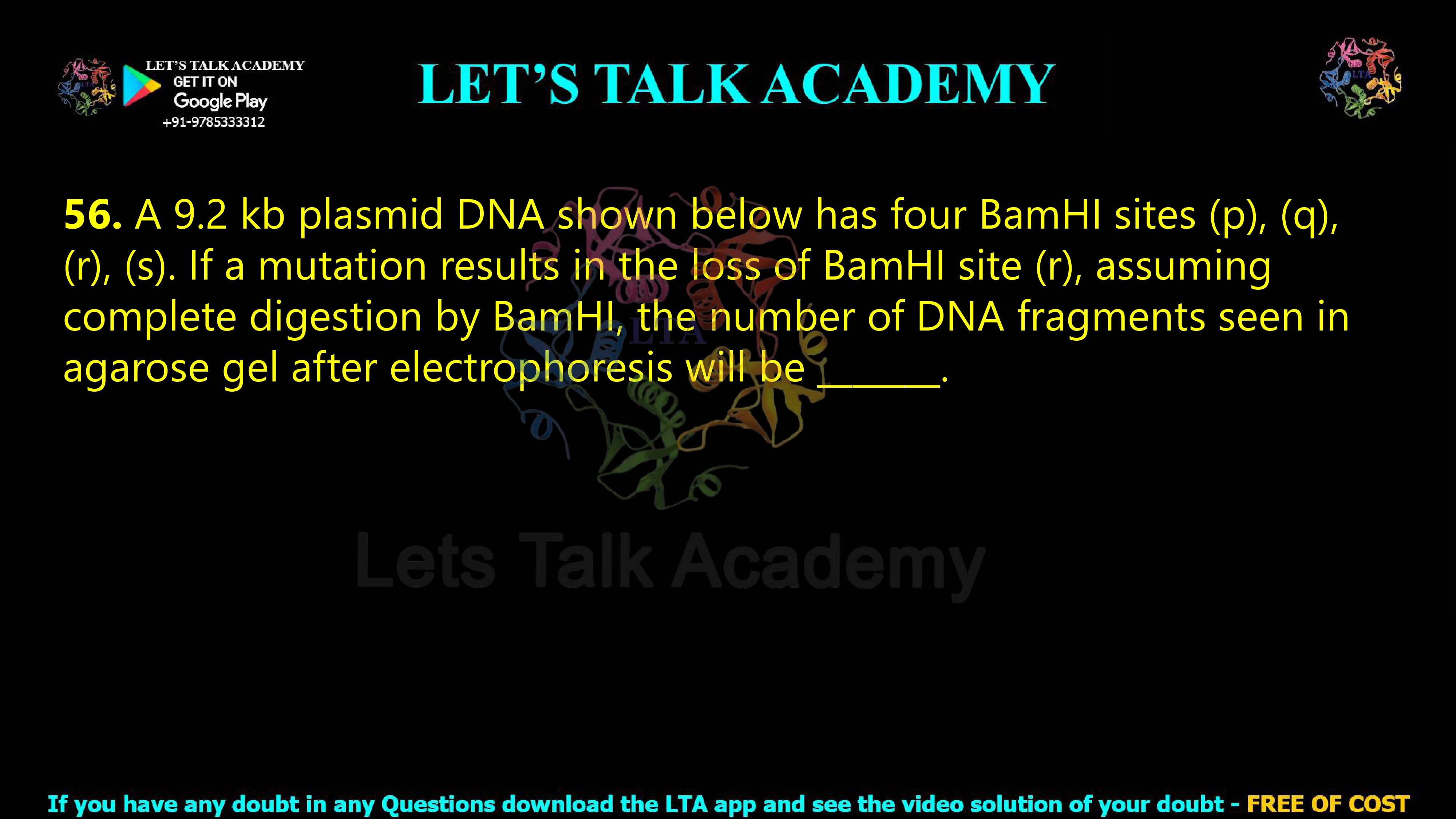
55. A 9.2 kb plasmid DNA shown below has four BamHI sites (p), (q), (r), (s). If a mutation results in the loss of BamHI site (r), assuming complete digestion by BamHI, the number of DNA fragments seen in agarose gel after electrophoresis will be _______.
Loss of a BamHI Restriction Site in Plasmid DNA: Number of Fragments After Complete Digestion
Understanding the Given Plasmid DNA
The question describes a 9.2 kb plasmid DNA containing four recognition sites for the restriction enzyme BamHI, labelled as (p), (q), (r), and (s). A plasmid is generally a circular double-stranded DNA molecule, and this circular nature is the most important concept required to solve the question correctly.
Originally, the plasmid contains four BamHI restriction sites. During complete digestion, BamHI recognizes and cuts the DNA at every intact BamHI recognition sequence. Therefore, an unchanged circular plasmid containing four BamHI sites would be cut at four different positions.
However, the question states that a mutation causes the loss of BamHI site (r). This means that BamHI can no longer recognize or cut the plasmid at site (r). Consequently, only three functional BamHI sites remain: (p), (q), and (s).
Therefore, after complete digestion, the circular plasmid is cut at three positions and produces three DNA fragments.
Key Concept: Number of Fragments Produced from Circular DNA
For a circular DNA molecule, the number of DNA fragments produced after complete restriction digestion is equal to the number of restriction sites recognized and cut by the restriction enzyme.
Therefore:
Number of fragments from circular DNA = Number of restriction sites
Initially, the plasmid has:
Number of BamHI sites = 4
Thus, before mutation:
Number of DNA fragments = 4
After mutation, BamHI site (r) is lost:
Remaining BamHI sites = 4 − 1 = 3
Therefore:
Number of DNA fragments after complete BamHI digestion = 3
Hence, the final answer is 3 DNA fragments.
Why Does a Circular Plasmid Produce Three Fragments After Three Cuts?
The relationship between the number of cuts and the number of fragments depends on whether the DNA molecule is circular or linear. In a circular plasmid, there are initially no free ends. The first restriction enzyme cut opens the circular DNA and converts it into one linear DNA molecule. Additional cuts divide this linearized molecule into separate fragments.
If BamHI cuts the circular plasmid at three different sites, the three regions present between these cutting sites become three separate DNA fragments. Therefore, three BamHI sites in circular DNA produce exactly three DNA fragments.
This can be represented conceptually as:
Circular plasmid with 3 BamHI sites → 3 cuts → 3 DNA fragments
The total length of all three fragments will still be equal to the original plasmid size of 9.2 kb. Restriction digestion changes the physical arrangement of the DNA but does not remove DNA from the plasmid.
Therefore:
Length of fragment 1 + Length of fragment 2 + Length of fragment 3 = 9.2 kb
Effect of the Loss of BamHI Site (r)
A restriction site is a specific nucleotide sequence recognized by a restriction endonuclease. BamHI normally recognizes its characteristic restriction sequence and cleaves the DNA at that position. If a mutation changes one or more essential nucleotides within the BamHI recognition sequence at site (r), the restriction enzyme can no longer recognize that location.
As a result, BamHI does not cut at site (r). The DNA segments that were previously separated by the cut at site (r) now remain connected. Therefore, two fragments that would originally have been produced separately become joined together to form one larger fragment.
The original plasmid has four functional BamHI sites and would produce four fragments after complete digestion. After the loss of one BamHI site, only three functional sites remain, so only three fragments are produced.
Thus:
Original condition: 4 BamHI sites → 4 fragments
After mutation: 3 BamHI sites → 3 fragments
What Will Be Seen on the Agarose Gel?
After complete digestion with BamHI, the DNA fragments are separated using agarose gel electrophoresis. DNA molecules migrate through the agarose gel according to their size, with smaller DNA fragments generally moving faster and farther than larger DNA fragments.
Since the mutated plasmid contains three functional BamHI sites, complete digestion produces three DNA fragments. Therefore, under normal conditions, three DNA bands are expected on the agarose gel.
However, an important technical distinction should be understood. The question asks for the number of DNA fragments produced, and the correct answer is definitely 3. In an actual gel, if two fragments happen to have exactly the same length, they may migrate together and appear as a single band. Unless the question specifically provides equal fragment sizes or asks about co-migration, the expected answer is based on the number of fragments produced.
Therefore, the expected number of fragments is 3.
Difference Between Circular and Linear DNA Digestion
Understanding the difference between circular and linear DNA is essential for solving restriction digestion questions.
Circular DNA
For circular DNA:
Number of fragments = Number of restriction sites
Therefore, a circular plasmid with three BamHI sites produces three DNA fragments after complete digestion.
Linear DNA
For linear DNA:
Number of fragments = Number of restriction sites + 1
Therefore, if a linear DNA molecule contains three BamHI sites, complete digestion would produce four DNA fragments.
The plasmid in this question is circular. Therefore, the circular DNA rule must be applied.
Step-by-Step Solution
The 9.2 kb plasmid initially contains four BamHI restriction sites: (p), (q), (r), and (s). A mutation eliminates site (r), so only three functional BamHI sites remain: (p), (q), and (s). Since plasmid DNA is circular, the number of fragments produced after complete digestion is equal to the number of functional restriction sites.
Therefore:
Functional BamHI sites after mutation = 3
Number of DNA fragments produced = 3
Final Answer: 3 DNA fragments
Final Answer
After the mutation, the 9.2 kb circular plasmid contains only three functional BamHI sites. Complete digestion by BamHI cuts the plasmid at these three positions. Since the DNA is circular, three restriction enzyme cuts produce three DNA fragments.
Therefore, the number of DNA fragments seen after agarose gel electrophoresis will be 3.


