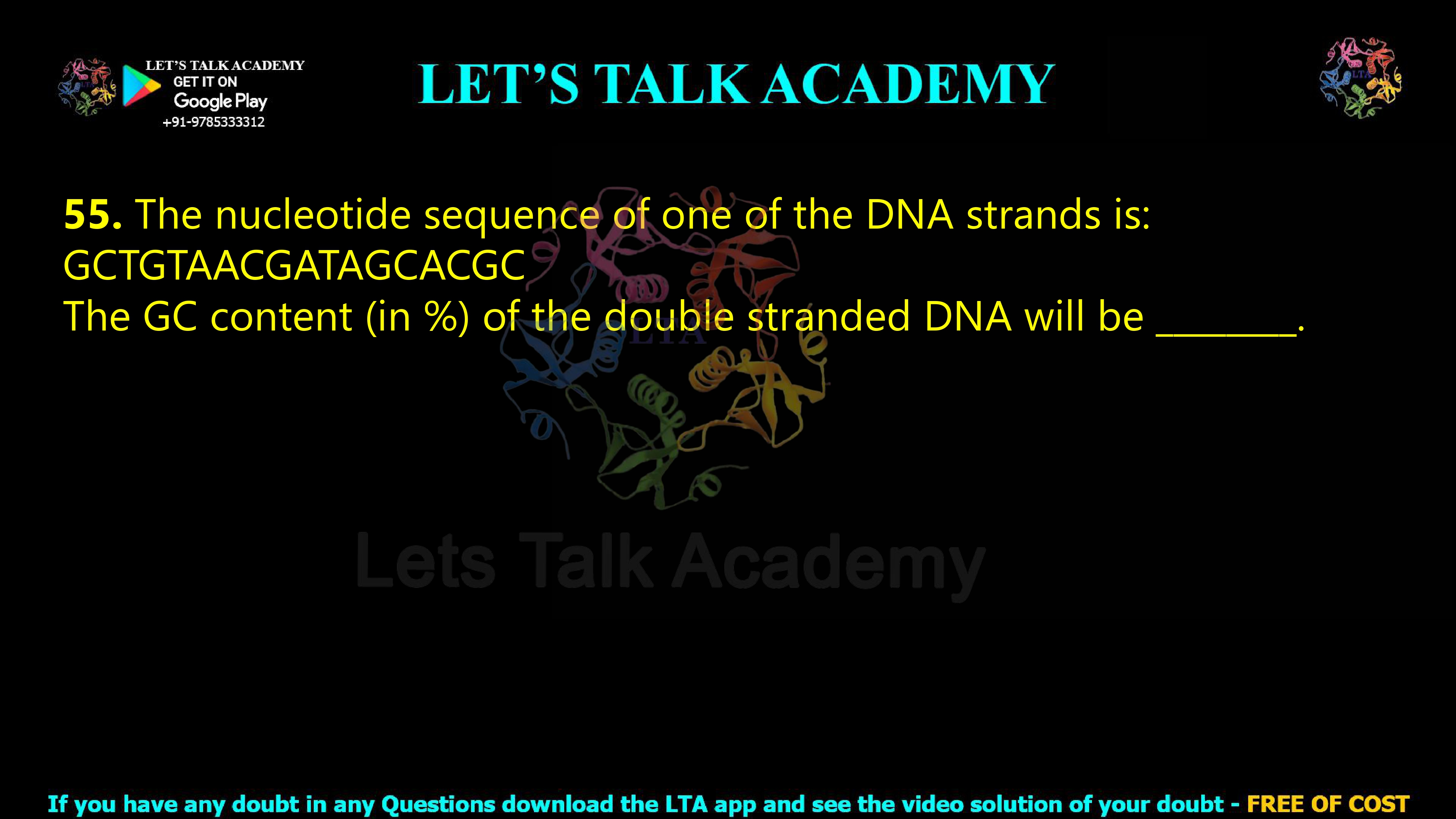
54. The nucleotide sequence of one of the DNA strands is:
GCTGTAACGATAGCACGC
The GC content (in %) of the double stranded DNA will be ________.
How to Calculate GC Content of Double-Stranded DNA from a Nucleotide Sequence?
The nucleotide sequence of one of the DNA strands is:
GCTGTAACGATAGCACGC
The question asks us to calculate the GC content, expressed as a percentage, of the double-stranded DNA. This is an important molecular biology calculation because the GC content of DNA influences several important properties of the molecule, including DNA stability, melting temperature, denaturation behavior, and the strength of base pairing.
To solve this question correctly, we first need to understand what GC content means, count the total number of nucleotides in the given DNA strand, determine the number of guanine and cytosine nucleotides, and then apply the GC percentage formula.
What Is GC Content in DNA?
GC content refers to the percentage of nitrogenous bases in a DNA molecule that are either guanine (G) or cytosine (C). DNA contains four major nitrogenous bases: adenine (A), thymine (T), guanine (G), and cytosine (C).
The GC content is calculated using the following formula:
GC content (%) = [(Number of G nucleotides + Number of C nucleotides) ÷ Total number of nucleotides] × 100
In double-stranded DNA, guanine pairs specifically with cytosine through three hydrogen bonds, whereas adenine pairs with thymine through two hydrogen bonds. Therefore, DNA molecules with a relatively high GC content generally show greater thermal stability and often have a higher melting temperature.
Step 1: Count the Total Number of Nucleotides
The given DNA strand is:
G C T G T A A C G A T A G C A C G C
Now count all the nucleotides present in the sequence.
The total number of nucleotides in the given DNA strand is:
Total nucleotides = 18
Therefore, the denominator in the GC content formula will be 18.
Step 2: Count the Number of Guanine Nucleotides
The given sequence is:
GCTGTAACGATAGCACGC
Now identify all the guanine nucleotides represented by the letter G.
The sequence contains:
Number of G nucleotides = 5
Step 3: Count the Number of Cytosine Nucleotides
Next, identify all the cytosine nucleotides represented by the letter C.
The sequence contains:
Number of C nucleotides = 5
Therefore, the total number of G and C nucleotides is:
G + C = 5 + 5 = 10
Step 4: Apply the GC Content Formula
The formula for calculating GC content is:
GC content (%) = [(G + C) ÷ Total number of nucleotides] × 100
Substituting the calculated values:
GC content (%) = (10 ÷ 18) × 100
Therefore:
GC content (%) = 55.56%
Thus, the GC content of the given DNA sequence is approximately 55.6%.
Why Is the GC Content of Double-Stranded DNA Also 55.56%?
The question specifically asks for the GC content of the double-stranded DNA, even though the nucleotide sequence of only one DNA strand is provided. This wording may initially appear confusing, but the GC percentage remains unchanged when the complementary strand is formed.
The given strand is:
5′-GCTGTAACGATAGCACGC-3′
Its complementary strand will contain a cytosine opposite every guanine and a guanine opposite every cytosine. Similarly, every adenine will pair with thymine, and every thymine will pair with adenine.
The complementary strand is:
3′-CGACATTGCTATCGTGCG-5′
The original strand contains 5 guanine and 5 cytosine nucleotides, giving a total of 10 GC bases. The complementary strand also contains a total of 10 GC bases because every G in the original strand produces a C in the complementary strand, while every C produces a G.
Therefore, in the complete double-stranded DNA molecule:
Total GC nucleotides = 10 + 10 = 20
Total nucleotides = 18 + 18 = 36
Now calculate the GC content:
GC content (%) = (20 ÷ 36) × 100 = 55.56%
Therefore, calculating the GC percentage from one DNA strand or from the complete double-stranded DNA gives the same result.
Relationship Between Complementary DNA Strands and GC Content
In double-stranded DNA, the base-pairing rules ensure that guanine always pairs with cytosine and adenine always pairs with thymine. Consequently, the complementary DNA strand does not change the overall proportion of GC nucleotides.
If one strand contains a certain total percentage of G and C nucleotides, its complementary strand will contain exactly the same combined percentage of G and C nucleotides. The individual percentages of G and C may interchange between the two strands, but their combined value remains constant.
This principle is especially useful in molecular biology and competitive examination questions because the GC content of double-stranded DNA can be calculated directly from the sequence of either one of its strands.
Why GC Content Is Important in Molecular Biology
GC content is an important characteristic of DNA because guanine and cytosine are connected by three hydrogen bonds, while adenine and thymine are connected by two hydrogen bonds. As a result, GC-rich DNA regions generally require more thermal energy for strand separation.
GC content is commonly considered during the analysis of DNA melting temperature, primer design, PCR experiments, genome composition, DNA hybridization, and sequencing studies. A correct understanding of GC percentage calculations is therefore useful not only for solving examination questions but also for understanding practical molecular biology techniques.
Final Answer
The given DNA strand contains 18 nucleotides, of which 5 are guanine (G) and 5 are cytosine (C).
Therefore:
GC content (%) = [(5 + 5) ÷ 18] × 100
GC content (%) = 55.56%


