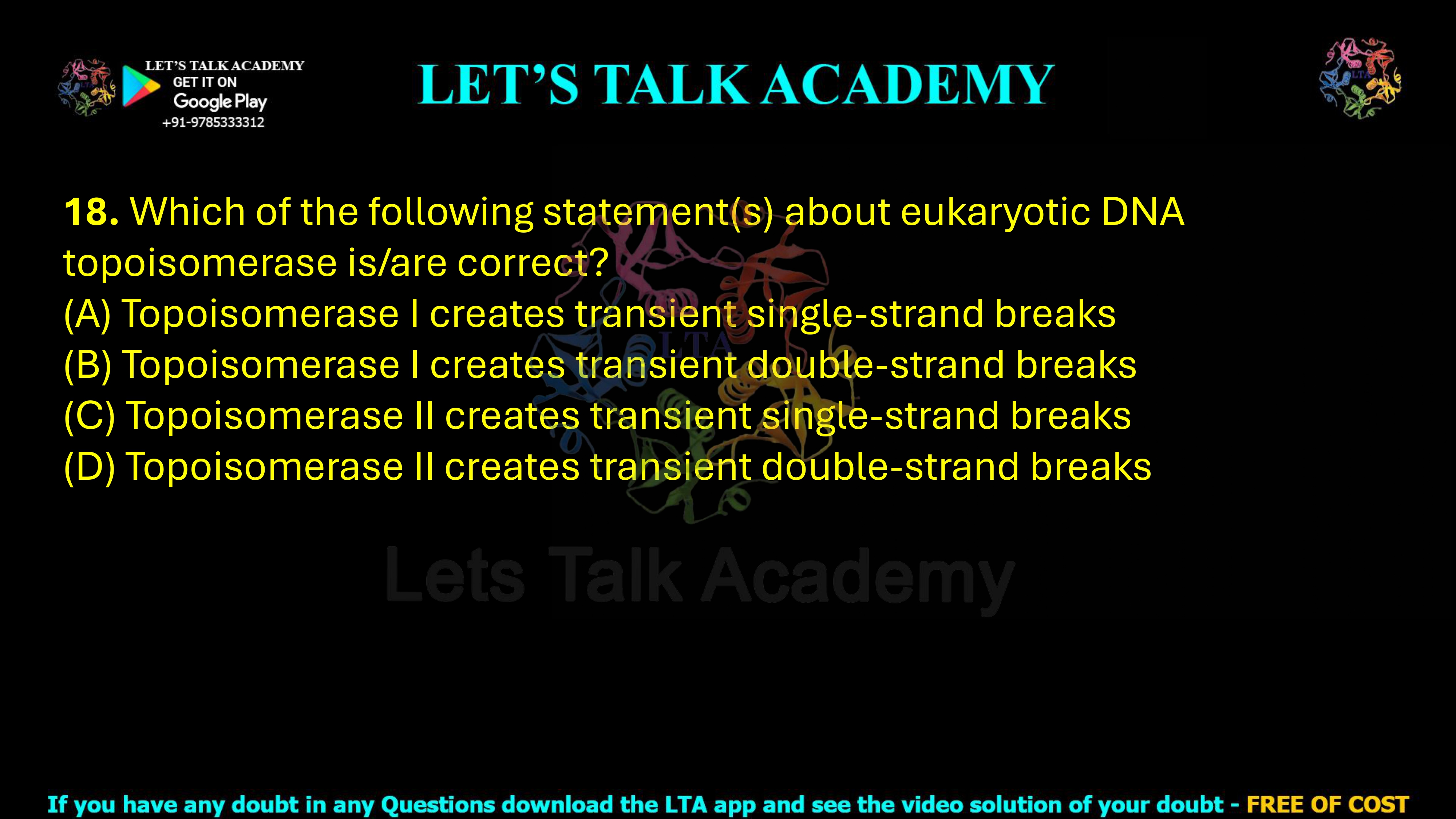
18. Which of the following statement(s) about eukaryotic DNA topoisomerase is/are correct?
(A) Topoisomerase I creates transient single-strand breaks
(B) Topoisomerase I creates transient double-strand breaks
(C) Topoisomerase II creates transient single-strand breaks
(D) Topoisomerase II creates transient double-strand breaks
Eukaryotic DNA Topoisomerase I and II: Single-Strand and Double-Strand Breaks Explained
Introduction
DNA is not a static molecule inside the cell. During essential biological processes such as DNA replication, transcription, recombination, and chromosome segregation, the DNA double helix is continuously unwound, rewound, twisted, and moved. These processes generate topological stress in the DNA molecule. If this stress is not controlled, DNA can become excessively supercoiled, tangled, or interlinked, which can interfere with the normal functioning of the genome.
Cells solve this problem with a specialized group of enzymes known as DNA topoisomerases. These enzymes temporarily break one or both strands of DNA, allow the DNA molecule to undergo a controlled topological change, and then reseal the break. The breaks created by topoisomerases are therefore transient catalytic intermediates rather than permanent DNA damage.
Correct Answer
Correct Statements: (A) and (D)
Topoisomerase I → Transient single-strand break
Topoisomerase II → Transient double-strand break
Detailed Explanation
The classification of DNA topoisomerases is based primarily on their catalytic mechanism. Type I topoisomerases cleave one strand of the DNA duplex at a time. This temporary single-strand break allows controlled rotation or passage of a DNA strand, thereby changing DNA supercoiling before the enzyme reseals the break.
In contrast, Type II topoisomerases cleave both strands of one DNA duplex simultaneously. Another segment of double-stranded DNA is then passed through this temporary double-strand break. The broken DNA is subsequently resealed. This mechanism allows Topoisomerase II to remove DNA knots, separate interlinked daughter DNA molecules, and regulate DNA topology.
Therefore, the defining relationship is simple and biologically fundamental: Topoisomerase I makes a transient single-strand break, while Topoisomerase II makes a transient double-strand break.
Explanation of Option (A): Topoisomerase I Creates Transient Single-Strand Breaks
This statement is correct.
Topoisomerase I acts by temporarily cleaving one strand of double-stranded DNA. The enzyme forms a transient covalent linkage with the DNA backbone, preventing the broken DNA ends from being lost. The temporary break allows the DNA molecule to relax torsional stress and alter its supercoiling state.
After the necessary topological rearrangement has occurred, Topoisomerase I reseals the broken strand and restores the continuity of the DNA backbone. Thus, the single-strand break is only a short-lived intermediate in the catalytic cycle.
Therefore:
Topoisomerase I → One DNA strand is temporarily broken
Hence, statement (A) is correct.
Explanation of Option (B): Topoisomerase I Creates Transient Double-Strand Breaks
This statement is incorrect.
Topoisomerase I does not normally create a transient break across both strands of a DNA duplex. Its defining catalytic feature is the cleavage of only one DNA strand at a time. This single-strand break is sufficient to permit relaxation of DNA supercoiling.
Transient double-strand cleavage is characteristic of Topoisomerase II, not Topoisomerase I. Therefore, statement (B) incorrectly assigns a Type II topoisomerase mechanism to Topoisomerase I.
Explanation of Option (C): Topoisomerase II Creates Transient Single-Strand Breaks
This statement is incorrect.
Topoisomerase II is characterized by its ability to create a transient double-strand break in DNA. It cuts both strands of one DNA duplex and passes another double-stranded DNA segment through the temporary opening.
A single-strand break is the characteristic catalytic intermediate of Topoisomerase I. Therefore, statement (C) incorrectly describes the mechanism of Topoisomerase II.
Explanation of Option (D): Topoisomerase II Creates Transient Double-Strand Breaks
This statement is correct.
Topoisomerase II temporarily cleaves both strands of a DNA duplex. The enzyme holds the broken DNA ends and passes another segment of double-stranded DNA through the temporary gap. It then reseals the break, restoring the integrity of the DNA molecule.
This mechanism allows Topoisomerase II to perform topological changes that cannot be achieved efficiently by a simple single-strand break. It is particularly important for removing DNA tangles and knots and for separating interlinked daughter chromosomes after DNA replication.
Therefore:
Topoisomerase II → Both DNA strands are temporarily broken
Hence, statement (D) is correct.
Summary of Each Statement
| Option | Statement | Correct/Incorrect | Reason |
|---|---|---|---|
| (A) | Topoisomerase I creates transient single-strand breaks | Correct | Type I topoisomerases cleave one DNA strand at a time. |
| (B) | Topoisomerase I creates transient double-strand breaks | Incorrect | Double-strand cleavage is characteristic of Topoisomerase II. |
| (C) | Topoisomerase II creates transient single-strand breaks | Incorrect | Topoisomerase II cleaves both strands of a DNA duplex. |
| (D) | Topoisomerase II creates transient double-strand breaks | Correct | Type II topoisomerases transiently cleave both DNA strands. |
What Are DNA Topoisomerases?
DNA topoisomerases are enzymes that regulate the topological state of DNA. The term DNA topology refers to properties such as supercoiling, knotting, and interlinking of DNA molecules. These structural problems naturally arise because DNA is a long double-helical polymer that must be opened and manipulated during many cellular processes.
When helicases or polymerases move along DNA, torsional stress develops in the surrounding DNA. For example, unwinding of the double helix during replication can generate positive supercoils ahead of the replication machinery. Topoisomerases relieve this stress by temporarily breaking DNA, allowing controlled movement of DNA segments, and then resealing the break.
Topoisomerase I: Mechanism of Action
Formation of a Transient Single-Strand Break
Topoisomerase I binds to DNA and cleaves the phosphodiester backbone of one DNA strand. The enzyme remains covalently attached to the DNA during the reaction, ensuring that the break remains controlled and reversible.
Relaxation of DNA Supercoiling
The temporary single-strand break allows the DNA to undergo controlled rotation or strand passage. This reduces torsional strain and changes the degree of DNA supercoiling.
Resealing of the DNA Strand
After the topological stress has been relieved, Topoisomerase I reverses the cleavage reaction and restores the phosphodiester bond. The enzyme then dissociates from the intact DNA molecule.
Topoisomerase II: Mechanism of Action
Binding of Two DNA Segments
Topoisomerase II interacts with two segments of double-stranded DNA. One segment is temporarily cleaved, while the other is transported through the opening.
Formation of a Transient Double-Strand Break
The enzyme cleaves both strands of one DNA duplex in a highly controlled manner. It remains associated with the DNA ends so that the break does not become an uncontrolled chromosome lesion.
Passage of Another DNA Duplex
A second double-stranded DNA segment passes through the temporary break. This process changes DNA topology and can remove knots, tangles, and interlinks.
Resealing of the Double-Strand Break
Topoisomerase II rejoins both broken DNA strands and restores the continuity of the DNA duplex.
Comparison of Topoisomerase I and Topoisomerase II
| Feature | Topoisomerase I | Topoisomerase II |
|---|---|---|
| Number of DNA Strands Cleaved | One strand | Two strands |
| Type of Break | Transient single-strand break | Transient double-strand break |
| Major Mechanism | Controlled strand rotation or strand passage | Passage of a DNA duplex through another DNA duplex |
| ATP Requirement | Generally not required | Required |
| Major Function | Relaxation of DNA supercoiling | Removal of tangles, knots and DNA interlinks |
| Change in Linking Number | Usually in steps of 1 | Usually in steps of 2 |
Why Are the DNA Breaks Called Transient?
The term transient means that the DNA break exists only temporarily during the normal catalytic cycle of the topoisomerase. The enzyme does not simply cut DNA and leave the chromosome damaged. Instead, it creates a controlled break, performs the required topological rearrangement, and then reseals the DNA.
This temporary cleavage is essential for the function of topoisomerases. Without breaking the DNA backbone, the enzyme would not be able to release supercoiling or allow one DNA segment to pass through another. The ability to create and reseal these breaks is therefore central to topoisomerase activity.
Role of Topoisomerases During DNA Replication
During DNA replication, helicase unwinds the parental DNA double helix at the replication fork. This unwinding creates torsional stress and positive supercoiling ahead of the fork. If this stress accumulates, the replication machinery may be unable to continue moving along the chromosome.
Topoisomerases remove this topological stress and allow the replication fork to progress. After DNA replication is completed, daughter DNA molecules may remain intertwined. Topoisomerase II is particularly important for resolving these interlinked DNA molecules so that the daughter chromosomes can segregate correctly during cell division.
Role of Topoisomerases During Transcription
The movement of RNA polymerase along DNA also creates topological stress. Positive supercoiling can develop ahead of the transcription complex, while negative supercoiling may accumulate behind it. Topoisomerases help maintain an appropriate topological state so that transcription can continue efficiently.
This function is especially important in highly active genes, where repeated transcription can generate considerable torsional strain in the DNA molecule.
Importance of Topoisomerase II in Chromosome Segregation
After DNA replication, newly synthesized sister DNA molecules can remain physically interlinked. These connections are known as catenanes. Before chromosomes can be distributed accurately to daughter cells, the interlinked DNA molecules must be separated.
Topoisomerase II resolves this problem by creating a temporary double-strand break in one DNA duplex, passing another duplex through the opening, and then resealing the break. This process, known as decatenation, is essential for successful chromosome segregation.
Topoisomerases as Important Drug Targets
Topoisomerases are important targets of several anticancer drugs because rapidly dividing cancer cells depend heavily on DNA replication and chromosome segregation. Some drugs stabilize the normally transient DNA-topoisomerase cleavage complex and prevent the enzyme from completing the resealing step.
When the topoisomerase-mediated break cannot be properly resolved, DNA damage accumulates and can ultimately cause cell death. For this reason, inhibitors of Topoisomerase I and Topoisomerase II are widely studied in cancer biology and pharmacology.
Biological Significance
DNA topoisomerases are essential for preserving genome function while allowing DNA to undergo the structural changes required for replication, transcription, recombination, and chromosome segregation. Topoisomerase I primarily manages DNA supercoiling through transient single-strand cleavage, whereas Topoisomerase II performs more complex topological rearrangements through transient double-strand cleavage.
The distinction between these two mechanisms is fundamental to understanding DNA topology. It also explains why the two enzyme classes perform overlapping but not identical biological functions.
Final Answer
Topoisomerase I → Creates transient single-strand breaks
Topoisomerase II → Creates transient double-strand breaks
Correct Statements: (A) and (D)


