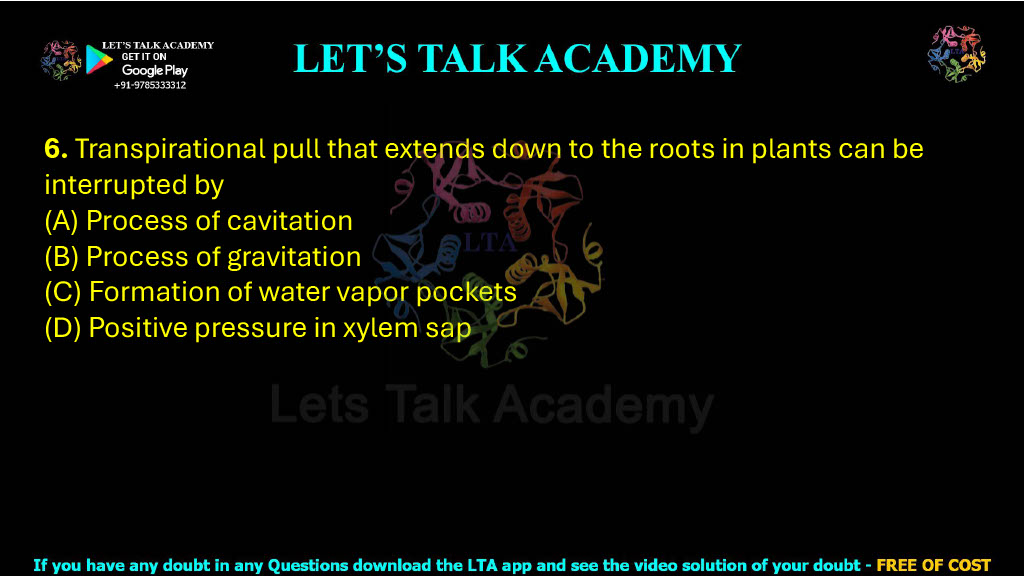
6. Transpirational pull that extends down to the roots in plants can be interrupted by
(A) Process of cavitation
(B) Process of gravitation
(C) Formation of water vapor pockets
(D) Positive pressure in xylem sap
Transpirational Pull in Plants and the Role of Cavitation
Introduction
Water transport from the roots to the leaves is one of the most remarkable physiological processes in higher plants. Large trees such as redwoods and eucalyptus transport water over heights exceeding 100 meters without the help of any mechanical pump. This upward movement of water is explained by the cohesion-tension theory, proposed by Dixon and Joly. According to this theory, evaporation of water from the leaf surface creates a negative pressure or tension that pulls a continuous column of water upward through the xylem vessels. This force is known as the transpirational pull.
The effectiveness of transpirational pull depends on the continuity of the water column inside the xylem. Water molecules remain connected through cohesive forces created by hydrogen bonding, while adhesion between water molecules and xylem walls provides additional stability. If this continuous column breaks, water transport is disrupted, reducing the supply of water to leaves and affecting photosynthesis, mineral transport, and plant growth. One of the major causes of this disruption is cavitation, a phenomenon that produces air bubbles within the xylem vessels.
Correct Answer
Correct Option: (A) Process of cavitation
Detailed Explanation
Transpirational pull depends on the presence of a continuous column of water extending from the roots to the leaves through the xylem vessels. As water evaporates from the stomata during transpiration, tension develops in the xylem, pulling water upward. This mechanism works efficiently only when the water column remains unbroken.
Cavitation is the process in which the continuous water column inside the xylem breaks because of the formation of air bubbles or gas-filled cavities. These bubbles block the movement of water through the xylem, producing a condition known as xylem embolism. When embolism develops, the transpirational pull cannot be transmitted effectively from the leaves to the roots, resulting in reduced water transport and sometimes wilting of the plant.
Cavitation usually occurs under conditions of severe water stress, drought, freezing temperatures, or mechanical injury. During periods of high transpiration and low soil moisture, the tension within the xylem becomes extremely high, increasing the likelihood of air entering the vessels and causing cavitation.
Although the formation of air or water vapor pockets is associated with cavitation, the recognized physiological process responsible for interrupting transpirational pull is specifically termed cavitation. Therefore, option (A) provides the most accurate scientific answer.
Explanation of Each Option
Option (A): Process of Cavitation
This option is correct. Cavitation breaks the continuous water column inside xylem vessels through the formation of air bubbles, preventing efficient transmission of transpirational pull.
Option (B): Process of Gravitation
This option is incorrect. Gravity opposes the upward movement of water but does not interrupt the transpirational pull mechanism. Plants overcome gravitational force through the tension generated during transpiration.
Option (C): Formation of Water Vapor Pockets
This option is incorrect. Water vapor or gas pockets develop during cavitation, but the actual physiological process responsible for disrupting water transport is known as cavitation. Therefore, this option is less accurate than option (A).
Option (D): Positive Pressure in Xylem Sap
This option is incorrect. Positive pressure, such as root pressure, actually assists water movement under certain conditions and does not interrupt transpirational pull.
Why Option (A) is Correct
Cavitation destroys the continuity of the xylem water column by producing air-filled embolisms. Since the cohesion-tension mechanism requires an uninterrupted column of water, cavitation directly interrupts transpirational pull and reduces water transport from roots to leaves.
Why the Other Options are Incorrect
Why Option (B) is Incorrect
Gravity acts continuously on water but does not break the water column or interrupt the cohesion-tension mechanism.
Why Option (C) is Incorrect
Water vapor pockets are a consequence of cavitation rather than the scientific term describing the process itself.
Why Option (D) is Incorrect
Positive pressure generated in the xylem, especially root pressure, supports rather than disrupts upward water movement.
Comparison of All Options
| Option | Process | Effect on Transpirational Pull | Correct or Incorrect |
|---|---|---|---|
| A | Cavitation | Breaks xylem water column and interrupts transport | Correct |
| B | Gravitation | Opposes water movement but does not break the water column | Incorrect |
| C | Water Vapor Pockets | Result of cavitation, not the actual process | Incorrect |
| D | Positive Xylem Pressure | May assist water movement through root pressure | Incorrect |
Steps in the Cohesion-Tension Mechanism
| Step | Event |
|---|---|
| 1 | Water is absorbed by root hairs |
| 2 | Water enters the xylem vessels |
| 3 | Transpiration occurs through stomata |
| 4 | Negative pressure develops in leaf xylem |
| 5 | Cohesion transmits the pull downward through the continuous water column |
| 6 | Water moves upward from roots to leaves |
Factors Responsible for Cavitation
| Factor | Effect |
|---|---|
| Severe Drought | Increases xylem tension and embolism |
| Freezing Temperature | Promotes gas bubble formation |
| Mechanical Injury | Damages xylem vessels |
| High Transpiration Rate | Raises negative pressure in xylem |
| Water Stress | Enhances risk of cavitation |
Comparison Between Cohesion and Cavitation
| Feature | Cohesion | Cavitation |
|---|---|---|
| Definition | Attraction between water molecules | Formation of air bubbles in xylem |
| Effect | Maintains continuous water column | Breaks water column |
| Importance | Supports ascent of sap | Interrupts water transport |
| Result | Efficient transpiration | Xylem embolism and reduced water movement |
Biological Significance
Cavitation represents one of the major limitations to efficient water transport in vascular plants. Although plants possess mechanisms such as bordered pits, new xylem formation, and root pressure to reduce or repair embolisms, excessive cavitation can severely impair water transport, decrease photosynthetic efficiency, reduce growth, and even lead to plant death during prolonged drought. The ability of different plant species to resist cavitation is an important adaptation that determines their survival under arid and changing climatic conditions.
Final Answer
Correct Option: (A) Process of cavitation
The process of cavitation interrupts transpirational pull by causing the formation of air bubbles within the xylem vessels. These air-filled embolisms break the continuous water column required for the cohesion-tension mechanism, thereby reducing or completely blocking the upward transport of water from the roots to the leaves.


