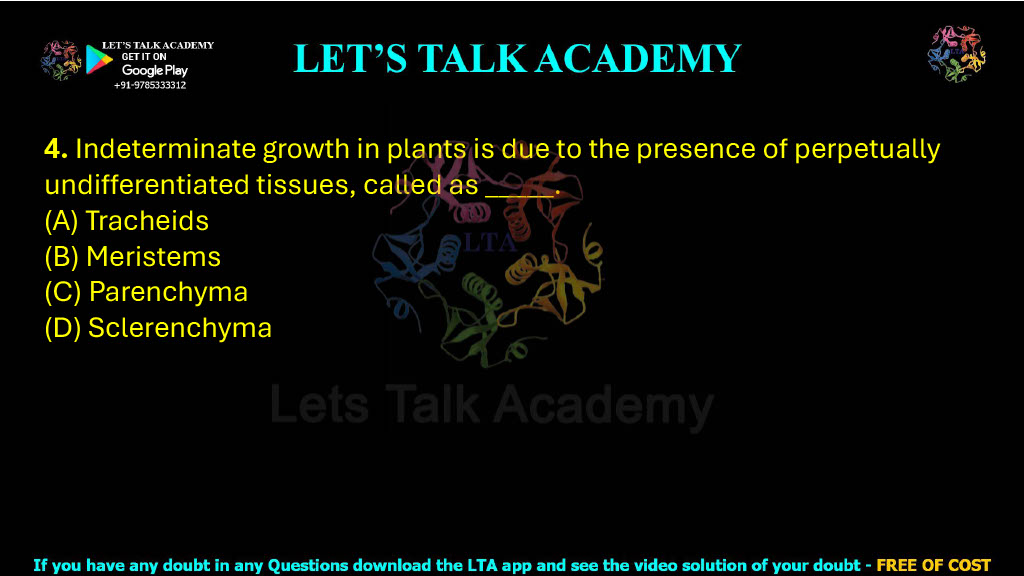
4. Indeterminate growth in plants is due to the presence of perpetually undifferentiated tissues, called as _____.
(A) Tracheids
(B) Meristems
(C) Parenchyma
(D) Sclerenchyma
Meristems are Responsible for Indeterminate Growth in Plants
Introduction
One of the most remarkable characteristics that distinguishes plants from most animals is their ability to grow continuously throughout their lifetime. Unlike animals, whose growth generally stops after reaching maturity, plants possess the unique ability to produce new leaves, stems, branches, roots, flowers, and vascular tissues year after year. This phenomenon is known as indeterminate growth, and it enables plants to adapt continuously to changing environmental conditions such as light availability, nutrient supply, mechanical injury, and seasonal variations.
The secret behind this continuous growth lies in the presence of specialized groups of actively dividing cells called meristems or meristematic tissues. These tissues remain permanently undifferentiated and retain their ability to divide throughout the life of the plant. As daughter cells produced by the meristem mature, they differentiate into specialized tissues such as epidermis, xylem, phloem, cortex, and supportive tissues. Therefore, meristems function as the primary source of all new cells in plants.
Correct Answer
Correct Option: (B) Meristems
Detailed Explanation
Meristems are specialized regions of actively dividing cells responsible for continuous plant growth. These cells possess thin primary cell walls, dense cytoplasm, prominent nuclei, and very small or absent vacuoles. Most importantly, meristematic cells remain undifferentiated and retain the capacity for repeated cell division throughout the life of the plant.
As these cells divide, some daughter cells continue to remain meristematic, while others differentiate into permanent tissues such as parenchyma, collenchyma, sclerenchyma, xylem, and phloem. This continuous production of new cells allows plants to exhibit indeterminate growth, meaning they continue growing as long as favorable environmental conditions exist.
There are three major types of meristems based on their position and function. Apical meristems, located at the tips of roots and shoots, are responsible for primary growth and increase the length of the plant. Lateral meristems, including vascular cambium and cork cambium, contribute to secondary growth by increasing stem and root thickness. Intercalary meristems, commonly found in grasses, enable rapid elongation after grazing or cutting.
The remaining options are permanent tissues that have already differentiated and therefore cannot sustain continuous plant growth.
Explanation of Each Option
Option (A): Tracheids
This option is incorrect. Tracheids are elongated dead cells that form part of the xylem tissue. Their primary function is the conduction of water and minerals and providing mechanical support. They do not undergo cell division.
Option (B): Meristems
This option is correct. Meristems consist of perpetually dividing, undifferentiated cells responsible for continuous growth and formation of all permanent plant tissues.
Option (C): Parenchyma
This option is incorrect. Parenchyma consists of living, differentiated cells involved in storage, photosynthesis, secretion, and wound healing. Although some parenchyma cells may regain the ability to divide under special conditions, they are not responsible for normal indeterminate growth.
Option (D): Sclerenchyma
This option is incorrect. Sclerenchyma consists of dead cells with thick lignified walls that provide mechanical strength. These cells have permanently lost their capacity for cell division.
Why Option (B) is Correct
Meristematic tissues remain permanently embryonic and continuously divide to produce new cells. Because these tissues persist throughout the life of the plant, they enable unlimited vegetative growth and the continuous formation of new organs, making them responsible for indeterminate growth.
Why the Other Options are Incorrect
Why Option (A) is Incorrect
Tracheids are mature xylem elements specialized for water transport and support. They are dead at maturity and cannot divide.
Why Option (C) is Incorrect
Parenchyma is a permanent tissue whose cells have already differentiated and normally do not contribute to continuous growth.
Why Option (D) is Incorrect
Sclerenchyma provides rigidity and strength but consists of dead, highly specialized cells incapable of mitosis.
Comparison of All Options
| Option | Tissue | Main Function | Correct or Incorrect |
|---|---|---|---|
| A | Tracheids | Water conduction and support | Incorrect |
| B | Meristems | Continuous cell division and plant growth | Correct |
| C | Parenchyma | Storage, photosynthesis and healing | Incorrect |
| D | Sclerenchyma | Mechanical support | Incorrect |
Types of Meristems
| Meristem | Location | Function |
|---|---|---|
| Apical Meristem | Root and shoot tips | Primary growth and increase in length |
| Lateral Meristem | Stem and root sides | Secondary growth and increase in girth |
| Intercalary Meristem | Base of leaves and internodes | Rapid elongation and regeneration |
Characteristics of Meristematic Cells
| Characteristic | Description |
|---|---|
| Cell Division | Actively dividing throughout life |
| Cell Wall | Thin primary wall |
| Nucleus | Large and prominent |
| Cytoplasm | Dense cytoplasm |
| Vacuoles | Very small or absent |
| Differentiation | Remain undifferentiated until required |
Permanent Plant Tissues Derived from Meristems
| Permanent Tissue | Major Function |
|---|---|
| Parenchyma | Storage and photosynthesis |
| Collenchyma | Flexible mechanical support |
| Sclerenchyma | Rigid mechanical strength |
| Xylem | Transport of water and minerals |
| Phloem | Transport of food |
Biological Significance
Meristems provide plants with extraordinary developmental flexibility. Continuous cell division allows plants to replace damaged tissues, produce new leaves and branches, develop flowers and fruits, and respond effectively to environmental changes. Secondary growth generated by lateral meristems enables trees to attain massive sizes and survive for hundreds or even thousands of years. Without meristematic tissues, plants would exhibit determinate growth similar to animals and would lose their remarkable regenerative capacity.
Final Answer
Correct Option: (B) Meristems
Indeterminate growth in plants is possible because of the presence of meristems, specialized tissues composed of continuously dividing, undifferentiated cells. These cells generate all permanent plant tissues and enable plants to grow throughout their lifetime by producing new roots, shoots, leaves, flowers, and vascular tissues.


