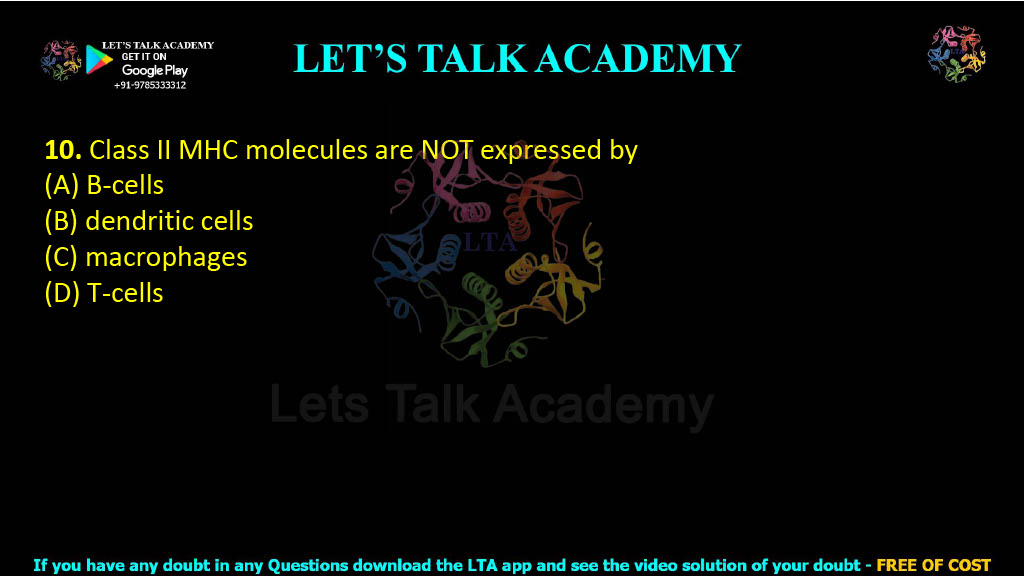
10. Class II MHC molecules are NOT expressed by
(A) B-cells
(B) dendritic cells
(C) macrophages
(D) T-cells
Class II MHC Molecules Are Not Expressed by T Cells
Introduction
The Major Histocompatibility Complex (MHC) is one of the most important components of the adaptive immune system. MHC molecules are specialized membrane glycoproteins that present antigenic peptides to T lymphocytes, allowing the immune system to distinguish self from non-self. Antigen presentation is essential for activating T cells and initiating antigen-specific immune responses against pathogens, tumors, and infected cells.
There are two major classes of MHC molecules in humans: MHC Class I and MHC Class II. MHC Class I molecules are expressed on nearly all nucleated cells and present endogenous antigens to CD8+ cytotoxic T cells. In contrast, MHC Class II molecules are expressed primarily on professional antigen-presenting cells (APCs), including dendritic cells, macrophages, and B lymphocytes. These molecules present extracellular antigens to CD4+ helper T cells and play a central role in initiating adaptive immune responses.
Correct Answer
Correct Option: (D) T-cells
Detailed Explanation
Major Histocompatibility Complex Class II (MHC-II) molecules are expressed mainly on professional antigen-presenting cells (APCs). These include dendritic cells, macrophages, and B lymphocytes. Their primary function is to present peptides derived from extracellular pathogens to CD4+ helper T lymphocytes. Recognition of these peptide-MHC Class II complexes activates helper T cells, which subsequently stimulate B cells, macrophages, and other immune cells to mount an effective immune response.
Unlike professional antigen-presenting cells, T cells normally do not express MHC Class II molecules. Instead, T lymphocytes recognize antigens presented by MHC molecules on other cells. Helper T cells recognize antigens presented on MHC Class II molecules, whereas cytotoxic T cells recognize antigens presented on MHC Class I molecules. Therefore, T cells function as antigen-recognizing lymphocytes rather than antigen-presenting cells.
Because T cells are not professional antigen-presenting cells under normal physiological conditions, they do not constitutively express MHC Class II molecules.
Explanation of Each Option
Option (A): B Cells
This statement is incorrect because B lymphocytes are professional antigen-presenting cells. They internalize specific antigens through their B-cell receptors, process these antigens, and present peptide fragments on MHC Class II molecules to CD4+ helper T cells. This interaction is essential for antibody production and B-cell activation.
Option (B): Dendritic Cells
This statement is incorrect because dendritic cells are the most efficient professional antigen-presenting cells. They express abundant MHC Class II molecules and initiate primary immune responses by activating naïve CD4+ helper T cells.
Option (C): Macrophages
This statement is incorrect because macrophages express MHC Class II molecules after engulfing pathogens. They process microbial proteins and present antigenic peptides to helper T cells, thereby coordinating innate and adaptive immunity.
Option (D): T Cells
This statement is correct. Mature T lymphocytes normally do not express MHC Class II molecules. Their role is to recognize peptide-MHC complexes presented by professional antigen-presenting cells rather than to present antigens themselves.
Why Option (D) is Correct
T cells function as antigen-responsive lymphocytes rather than antigen-presenting cells. MHC Class II molecules are restricted primarily to professional APCs such as dendritic cells, macrophages, and B cells. Therefore, T cells normally lack constitutive expression of MHC Class II molecules.
Why the Other Options are Incorrect
Why Option (A) is Incorrect
B cells express MHC Class II molecules and present processed antigens to helper T cells.
Why Option (B) is Incorrect
Dendritic cells are the most potent professional antigen-presenting cells and express abundant MHC Class II molecules.
Why Option (C) is Incorrect
Macrophages express MHC Class II molecules to activate CD4+ helper T cells after phagocytosing pathogens.
Comparison of All Options
| Option | Cell Type | Expresses MHC Class II? | Correct or Incorrect |
|---|---|---|---|
| A | B Cells | Yes | Incorrect |
| B | Dendritic Cells | Yes | Incorrect |
| C | Macrophages | Yes | Incorrect |
| D | T Cells | No | Correct |
Professional Antigen-Presenting Cells
| Cell Type | MHC Class II Expression | Major Function |
|---|---|---|
| Dendritic Cells | Present | Activate naïve CD4+ T cells |
| Macrophages | Present | Present phagocytosed antigens |
| B Cells | Present | Present specific antigens during antibody responses |
| T Cells | Absent (normally) | Recognize antigen-MHC complexes |
Difference Between MHC Class I and MHC Class II
| Feature | MHC Class I | MHC Class II |
|---|---|---|
| Expression | All nucleated cells | Professional APCs |
| Presents | Endogenous antigens | Exogenous antigens |
| Recognized By | CD8+ Cytotoxic T Cells | CD4+ Helper T Cells |
| Main Function | Elimination of infected cells | Activation of helper T cells |
Biological Significance of MHC Class II Molecules
MHC Class II molecules are essential for initiating adaptive immune responses against extracellular pathogens. They enable professional antigen-presenting cells to communicate with helper T lymphocytes, leading to cytokine production, macrophage activation, B-cell differentiation, antibody production, and immune memory. Defects in MHC Class II expression result in severe immunodeficiency, while inappropriate antigen presentation contributes to autoimmune diseases and transplant rejection.
Final Answer
Correct Option: (D) T-cells
Class II MHC molecules are expressed primarily on professional antigen-presenting cells, including dendritic cells, macrophages, and B lymphocytes. Mature T cells do not normally express MHC Class II molecules, making them the correct answer to this question.


