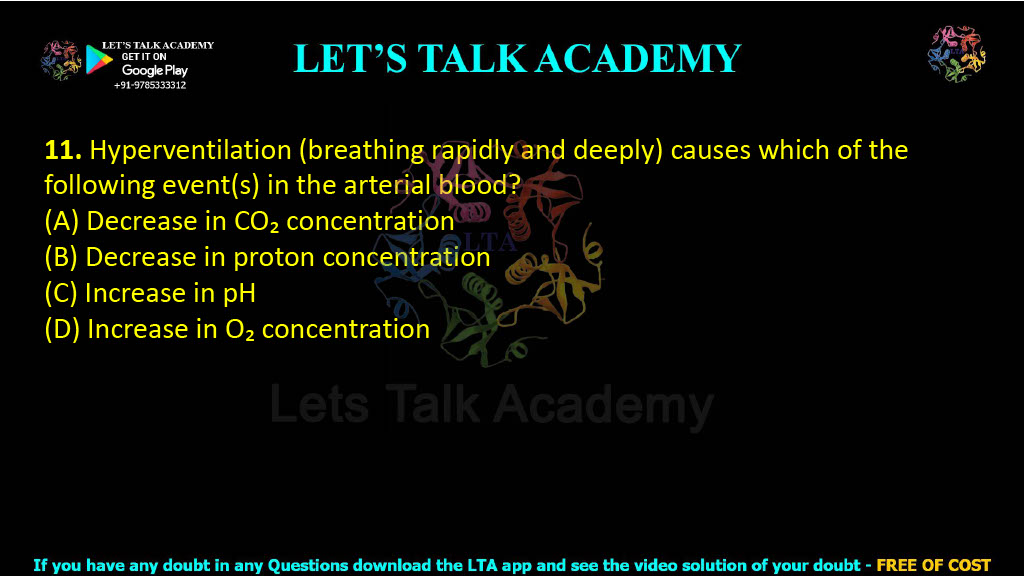
11. Hyperventilation (breathing rapidly and deeply) causes which of the following event(s) in the arterial blood?
(A) Decrease in CO₂ concentration
(B) Decrease in proton concentration
(C) Increase in pH
(D) Increase in O₂ concentration
Effects of Hyperventilation on Arterial Blood
Introduction
Respiration is one of the most essential physiological processes responsible for maintaining oxygen supply and carbon dioxide removal from the body. Besides gas exchange, the respiratory system plays a critical role in regulating the acid-base balance of blood. The concentration of carbon dioxide (CO₂) directly influences the concentration of hydrogen ions (H⁺), making breathing an important regulator of blood pH.
Hyperventilation refers to breathing that is faster and deeper than normal. During hyperventilation, excessive amounts of carbon dioxide are expelled from the lungs. Since carbon dioxide participates in the bicarbonate buffer system, its excessive removal alters blood chemistry, decreases hydrogen ion concentration, and increases blood pH, producing a condition known as respiratory alkalosis.
Correct Answer
Correct Options: (A), (B) and (C)
Detailed Explanation
Hyperventilation increases alveolar ventilation beyond the body’s metabolic requirement. As a result, carbon dioxide is removed from the blood more rapidly than it is produced by cellular respiration. This causes the partial pressure of carbon dioxide (PaCO₂) in arterial blood to decrease.
The bicarbonate buffer system is represented by the following reversible reaction:
CO₂ + H₂O ⇌ H₂CO₃ ⇌ H⁺ + HCO₃⁻
When carbon dioxide decreases, the equilibrium shifts toward the left, reducing the formation of carbonic acid (H₂CO₃) and hydrogen ions (H⁺). Consequently, the hydrogen ion concentration falls and the blood becomes more alkaline. Therefore, arterial blood pH increases, producing respiratory alkalosis.
Although hyperventilation may slightly increase the amount of dissolved oxygen in plasma, arterial hemoglobin is already nearly fully saturated under normal physiological conditions. Therefore, arterial oxygen concentration does not increase significantly, making option (D) incorrect in the context of this question.
Explanation of Each Option
Option (A): Decrease in CO₂ Concentration
This statement is correct. Hyperventilation removes carbon dioxide rapidly from the lungs, decreasing arterial partial pressure of carbon dioxide (PaCO₂). This is the primary physiological effect of hyperventilation.
Option (B): Decrease in Proton Concentration
This statement is correct. As carbon dioxide levels decrease, less carbonic acid is formed, resulting in fewer hydrogen ions being produced. Therefore, arterial hydrogen ion concentration decreases.
Option (C): Increase in pH
This statement is correct. Since hydrogen ion concentration decreases, arterial blood becomes more alkaline, leading to an increase in blood pH. This condition is known as respiratory alkalosis.
Option (D): Increase in O₂ Concentration
This statement is incorrect. Under normal conditions, arterial hemoglobin is already approximately 97–99% saturated with oxygen. Hyperventilation produces only a minimal increase in dissolved oxygen, which is physiologically insignificant. Therefore, oxygen concentration does not increase appreciably.
Why Options (A), (B), and (C) are Correct
Hyperventilation primarily affects carbon dioxide removal. The reduction in CO₂ shifts the bicarbonate buffer equilibrium, lowering hydrogen ion concentration and increasing blood pH. These three events occur simultaneously and are characteristic features of respiratory alkalosis.
Why Option (D) is Incorrect
Hyperventilation cannot substantially increase arterial oxygen content because hemoglobin is already nearly saturated under normal breathing conditions. The principal effect of hyperventilation is removal of CO₂ rather than increasing oxygen delivery.
Comparison of All Options
| Option | Physiological Change | Occurs During Hyperventilation? | Correct or Incorrect |
|---|---|---|---|
| A | Decrease in CO₂ concentration | Yes | Correct |
| B | Decrease in H⁺ concentration | Yes | Correct |
| C | Increase in blood pH | Yes | Correct |
| D | Increase in O₂ concentration | No significant increase | Incorrect |
Bicarbonate Buffer System
| Reaction | Effect of Hyperventilation |
|---|---|
| CO₂ + H₂O ⇌ H₂CO₃ | CO₂ decreases, reducing carbonic acid formation |
| H₂CO₃ ⇌ H⁺ + HCO₃⁻ | Hydrogen ion concentration decreases |
| Blood pH | Increases (Respiratory Alkalosis) |
Physiological Changes During Hyperventilation
| Parameter | Change |
|---|---|
| Respiratory Rate | Increases |
| Alveolar Ventilation | Increases |
| Arterial CO₂ (PaCO₂) | Decreases |
| Hydrogen Ion Concentration | Decreases |
| Blood pH | Increases |
| Arterial Oxygen Saturation | Minimal or no significant increase |
Biological Significance of Hyperventilation
Hyperventilation is an important compensatory mechanism during certain physiological conditions such as exercise, high altitude adaptation, metabolic acidosis, and anxiety. However, excessive hyperventilation may produce respiratory alkalosis, cerebral vasoconstriction, dizziness, tingling sensations, muscle cramps, and even temporary loss of consciousness due to reduced cerebral blood flow. Therefore, maintaining an appropriate balance between ventilation and metabolic demand is essential for normal physiological function.
Final Answer
Correct Options: (A), (B) and (C)
Hyperventilation causes excessive elimination of carbon dioxide from the blood. This decreases arterial CO₂ concentration, reduces hydrogen ion concentration through the bicarbonate buffer system, and increases blood pH, producing respiratory alkalosis. The increase in arterial oxygen concentration is minimal and not considered a significant physiological consequence of hyperventilation.


