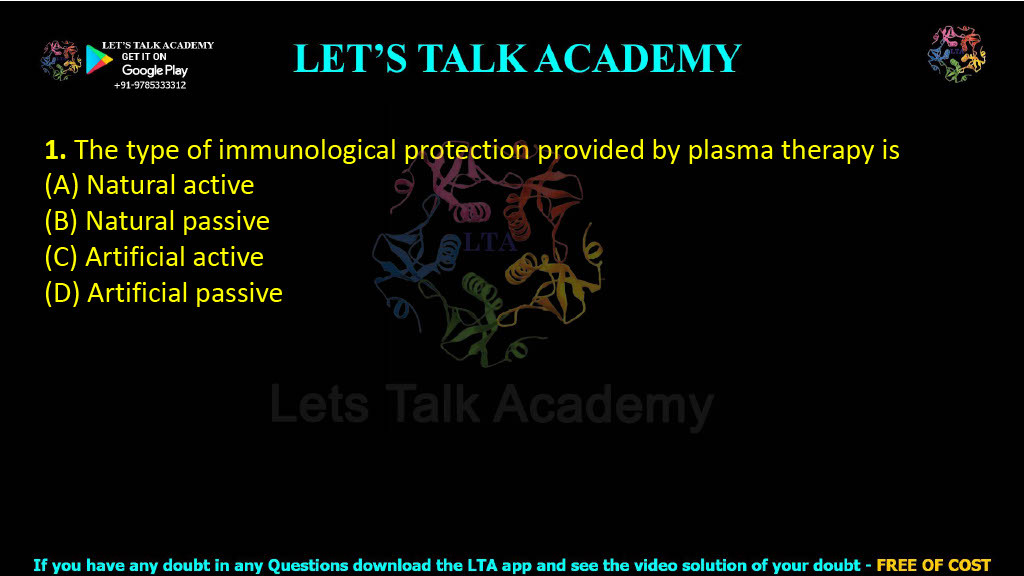
1. The type of immunological protection provided by plasma therapy is
(A) Natural active
(B) Natural passive
(C) Artificial active
(D) Artificial passive
Plasma Therapy Provides Artificial Passive Immunity
Introduction
The human immune system protects the body against bacteria, viruses, fungi, parasites, and other disease-causing microorganisms through highly coordinated innate and adaptive immune responses. Adaptive immunity can be acquired either naturally or artificially and may be active or passive depending on how immunity is obtained. Understanding these different types of immunity is fundamental in immunology because they determine the duration of protection, memory response, and clinical applications in disease prevention and treatment.
One important medical approach is plasma therapy, also known as convalescent plasma therapy. In this procedure, plasma collected from individuals who have recovered from a disease is transfused into infected or susceptible patients. Since the donated plasma already contains disease-specific antibodies, the recipient receives immediate protection without producing antibodies on their own. This type of immunity is classified as artificial passive immunity.
Correct Answer
Correct Option: (D) Artificial Passive
Detailed Explanation
Plasma therapy involves transferring antibodies from the plasma of an immune individual to another person. The recipient receives ready-made antibodies instead of producing them through activation of their own immune system. Because the antibodies are supplied externally, immunity develops immediately but remains temporary, as the transferred antibodies gradually degrade and are not continuously produced by the recipient.
This form of immunity is considered passive immunity because antibodies are transferred directly rather than being synthesized by the recipient’s B lymphocytes. It is classified as artificial because the antibodies are administered through a medical procedure rather than acquired naturally. Therefore, plasma therapy provides artificial passive immunity.
During outbreaks of infectious diseases such as COVID-19, Ebola, and certain viral infections, convalescent plasma has been used to provide immediate immune protection for selected patients. Although its effectiveness depends on the disease and antibody levels, the immunological principle remains the same—external transfer of preformed antibodies.
Explanation of Each Option
Option (A): Natural Active Immunity
This statement is incorrect. Natural active immunity develops when a person becomes naturally infected by a pathogen. The immune system recognizes foreign antigens, activates B and T lymphocytes, produces antibodies, and forms memory cells. Recovery from diseases such as chickenpox generally produces natural active immunity. Plasma therapy does not stimulate antibody production by the recipient and therefore is not active immunity.
Option (B): Natural Passive Immunity
This statement is incorrect. Natural passive immunity occurs when antibodies are transferred naturally from mother to child through the placenta during pregnancy or through breast milk after birth. Since plasma therapy involves medical administration of donor plasma rather than natural transfer, it is not natural passive immunity.
Option (C): Artificial Active Immunity
This statement is incorrect. Artificial active immunity develops after vaccination. Vaccines contain antigens that stimulate the recipient’s immune system to produce antibodies and long-lasting memory cells. Plasma therapy supplies antibodies directly without stimulating active immune memory.
Option (D): Artificial Passive Immunity
This statement is correct. Plasma therapy transfers preformed antibodies from an immune donor to a recipient through a medical procedure. The recipient receives immediate but temporary protection because the transferred antibodies gradually disappear over time and immunological memory is not generated.
Why Option (D) is Correct
Artificial passive immunity is defined as the administration of preformed antibodies through medical intervention. Plasma therapy perfectly fits this definition because antibodies collected from recovered individuals are transfused into another person, providing rapid protection without activating the recipient’s adaptive immune response.
Why the Other Options are Incorrect
Why Option (A) is Incorrect
Natural active immunity develops after natural infection and involves antibody production by the individual’s own immune system.
Why Option (B) is Incorrect
Natural passive immunity occurs only through maternal transfer of antibodies via the placenta or breast milk.
Why Option (C) is Incorrect
Artificial active immunity results from vaccination, where the immune system actively produces antibodies and memory cells.
Comparison of All Options
| Option | Type of Immunity | Correct or Incorrect | Reason |
|---|---|---|---|
| A | Natural Active | Incorrect | Develops after natural infection. |
| B | Natural Passive | Incorrect | Occurs through maternal antibody transfer. |
| C | Artificial Active | Incorrect | Produced after vaccination. |
| D | Artificial Passive | Correct | Ready-made antibodies are transferred through plasma therapy. |
Types of Acquired Immunity
| Type of Immunity | How It Is Acquired | Examples |
|---|---|---|
| Natural Active | Natural infection | Recovery from measles, chickenpox |
| Natural Passive | Maternal antibody transfer | Placental IgG, breast milk IgA |
| Artificial Active | Vaccination | BCG, Hepatitis B vaccine, COVID-19 vaccine |
| Artificial Passive | Injection or transfusion of antibodies | Plasma therapy, antivenom, rabies immunoglobulin, tetanus immunoglobulin |
Active Immunity vs Passive Immunity
| Feature | Active Immunity | Passive Immunity |
|---|---|---|
| Source of Antibodies | Produced by the individual’s own immune system | Received from another individual |
| Memory Cells Formed | Yes | No |
| Onset of Protection | Slow | Immediate |
| Duration of Protection | Long-lasting | Short-term |
| Examples | Natural infection, vaccination | Plasma therapy, immunoglobulin therapy |
Biological Significance of Plasma Therapy
Plasma therapy provides rapid protection during situations where immediate immunity is required and there is insufficient time for the recipient to develop an active immune response. It has been used in the management of several infectious diseases and toxin-mediated conditions. Although passive immunity does not generate immunological memory, it can reduce disease severity, neutralize pathogens or toxins, and provide temporary protection until the recipient’s immune system becomes effective or other treatments take effect.
Final Answer
Correct Option: (D) Artificial Passive
Plasma therapy provides artificial passive immunity because it involves the medical transfer of preformed antibodies from an immune donor to a recipient. The protection is immediate but temporary, and no immunological memory is generated because the recipient does not actively produce the antibodies.


