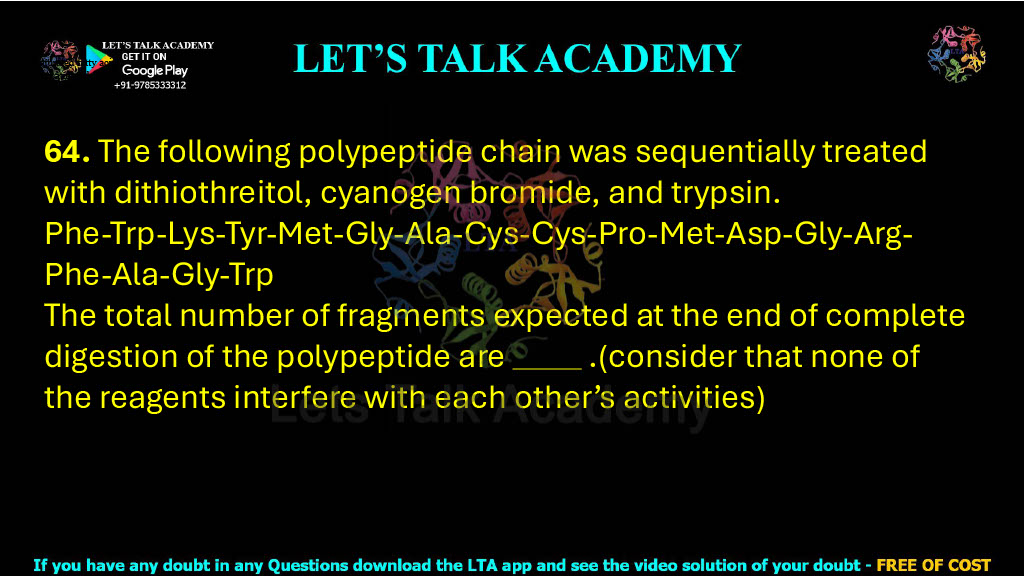
64. The following polypeptide chain was sequentially treated with dithiothreitol, cyanogen bromide, and trypsin.
Phe-Trp-Lys-Tyr-Met-Gly-Ala-Cys-Cys-Pro-Met-Asp-Gly-Arg-Phe-Ala-Gly-Trp
The total number of fragments expected at the end of complete digestion of the polypeptide are .(consider that none of the reagents interfere with each other’s activities)
How Many Peptide Fragments Are Produced After Sequential Treatment with DTT, Cyanogen Bromide, and Trypsin?
Correct Answer
5 Fragments
Introduction
Protein sequencing and structural characterization frequently involve selective cleavage of peptide chains using chemical reagents and proteolytic enzymes. Each reagent recognizes a specific amino acid residue and cleaves peptide bonds at predictable positions. By combining multiple cleavage methods, scientists can determine protein sequences, identify peptide domains, and analyze protein structures with remarkable accuracy.
In this problem, the peptide is treated sequentially with dithiothreitol (DTT), cyanogen bromide (CNBr), and trypsin. Each reagent has a unique role. DTT reduces disulfide bonds, cyanogen bromide specifically cleaves at the C-terminal side of methionine, and trypsin hydrolyzes peptide bonds on the C-terminal side of lysine and arginine, except when followed by proline.
Understanding the Concept Behind the Question
The peptide sequence is:
Phe–Trp–Lys–Tyr–Met–Gly–Ala–Cys–Cys–Pro–Met–Asp–Gly–Arg–Phe–Ala–Gly–Trp
First identify all cleavage sites.
Step 1. Action of Dithiothreitol (DTT)
DTT is a reducing agent.
It reduces disulfide bonds (–S–S–) between cysteine residues.
In the given peptide, the two cysteine residues occur as:
Cys–Cys
These cysteines are adjacent in the primary sequence and do not form an intramolecular disulfide bond with each other because they are already linked by peptide bonds.
Therefore, DTT does not cleave the peptide chain and produces no additional fragments.
Number of fragments after DTT = 1
Step 2. Action of Cyanogen Bromide (CNBr)
Cyanogen bromide specifically cleaves after methionine (Met) residues.
The sequence contains two methionine residues.
Phe–Trp–Lys–Tyr–Met | Gly–Ala–Cys–Cys–Pro–Met | Asp–Gly–Arg–Phe–Ala–Gly–Trp
Thus, CNBr introduces two cleavage sites.
The peptide is divided into:
Fragment 1
Phe–Trp–Lys–Tyr–Met
Fragment 2
Gly–Ala–Cys–Cys–Pro–Met
Fragment 3
Asp–Gly–Arg–Phe–Ala–Gly–Trp
Therefore,
Number of fragments after CNBr = 3
Step 3. Action of Trypsin
Trypsin cleaves at the C-terminal side of Lys (K) and Arg (R) unless the next amino acid is Proline (P).
Now examine each fragment separately.
Fragment 1
Phe–Trp–Lys–Tyr–Met
Lys is followed by Tyr.
Therefore, trypsin cleaves after Lys.
Result:
Phe–Trp–Lys
Tyr–Met
Fragment 1 becomes 2 fragments.
Fragment 2
Gly–Ala–Cys–Cys–Pro–Met
There is no Lys or Arg.
Therefore,
No cleavage occurs.
Fragment 2 remains 1 fragment.
Fragment 3
Asp–Gly–Arg–Phe–Ala–Gly–Trp
Arg is followed by Phe.
Therefore, trypsin cleaves after Arg.
Result:
Asp–Gly–Arg
Phe–Ala–Gly–Trp
Fragment 3 becomes 2 fragments.
Step 4. Count the Final Number of Fragments
After complete digestion:
- Fragment 1 → 2 fragments
- Fragment 2 → 1 fragment
- Fragment 3 → 2 fragments
Total:
2 + 1 + 2 = 5 fragments
Final Calculation
Total Number of Fragments = 5
Why Doesn’t DTT Increase the Number of Fragments?
DTT only reduces disulfide bonds.
It does not hydrolyze peptide bonds.
Since the two cysteine residues are adjacent in the primary sequence and no disulfide bridge is specified, reduction by DTT does not separate the peptide chain into additional fragments.
Therefore, only CNBr and trypsin contribute to peptide fragmentation.
Cleavage Specificities Used
Dithiothreitol (DTT)
- Reduces disulfide bonds
- Does not cleave peptide bonds
Cyanogen Bromide (CNBr)
- Cleaves at the C-terminal side of Methionine (Met)
Trypsin
- Cleaves at the C-terminal side of Lysine (Lys) and Arginine (Arg)
- No cleavage when Lys or Arg is followed by Proline
Biological Importance
Selective cleavage of proteins is fundamental in protein sequencing, mass spectrometry, structural biology, and proteomics. Chemical reagents such as cyanogen bromide and enzymes like trypsin generate predictable peptide fragments that enable researchers to reconstruct complete amino acid sequences. DTT is routinely used before proteolytic digestion to reduce disulfide bonds, ensuring efficient unfolding of proteins and improving accessibility of cleavage sites during proteomic analyses.
High-Yield Points
- DTT reduces disulfide bonds only.
- DTT does not hydrolyze peptide bonds.
- CNBr cleaves after Methionine.
- Trypsin cleaves after Lysine and Arginine.
- Trypsin does not cleave if Lys/Arg is followed by Proline.
- Number of fragments equals number of cleavage sites + 1 for each independent peptide.
Frequently Asked Questions
Why doesn’t DTT increase the number of peptide fragments?
DTT only reduces disulfide bridges between cysteine residues. It does not break peptide bonds. Since no disulfide-linked chains are present in this peptide, the number of peptide fragments remains unchanged.
Why does cyanogen bromide cleave only after methionine?
CNBr reacts specifically with the sulfur atom present in the methionine side chain, producing selective cleavage at the C-terminal side of methionine.
Why is trypsin highly specific?
Trypsin recognizes the positively charged side chains of lysine and arginine, cleaving peptide bonds immediately after these amino acids unless the next residue is proline.
Key Takeaways
The peptide is first treated with DTT, which reduces disulfide bonds but does not cleave peptide bonds, leaving the chain intact. Cyanogen bromide then cleaves after the two methionine residues, producing three peptide fragments. Finally, trypsin cleaves after the lysine residue in the first fragment and the arginine residue in the third fragment, while the middle fragment remains unchanged because it contains neither lysine nor arginine. Consequently, the complete sequential digestion produces five peptide fragments.
Final Answer
Total Number of Fragments = 5
Explanation
The peptide contains two methionine residues, so cyanogen bromide cleaves the chain at two positions, producing three fragments. Trypsin subsequently cleaves after the lysine residue in the first fragment and after the arginine residue in the third fragment, generating two additional fragments. DTT only reduces disulfide bonds and does not hydrolyze peptide bonds; therefore, it does not increase the number of fragments. The final number of peptide fragments obtained after complete sequential digestion is:
2 + 1 + 2 = 5 fragments.


