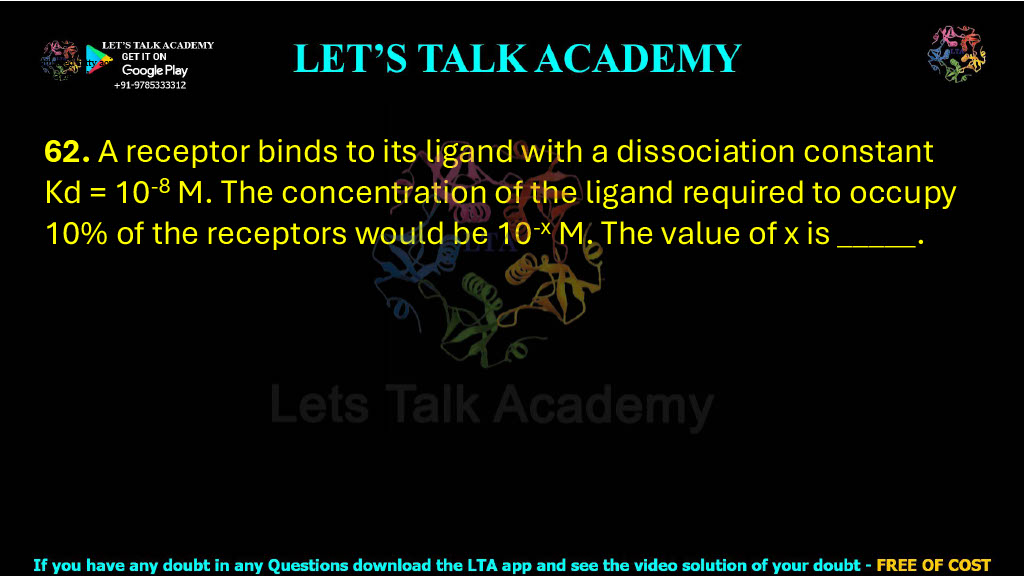
62. A receptor binds to its ligand with a dissociation constant Kd = 10-8 M. The concentration of the ligand required to occupy 10% of the receptors would be 10-x M. The value of x is ______ .
How to Calculate Ligand Concentration from Dissociation Constant (Kd)?
Correct Answer
x = 8.95 (≈ 9.0)
Ligand concentration = 1.11 × 10⁻⁹ M
Introduction
The interaction between a receptor and its ligand is one of the most fundamental processes in cell biology, biochemistry, pharmacology, and molecular signaling. The strength of this interaction is commonly expressed by the dissociation constant (Kd), which represents the ligand concentration at which 50% of the receptors are occupied. A smaller Kd indicates stronger binding affinity because less ligand is required to occupy the receptors, whereas a larger Kd reflects weaker binding.
The relationship between ligand concentration and receptor occupancy follows the Langmuir binding equation, also known as the receptor occupancy equation. This equation enables scientists to calculate the concentration of ligand required to achieve any desired level of receptor binding.
Understanding the Concept Behind the Question
The receptor occupancy equation is:
Fractional Occupancy (θ) = [L] / (Kd + [L])
where,
- θ = Fraction of receptors occupied
- [L] = Ligand concentration
- Kd = Dissociation constant
The given values are:
Kd = 10⁻⁸ M
Occupancy = 10% = 0.10
The objective is to calculate the ligand concentration required to produce 10% receptor occupancy.
Step 1. Write the Receptor Occupancy Equation
θ = [L] / (Kd + [L])
Substitute the given values:
0.10 = [L] / (10⁻⁸ + [L])
Step 2. Rearrange the Equation
Multiply both sides:
0.10 (10⁻⁸ + [L]) = [L]
Expanding:
10⁻⁹ + 0.10[L] = [L]
Move all ligand terms to one side:
[L] − 0.10[L] = 10⁻⁹
0.90[L] = 10⁻⁹
Step 3. Calculate Ligand Concentration
[L] = 10⁻⁹ / 0.90
[L] = 1.11 × 10⁻⁹ M
Step 4. Calculate the Value of x
The question expresses the concentration as:
10⁻ˣ M
We know:
1.11 × 10⁻⁹ M
Taking logarithms:
x = −log(1.11 × 10⁻⁹)
x = 8.95
Rounded appropriately:
x ≈ 9.0
Final Calculation
Ligand concentration = 1.11 × 10⁻⁹ M
x = 8.95 (≈ 9.0)
Why Is the Ligand Concentration Lower Than Kd?
The dissociation constant (Kd) corresponds to the ligand concentration at which 50% of receptors are occupied.
Since the question asks for only 10% occupancy, a much lower ligand concentration is sufficient.
Consequently, the required ligand concentration is approximately one-tenth of Kd, resulting in a value close to 10⁻⁹ M.
Formula Used
Receptor Occupancy Equation
θ = [L] / (Kd + [L])
where,
- θ = Fractional receptor occupancy
- Kd = Dissociation constant
- [L] = Ligand concentration
Rearranged Formula
For any receptor occupancy:
[L] = (θ × Kd) / (1 − θ)
This rearranged equation provides a direct method for solving receptor-binding numerical problems.
Biological Importance
Receptor-ligand interactions regulate nearly every aspect of cellular communication, including hormone signaling, neurotransmission, immune responses, and drug action. The dissociation constant (Kd) is widely used to compare receptor affinities and to determine the concentration of hormones, neurotransmitters, or pharmaceutical drugs required to produce a biological response.
Understanding receptor occupancy is essential in pharmacology because therapeutic efficacy often depends on achieving a specific percentage of receptor binding while minimizing unwanted side effects.
High-Yield Points
- Kd is the ligand concentration at 50% receptor occupancy.
- Lower Kd indicates higher binding affinity.
- Receptor occupancy equation:
θ = [L] / (Kd + [L])
- Rearranged equation:
[L] = (θ × Kd)/(1 − θ)
- At 10% occupancy, ligand concentration is much lower than Kd.
- At 50% occupancy, [L] = Kd.
Frequently Asked Questions
What does Kd represent?
The dissociation constant (Kd) is the ligand concentration required to occupy 50% of the available receptors at equilibrium.
Why is ligand concentration smaller than Kd for 10% occupancy?
Since only a small fraction of receptors needs to be occupied, much less ligand is required than the concentration needed to occupy half of the receptors.
Does a lower Kd indicate stronger binding?
Yes. A lower Kd means the receptor binds its ligand more tightly, requiring a lower ligand concentration to achieve the same receptor occupancy.
Key Takeaways
The relationship between receptor occupancy and ligand concentration is described by the Langmuir binding equation. For a receptor with Kd = 10⁻⁸ M, achieving 10% occupancy requires substituting θ = 0.10 into the receptor occupancy equation. Solving the equation yields a ligand concentration of 1.11 × 10⁻⁹ M, which corresponds to:
10⁻⁸⋅⁹⁵ M
Thus,
x = 8.95, which is approximately 9.0.
Final Answer
x = 8.95 (≈ 9.0)
Explanation
The receptor occupancy equation is:
θ = [L] / (Kd + [L])
For 10% occupancy (θ = 0.10) and Kd = 10⁻⁸ M:
0.10 = [L] / (10⁻⁸ + [L])
Solving,
[L] = (0.10 × 10⁻⁸)/(1 − 0.10)
= 1.11 × 10⁻⁹ M
Expressing this concentration as 10⁻ˣ M:
x = −log(1.11 × 10⁻⁹) = 8.95
Therefore, the required value is:
x = 8.95 (approximately 9.0).


