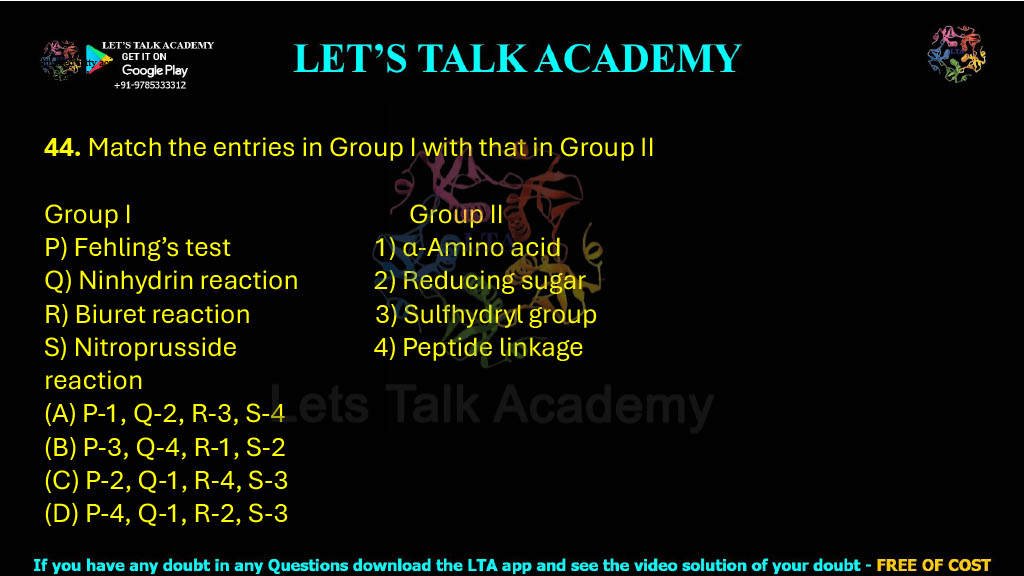
44. Match the entries in Group I with that in Group II
Group I Group II
P) Fehling’s test 1) α-Amino acid
Q) Ninhydrin reaction 2) Reducing sugar
R) Biuret reaction 3) Sulfhydryl group
S) Nitroprusside 4) Peptide linkage
reaction
(A) P-1, Q-2, R-3, S-4
(B) P-3, Q-4, R-1, S-2
(C) P-2, Q-1, R-4, S-3
(D) P-4, Q-1, R-2, S-3
Match Fehling’s Test, Ninhydrin Reaction, Biuret Reaction, and Nitroprusside Reaction
Correct Answer
(C) P-2, Q-1, R-4, S-3
Introduction
Biochemical tests are indispensable tools in analytical biochemistry because they enable the identification of carbohydrates, amino acids, proteins, and various functional groups based on characteristic chemical reactions. Long before the development of sophisticated analytical techniques such as mass spectrometry and chromatography, classical colorimetric tests provided reliable methods for detecting biomolecules in biological samples. Even today, these reactions remain important in laboratory practicals and competitive examinations because they illustrate the chemical properties of biological molecules in a simple and memorable way.
Among the most frequently tested biochemical assays are Fehling’s test, Ninhydrin reaction, Biuret reaction, and the Nitroprusside reaction. Each of these tests is highly specific for a particular functional group or class of biomolecules. Fehling’s test detects reducing sugars, Ninhydrin identifies α-amino acids, the Biuret reaction detects peptide bonds in proteins, and the Nitroprusside reaction identifies sulfhydryl (-SH) groups present in compounds such as cysteine.
Understanding the Concept Behind the Question
The question requires matching each biochemical test with the biomolecule or functional group that it specifically detects.
The correct associations are:
- Fehling’s Test → Reducing Sugar
- Ninhydrin Reaction → α-Amino Acid
- Biuret Reaction → Peptide Linkage
- Nitroprusside Reaction → Sulfhydryl Group
Thus,
- P → 2
- Q → 1
- R → 4
- S → 3
This combination corresponds to Option (C).
Why Option (A) Is Incorrect
Option (A) incorrectly associates Fehling’s test with α-amino acids and Ninhydrin with reducing sugars.
In reality, Fehling’s reagent detects reducing sugars, whereas Ninhydrin specifically reacts with free α-amino groups of amino acids.
The Biuret reaction does not detect sulfhydryl groups, and Nitroprusside is not a test for peptide bonds.
Therefore,
Option (A) is incorrect.
Why Option (B) Is Incorrect
This option incorrectly matches almost every biochemical test.
Fehling’s test is not used for sulfhydryl groups, Ninhydrin does not detect peptide bonds, Biuret does not identify amino acids individually, and Nitroprusside is not used for reducing sugars.
Therefore,
Option (B) is incorrect.
Why Option (C) Is Correct
Fehling’s Test → Reducing Sugar (P → 2)
Fehling’s test detects reducing sugars such as glucose, lactose, and maltose. These sugars possess a free aldehyde or ketone group capable of reducing Cu²⁺ ions to Cu₂O, producing a characteristic brick-red precipitate.
Ninhydrin Reaction → α-Amino Acid (Q → 1)
Ninhydrin reacts with free α-amino groups of amino acids, releasing carbon dioxide and ammonia while producing the characteristic deep blue-purple (Ruhemann’s purple) colour. This reaction is widely used for amino acid detection and fingerprint analysis.
Biuret Reaction → Peptide Linkage (R → 4)
The Biuret reaction detects peptide bonds rather than free amino acids. In an alkaline medium, copper ions form a violet-colored coordination complex with peptide linkages, making this reaction a standard qualitative test for proteins.
Nitroprusside Reaction → Sulfhydryl Group (S → 3)
Nitroprusside reagent reacts specifically with free sulfhydryl (-SH) groups, especially those present in the amino acid cysteine, producing a characteristic reddish-purple coloration.
Thus, the correct matching is:
P-2, Q-1, R-4, S-3
Therefore,
Option (C) is correct.
Why Option (D) Is Incorrect
This option incorrectly matches Fehling’s test with peptide bonds and Biuret reaction with reducing sugars.
Neither association is chemically correct because Fehling’s reagent detects carbohydrates, whereas the Biuret reaction identifies peptide bonds.
Therefore,
Option (D) is incorrect.
Explanation of Each Biochemical Test
Fehling’s Test
Fehling’s solution contains alkaline copper(II) ions that are reduced by reducing sugars to form red cuprous oxide (Cu₂O).
Positive result:
Brick-red precipitate
Used for:
- Glucose
- Lactose
- Maltose
- Other reducing sugars
Ninhydrin Reaction
Ninhydrin reacts with free α-amino groups present in amino acids.
Positive result:
Deep blue or purple colour (Ruhemann’s Purple)
Used for:
- Amino acid detection
- Protein hydrolysates
- Fingerprint analysis
Biuret Reaction
The Biuret reagent contains copper sulfate in alkaline solution.
Copper ions bind to two or more peptide bonds, producing a violet-colored complex.
Positive result:
Purple or violet colour
Used for:
- Proteins
- Polypeptides
Nitroprusside Reaction
Sodium nitroprusside reacts with free sulfhydryl (-SH) groups.
Positive result:
Red-purple colour
Used primarily for:
- Cysteine
- Sulfhydryl-containing compounds
Comparison of the Biochemical Tests
| Test | Detects | Positive Result |
|---|---|---|
| Fehling’s Test | Reducing Sugar | Brick-red precipitate |
| Ninhydrin Reaction | α-Amino Acid | Purple colour |
| Biuret Reaction | Peptide Linkage | Violet colour |
| Nitroprusside Reaction | Sulfhydryl Group | Red-purple colour |
Biological Importance
These biochemical tests remain important because they exploit the unique chemical properties of biological molecules. Fehling’s test distinguishes reducing carbohydrates based on their reducing ability, Ninhydrin identifies amino acids through their free amino groups, the Biuret reaction confirms the presence of proteins by detecting peptide bonds, and the Nitroprusside reaction identifies thiol-containing compounds such as cysteine.
Although modern analytical techniques have largely replaced these assays in research laboratories, they continue to serve as essential teaching tools and are routinely tested in competitive examinations because they demonstrate fundamental principles of biomolecular chemistry.
High-Yield Points
- Fehling’s Test → Reducing sugars
- Ninhydrin → α-Amino acids
- Biuret → Peptide bonds
- Nitroprusside → Sulfhydryl (-SH) groups
- Ruhemann’s Purple is produced in the Ninhydrin reaction.
- Biuret reaction requires at least two peptide bonds.
- Fehling’s test produces Cu₂O (brick-red precipitate).
Frequently Asked Questions
Why does Ninhydrin produce a purple colour?
Ninhydrin reacts with free α-amino groups to produce Ruhemann’s Purple, a highly coloured compound used for amino acid detection.
Does the Biuret reaction detect individual amino acids?
No. The Biuret reaction requires peptide bonds, so free amino acids give a negative result.
Which amino acid gives a positive Nitroprusside test?
Cysteine, because it contains a free sulfhydryl (-SH) group capable of reacting with sodium nitroprusside.
Key Takeaways
Classical biochemical tests identify biomolecules based on characteristic chemical reactions. Fehling’s test detects reducing sugars, Ninhydrin reaction identifies α-amino acids, Biuret reaction confirms the presence of peptide linkages in proteins, and the Nitroprusside reaction detects free sulfhydryl (-SH) groups. Understanding these reactions and their underlying chemical principles is essential for laboratory biochemistry and for success in competitive examinations.
Final Answer
Correct Option: (C) P-2, Q-1, R-4, S-3
Explanation
The correct matching is:
- Fehling’s Test → Reducing Sugar (2) because reducing sugars reduce Cu²⁺ to Cu₂O, producing a brick-red precipitate.
- Ninhydrin Reaction → α-Amino Acid (1) because free amino groups react with ninhydrin to form Ruhemann’s Purple.
- Biuret Reaction → Peptide Linkage (4) because copper ions form a violet complex with peptide bonds in proteins.
- Nitroprusside Reaction → Sulfhydryl Group (3) because sodium nitroprusside specifically reacts with –SH groups, especially in cysteine.
Therefore, the correct matching is P-2, Q-1, R-4, S-3, making Option (C) the correct answer.


