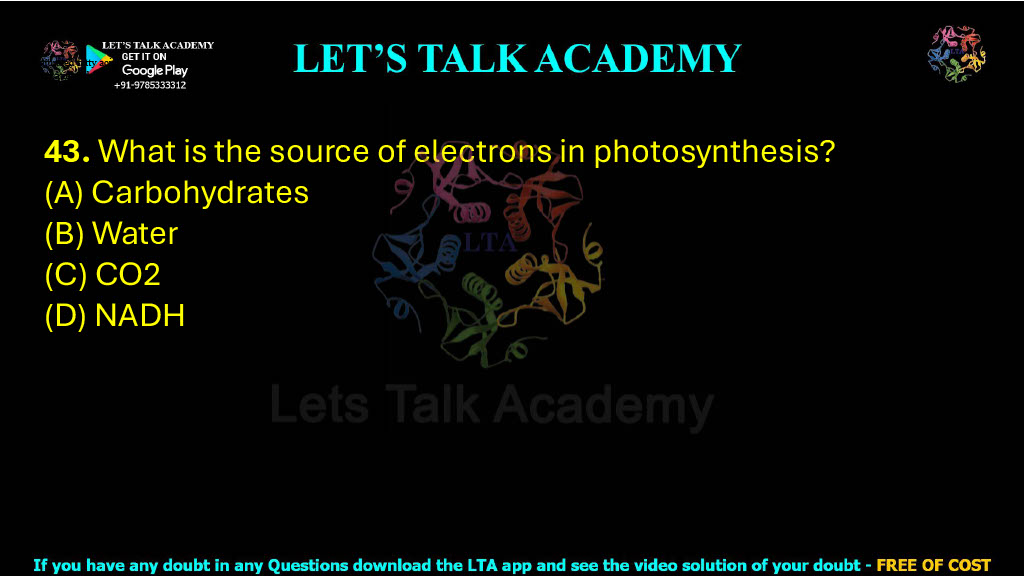
43. What is the source of electrons in photosynthesis?
(A) Carbohydrates
(B) Water
(C) CO2
(D) NADH
What Is the Source of Electrons in Photosynthesis?
Correct Answer
(B) Water
Introduction
Photosynthesis is one of the most important biological processes on Earth because it converts light energy into chemical energy, allowing plants, algae, and cyanobacteria to synthesize carbohydrates from carbon dioxide and water. This remarkable process not only provides food for nearly all living organisms but also releases oxygen into the atmosphere, making aerobic life possible. The light-dependent reactions of photosynthesis involve the movement of electrons through a sophisticated electron transport chain located within the thylakoid membrane of chloroplasts. These electrons are ultimately used to reduce NADP⁺ into NADPH, which is later utilized during the Calvin cycle to synthesize glucose.
A fundamental question in photosynthesis is the origin of these electrons. Unlike cellular respiration, where electrons are obtained from the oxidation of organic molecules such as glucose, photosynthesis acquires its electrons from water (H₂O). During the light reactions, water molecules undergo photolysis, releasing electrons, protons, and molecular oxygen. This process is catalyzed by the oxygen-evolving complex (OEC) associated with Photosystem II (PSII).
Understanding the Concept Behind the Question
The light reactions begin when chlorophyll molecules in Photosystem II absorb sunlight.
The absorbed energy excites electrons in the reaction center chlorophyll (P680). These excited electrons leave the chlorophyll molecule and enter the photosynthetic electron transport chain.
To replace these lost electrons, water molecules are split through a process known as photolysis.
The reaction is:
2H₂O → 4H⁺ + 4e⁻ + O₂
This reaction supplies:
- Electrons to Photosystem II.
- Protons (H⁺) that contribute to ATP synthesis.
- Oxygen (O₂) released into the atmosphere.
Thus, water is the ultimate source of electrons in oxygenic photosynthesis.
Therefore,
Option (B) is the correct answer.
Why Option (A) Is Incorrect
Carbohydrates
Carbohydrates such as glucose are products of photosynthesis, not the source of electrons.
In fact, carbohydrates are synthesized later during the Calvin cycle using ATP and NADPH generated during the light reactions.
Although carbohydrates donate electrons during cellular respiration, they do not supply electrons during photosynthesis.
Therefore,
Option (A) is incorrect.
Why Option (B) Is Correct
Water
Water serves as the primary electron donor in oxygenic photosynthesis.
Within Photosystem II, the oxygen-evolving complex (OEC) catalyzes the splitting of water molecules.
The reaction is:
2H₂O → O₂ + 4H⁺ + 4e⁻
The released electrons replace those lost by chlorophyll after light excitation, allowing continuous electron flow through the photosynthetic electron transport chain.
Simultaneously:
- Oxygen is released into the atmosphere.
- Protons contribute to the proton gradient that drives ATP synthesis.
Because water supplies the electrons required for photosynthesis, it is the correct answer.
Therefore,
Option (B) is correct.
Why Option (C) Is Incorrect
Carbon Dioxide (CO₂)
Carbon dioxide functions as the carbon source during photosynthesis rather than the electron source.
In the Calvin cycle, CO₂ is reduced into carbohydrates using the reducing power supplied by NADPH, whose electrons ultimately originate from water.
Thus, CO₂ receives electrons instead of donating them.
Therefore,
Option (C) is incorrect.
Why Option (D) Is Incorrect
NADH
NADH is a major electron carrier in cellular respiration, particularly in glycolysis and the citric acid cycle.
Photosynthetic cells primarily utilize NADP⁺/NADPH, not NADH, during the light reactions.
Furthermore, NADH does not donate electrons to initiate photosynthesis.
Instead, electrons obtained from water reduce NADP⁺ to NADPH.
Therefore,
Option (D) is incorrect.
Photolysis of Water
The splitting of water occurs in Photosystem II through the action of the oxygen-evolving complex (OEC), which contains a manganese-calcium cluster.
Overall reaction:
2H₂O → 4H⁺ + 4e⁻ + O₂
This reaction provides three essential products:
- Electrons replace those lost from chlorophyll.
- Protons help generate ATP through chemiosmosis.
- Oxygen is released as a by-product.
This oxygen is the major source of atmospheric oxygen on Earth.
Flow of Electrons During Photosynthesis
The overall electron pathway is:
Water
↓
Photosystem II (P680)
↓
Plastoquinone
↓
Cytochrome b₆f Complex
↓
Plastocyanin
↓
Photosystem I (P700)
↓
Ferredoxin
↓
NADP⁺ Reductase
↓
NADPH
Thus, every electron that ultimately reaches NADPH originates from water.
Biological Importance
The ability of photosynthetic organisms to extract electrons from water is one of the most significant evolutionary innovations in Earth’s history. Water is an abundant, renewable, and stable molecule, making it an ideal electron donor for photosynthesis.
The oxygen released during photolysis transformed Earth’s atmosphere during the Great Oxygenation Event, enabling the evolution of aerobic organisms. Simultaneously, the electrons extracted from water provide the reducing power required to convert carbon dioxide into carbohydrates, supporting nearly all ecosystems on the planet.
Comparison of the Given Options
| Substance | Role in Photosynthesis | Correct? |
|---|---|---|
| Carbohydrates | Product of Calvin cycle | ❌ |
| Water | Electron donor in photolysis | ✅ |
| CO₂ | Carbon source | ❌ |
| NADH | Electron carrier in respiration | ❌ |
High-Yield Points
- Water is the electron donor in oxygenic photosynthesis.
- Photolysis occurs in Photosystem II.
- Oxygen-evolving complex contains Mn₄Ca cluster.
- Water splitting releases:
- Electrons
- Protons
- Oxygen
- Electrons ultimately reduce NADP⁺ to NADPH.
- Atmospheric oxygen originates from water, not CO₂.
Frequently Asked Questions
Why is water considered the source of electrons?
Water undergoes photolysis in Photosystem II, releasing electrons that replace those lost by chlorophyll and ultimately reduce NADP⁺ to NADPH.
Does carbon dioxide donate electrons during photosynthesis?
No. Carbon dioxide is reduced into carbohydrates and therefore acts as an electron acceptor rather than an electron donor.
Why is oxygen released during photosynthesis?
Oxygen is produced as a by-product when water molecules are split during the light-dependent reactions of photosynthesis.
Key Takeaways
The ultimate source of electrons in oxygenic photosynthesis is water. During the light-dependent reactions, the oxygen-evolving complex of Photosystem II catalyzes the photolysis of water, producing electrons, protons, and molecular oxygen. These electrons travel through the photosynthetic electron transport chain to reduce NADP⁺ into NADPH, which later powers the Calvin cycle for carbohydrate synthesis. Understanding that water supplies the electrons while carbon dioxide accepts them is a fundamental concept in photosynthesis and a high-yield topic for competitive examinations.
Final Answer
Correct Option: (B) Water
Explanation
In oxygenic photosynthesis, water (H₂O) is the primary source of electrons. During the light-dependent reactions, the oxygen-evolving complex (OEC) of Photosystem II splits water molecules through photolysis, producing electrons, protons, and oxygen according to the reaction:
2H₂O → 4H⁺ + 4e⁻ + O₂
The released electrons replace those lost by chlorophyll and ultimately reduce NADP⁺ to NADPH, while oxygen is released into the atmosphere. Therefore, the correct answer is Option (B) – Water.


