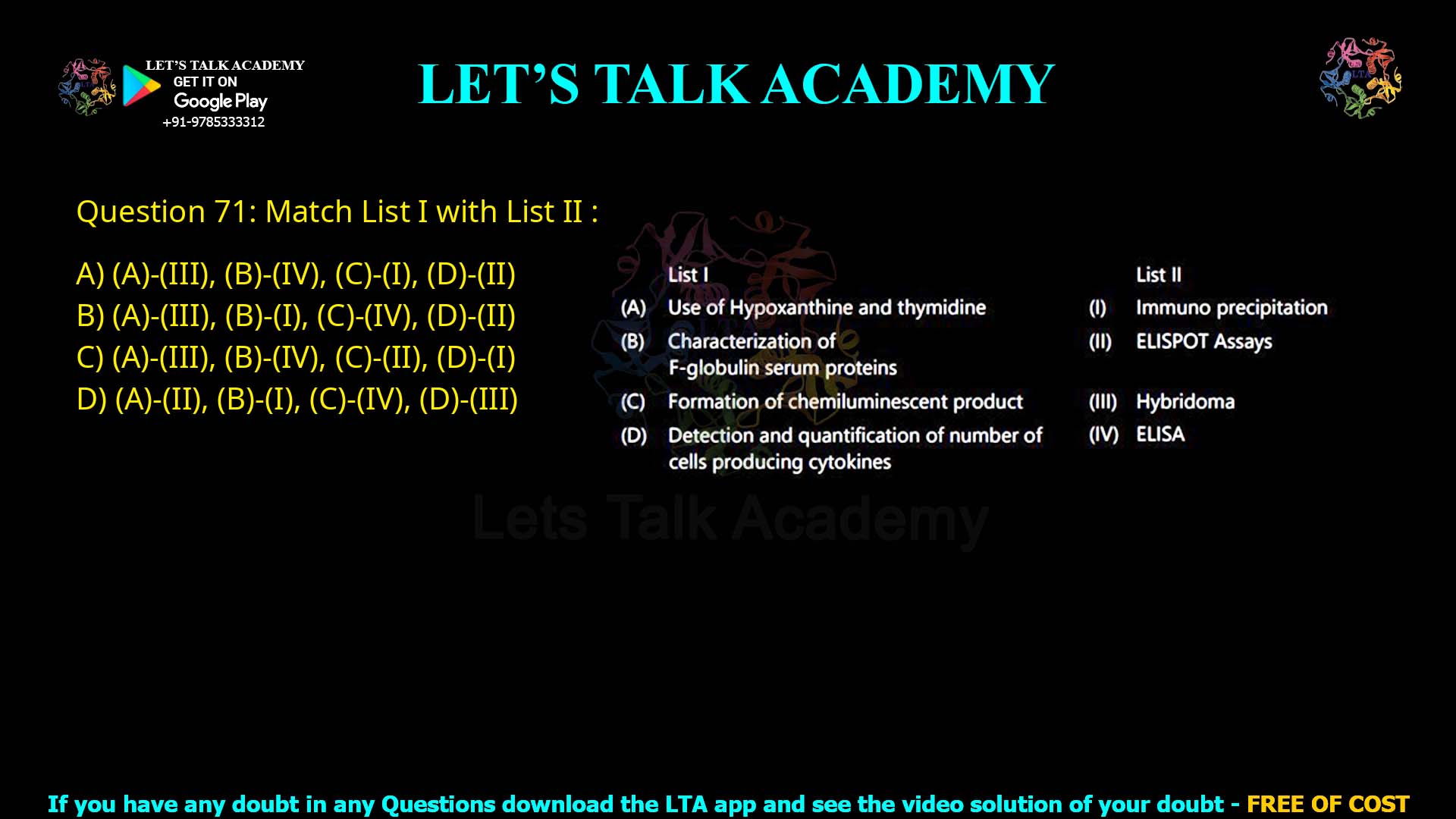
Q.71 Match List I with List II :
List I
- (A) Use of Hypoxanthine and thymidine
- (B) Characterization of γ-globulin serum proteins
- (C) Formation of chemiluminescent product
- (D) Detection and quantification of number of cells producing cytokines
List II
- (I) Immuno precipitation
- (II) ELISPOT Assays
- (III) Hybridoma
- (IV) ELISA
Choose the correct answer from the options given below:
- (1) (A)-(III), (B)-(IV), (C)-(I), (D)-(II)
- (2) (A)-(III), (B)-(I), (C)-(IV), (D)-(II)
- (3) (A)-(III), (B)-(IV), (C)-(II), (D)-(I)
- (4) (A)-(II), (B)-(I), (C)-(IV), (D)-(III)
The correct answer is option (2): (A)-(III), (B)-(I), (C)-(IV), (D)-(II).
This matching question tests knowledge of immunological techniques in biotechnology, key for exams like GATE Life Sciences.
Matching Explanations
(A) Use of Hypoxanthine and Thymidine → (III) Hybridoma
Hypoxanthine and thymidine form part of HAT medium (with aminopterin) used in hybridoma technology to select fused myeloma-spleen cells for monoclonal antibody production. Unfused myeloma cells lack HGPRT and die without the salvage pathway provided by HT, while unfused B cells don’t proliferate long-term.
(B) Characterization of γ-Globulin Serum Proteins → (I) Immunoprecipitation
Immunoprecipitation isolates and characterizes γ-globulins (immunoglobulins in serum) by forming antigen-antibody complexes that precipitate, often analyzed via electrophoresis or diffusion for purity and identity.
(C) Formation of Chemiluminescent Product → (IV) ELISA
Chemiluminescent ELISA uses HRP enzyme with luminol substrate; oxidation produces light-emitting intermediates detected by luminometer for high-sensitivity quantification.
(D) Detection and Quantification of Number of Cells Producing Cytokines → (II) ELISPOT Assays
ELISPOT captures cytokines secreted by individual cells on a coated membrane, forming visible spots per cytokine-producing cell for direct enumeration at single-cell resolution.
Option Analysis
Option A-III B-IV C-I D-II B-I C-IV D-II B-IV C-II D-I A-II B-I C-IV D-III Correct? (1) ✓ ✗ ✗ ✓ No (2) ✓ ✓ ✓ ✓ ✓ ✓ Yes (3) ✓ ✗ ✓ ✗ ✓ No (4) ✗ ✓ ✓ ✓ ✓ ✓ ✗ No Option (2) uniquely matches all pairs correctly based on technique principles.
Introduction to Key Immunological Techniques in GATE Life Sciences
Hypoxanthine thymidine hybridoma ELISPOT ELISA immunoprecipitation techniques are essential for matching questions in competitive exams like GATE Life Sciences, testing biotech and immunology knowledge. This article solves Q.71 with detailed explanations.
HAT Medium in Hybridoma Technology
Hybridoma production uses HAT (hypoxanthine-aminopterin-thymidine) medium where hypoxanthine and thymidine enable salvage pathway nucleotide synthesis in fused cells only.
Immunoprecipitation for γ-Globulin Analysis
Immunoprecipitation characterizes serum γ-globulins by precipitating immune complexes, vital for antibody studies.
Chemiluminescent Detection in ELISA
ELISA employs chemiluminescence via luminol-HRP reaction for sensitive signal amplification in immunoassays.
ELISPOT for Cytokine-Secreting Cells
ELISPOT quantifies cytokine-producing cells by spotting secreted factors, outperforming bulk ELISA for frequency analysis.
Exam Tips for Matching Questions
Practice linking techniques to principles: HAT for selection, IP for precipitation, chemiluminescence for ELISA, spots for ELISPOT.


