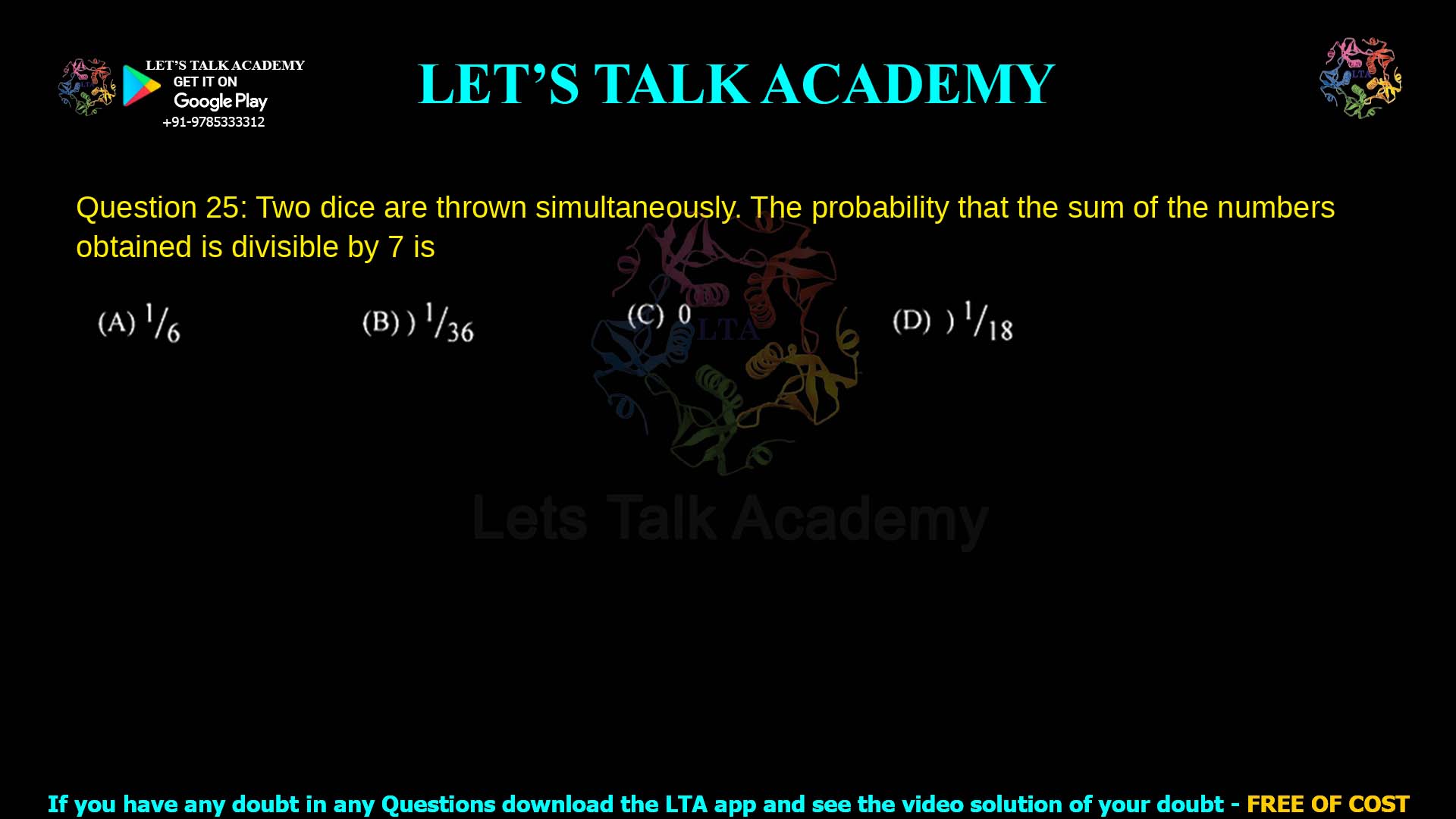
Q.25 Two dice are thrown simultaneously. The probability that the sum of the numbers obtained is divisible by 7 is
(A) 1/t6
(B) “36
(C) 0
(D) 1/18
Total Outcomes
Two fair six-sided dice produce 6×6=36 equally likely outcomes, ranging from (1,1) sum 2 to (6,6) sum 12.
Favorable Outcomes
Sums divisible by 7 within 2-12 are only 7 (14 exceeds 12). The pairs summing to 7 are:
- (1,6)=7
- (2,5)=7
- (3,4)=7
- (4,3)=7
- (5,2)=7
- (6,1)=7
Probability = 6/36 = 1/6.
Option Analysis
| Option | Value | Correct? | Reason |
|---|---|---|---|
| (A) | 1/6 | Yes | Matches 6 favorable outcomes out of 36. |
| (B) | 6/36 | Equivalent | Simplifies to 1/6, but not reduced form. |
| (C) | 0 | No | Ignores the 6 valid sum-7 cases. |
| (D) | 1/18 | No | Too low; would imply only 2 favorable outcomes. |
Exam Tips
When exploring probability two dice sum divisible by 7, students preparing for competitive exams like CSIR NET encounter this classic question. Two fair dice yield 36 total outcomes, but only sums of 7 (divisible by 7) count as favorable—6 specific pairs make the probability exactly 1/6.
Why Only Sum 7? Dice sums range 2-12. Multiples of 7 are 7 and 14, but 14=6+8 exceeds dice limits, and 0 is impossible. Thus, focus on sum=7 pairs.
- For probability two dice sum divisible by 7, always enumerate outcomes systematically.
- Use sample space tables for verification.
- Common trap: forgetting ordered pairs like (3,4) vs (4,3).


