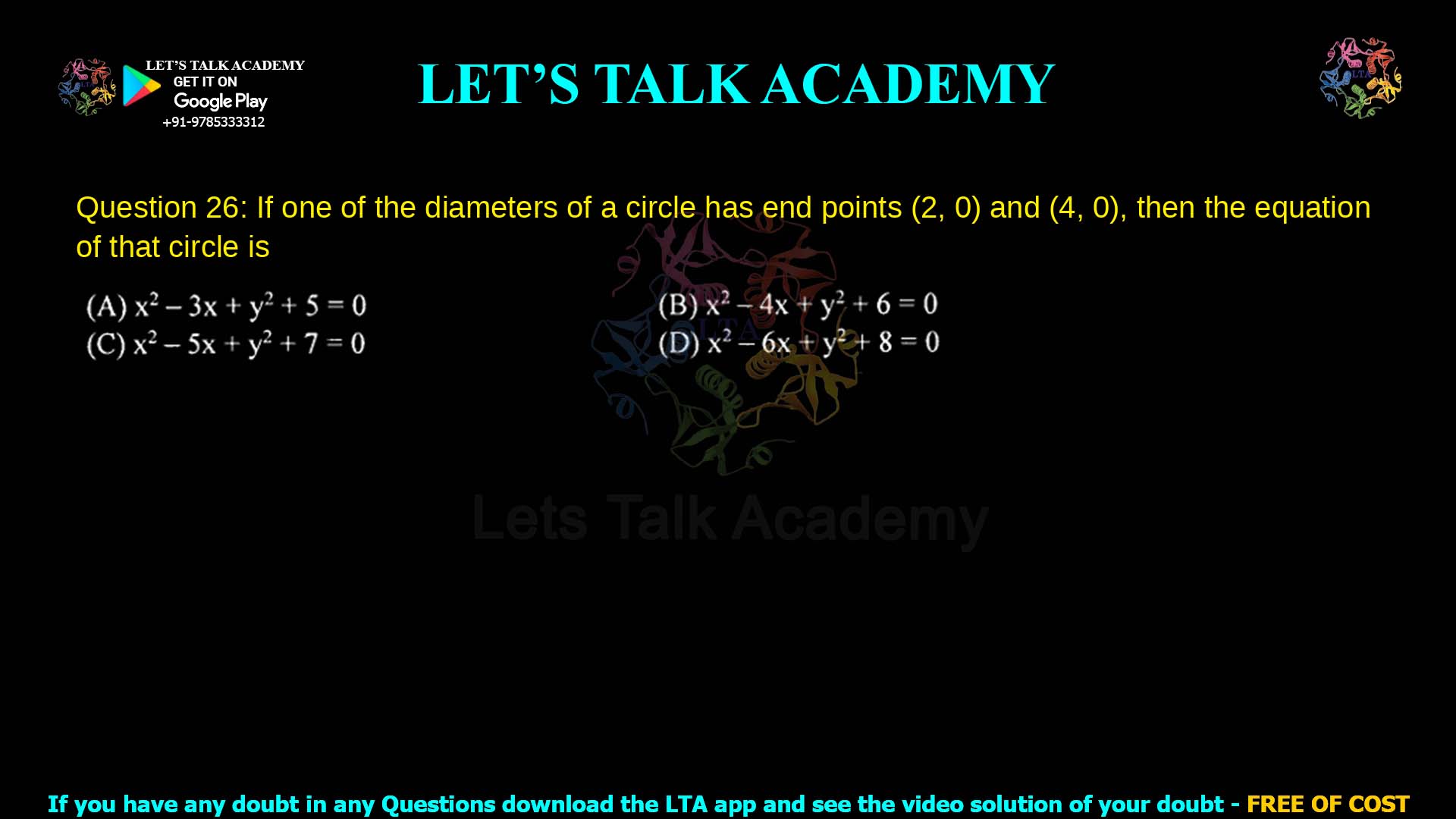
Q.26 If one of the diameters of a circle has end points (2,0) and (4,0), then the equation of that circle is
(A) x2−3x+y2+5=0
(B) x2−4x+y2+6=0
(C) x2−5x+y2+7=0
(D) x2−6x+y2+8=0
Solving Method
The center lies at the midpoint of the diameter endpoints: (h, k) = ((2+4)/2, (0+0)/2) = (3, 0).
The radius equals half the diameter length: distance between points is |4-2| = 2, so radius r = 1. The standard equation (x – 3)² + (y – 0)² = 1² expands to x² – 6x + 9 + y² = 1, or x² + y² – 6x + 8 = 0. Both endpoints satisfy this equation.
Option Analysis
Verify each option by substituting endpoints (2,0) and (4,0); only the correct circle passes both points.
| Option | Equation | At (2,0) | At (4,0) | Valid? |
|---|---|---|---|---|
| (A) | x² – 3x + y² + 5 = 0 | 4 ≠ 0 | 5 ≠ 0 | No |
| (B) | x² – 4x + y² + 6 = 0 | 2 ≠ 0 | 2 ≠ 0 | No |
| (C) | x² – 5x + y² + 7 = 0 | 1 ≠ 0 | -1 ≠ 0 | No |
| (D) | x² – 6x + y² + 8 = 0 | 0 = 0 | 0 = 0 | Yes |
[code_file:1]
SEO Article Content
The equation of a circle with diameter endpoints (2,0) and (4,0) is a common coordinate geometry problem in exams like JEE or class 10-12 math. This MCQ tests understanding of circle equations using the diameter method.
Step-by-Step Solution
Start with the center as midpoint: (3, 0). Radius is 1 unit. Expand (x-3)² + y² = 1 to get x² – 6x + y² + 8 = 0, matching option (D).
Why Other Options Fail
Options (A)-(C) yield centers at (1.5,0), (2,0), (2.5,0) respectively, none matching the true center (3,0). Endpoint substitution confirms only (D) works.
Quick Formula Tip
For diameter endpoints (x₁,y₁), (x₂,y₂), use (x – x₁)(x – x₂) + (y – y₁)(y – y₂) = 0: here, (x-2)(x-4) + y·y = 0 simplifies to option (D).


