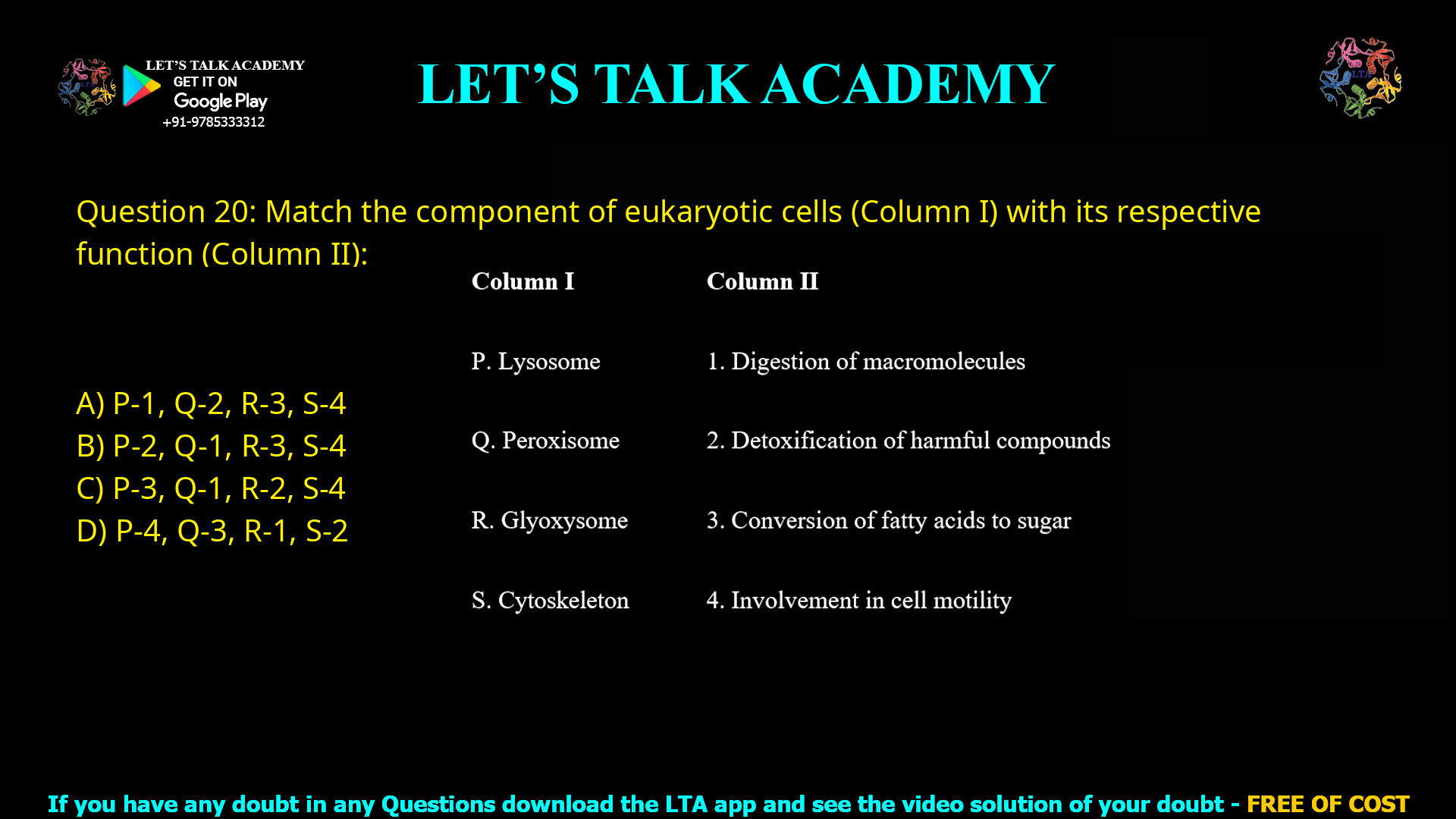
Q.20 Match the component of eukaryotic cells (Column I) with its respective function
(Column II).
Column I Column II
P. Lysosome 1. Digestion of macromolecules
Q. Peroxisome 2. Detoxification of harmful compounds
R. Glyoxysome 3. Conversion of fatty acids to sugar
S. Cytoskeleton 4. Involvement in cell motility
(A) P-1, Q-2, R-3, S-4
(B) P-2, Q-1, R-3, S-4
(C) P-3, Q-1, R-2, S-4
(D) P-4, Q-3, R-1, S-2
This comprehensive guide breaks down a key multiple-choice question on eukaryotic cell components and their functions. Perfect for biology students, researchers in molecular biology, and plant sciences enthusiasts preparing for exams like NEET, CSIR NET, or university assessments. Discover the correct answer, detailed explanations for each organelle, and why other options fall short.
Correct Answer: Option (A) P-1, Q-2, R-3, S-4
This matching aligns perfectly with the specialized roles of each organelle in eukaryotic cells, including those in plants and animals. Here’s a breakdown of why each pairing fits, drawing from core concepts in cell biology, biochemistry, and plant physiology.
P. Lysosome → 1. Digestion of macromolecules
Lysosomes act as the cell’s “digestive system.” They contain hydrolytic enzymes that break down proteins, lipids, carbohydrates, and nucleic acids—macromolecules—into simpler units. This occurs during autophagy, phagocytosis, or recycling worn-out organelles. Found mainly in animal cells (plants have analogous vacuoles), their acidic interior (pH ~5) optimizes enzyme activity.
Q. Peroxisome → 2. Detoxification of harmful compounds
Peroxisomes handle oxidative reactions, breaking down hydrogen peroxide (H₂O₂) via catalase into water and oxygen, preventing cellular damage. They detoxify alcohols, fatty acids via beta-oxidation, and other toxins. Ubiquitous in eukaryotes, including plant cells, they protect against reactive oxygen species (ROS) from metabolism.
R. Glyoxysome → 3. Conversion of fatty acids to sugar
Glyoxysomes are specialized peroxisomes unique to plant cells (e.g., germinating seeds). They facilitate the glyoxylate cycle, bypassing CO₂-releasing steps of the Krebs cycle to convert acetyl-CoA from fatty acid beta-oxidation into succinate, then glucose via gluconeogenesis. This allows seedlings to convert stored seed oils into sugars for growth.
S. Cytoskeleton → 4. Involvement in cell motility
The cytoskeleton—a network of microfilaments (actin), microtubules, and intermediate filaments—provides structural support, enables intracellular transport, and drives motility. Actin-myosin interactions power amoeboid movement, cilia/flagella beating, and cytokinesis. Essential in all eukaryotes for shape, division, and migration.
Why Other Options Are Incorrect: Detailed Analysis
Each wrong option swaps at least one key function, highlighting common confusions in cell biology exams.
-
Option (B) P-2, Q-1, R-3, S-4: Swaps lysosome and peroxisome. Lysosomes digest macromolecules via broad hydrolases, not primarily detoxify (that’s peroxisomes’ catalase/superoxide dismutase role). Peroxisomes don’t handle general macromolecule breakdown.
-
Option (C) P-3, Q-1, R-2, S-4: Misassigns all but cytoskeleton. Lysosomes don’t convert fats to sugar (plant-specific glyoxysome trait). Peroxisomes detoxify but aren’t for macromolecule digestion. Glyoxysomes enable fat-to-sugar via glyoxylate cycle, not general detox.
-
Option (D) P-4, Q-3, R-1, S-2: Completely mismatches. Cytoskeleton drives motility, not lysosomes. Glyoxysomes don’t convert fats to sugar in animals (absent there). Macromolecule digestion isn’t glyoxysomes’ role.
Quick Reference Table: Organelles and Functions
| Component | Correct Function | Key Location/Notes |
|---|---|---|
| Lysosome (P) | Digestion of macromolecules (1) | Animal cells; hydrolytic enzymes |
| Peroxisome (Q) | Detoxification of harmful compounds (2) | All eukaryotes; ROS breakdown |
| Glyoxysome (R) | Conversion of fatty acids to sugar (3) | Plant cells (seeds); glyoxylate cycle |
| Cytoskeleton (S) | Involvement in cell motility (4) | All eukaryotes; actin/microtubules |
Exam Tips for Eukaryotic Cell Organelles
-
Mnemonics: Lysosomes = “Lyse” (break down). Peroxisomes = “Peroxide detox.” Glyoxysomes = “Glyoxylate for plants.” Cytoskeleton = “Cell skeleton moves.”
-
Plant vs. Animal: Glyoxysomes shine in plant biology—crucial for your studies in plant sciences and biochemistry.
-
Related Topics: Link to beta-oxidation, autophagy, and microtubule motors for deeper prep.
This matching reinforces how organelles specialize for survival, from detoxification in stressful environments to energy conversion in germinating plants.


1 Comment
Ankita Pareek
April 27, 2026Option A is correct