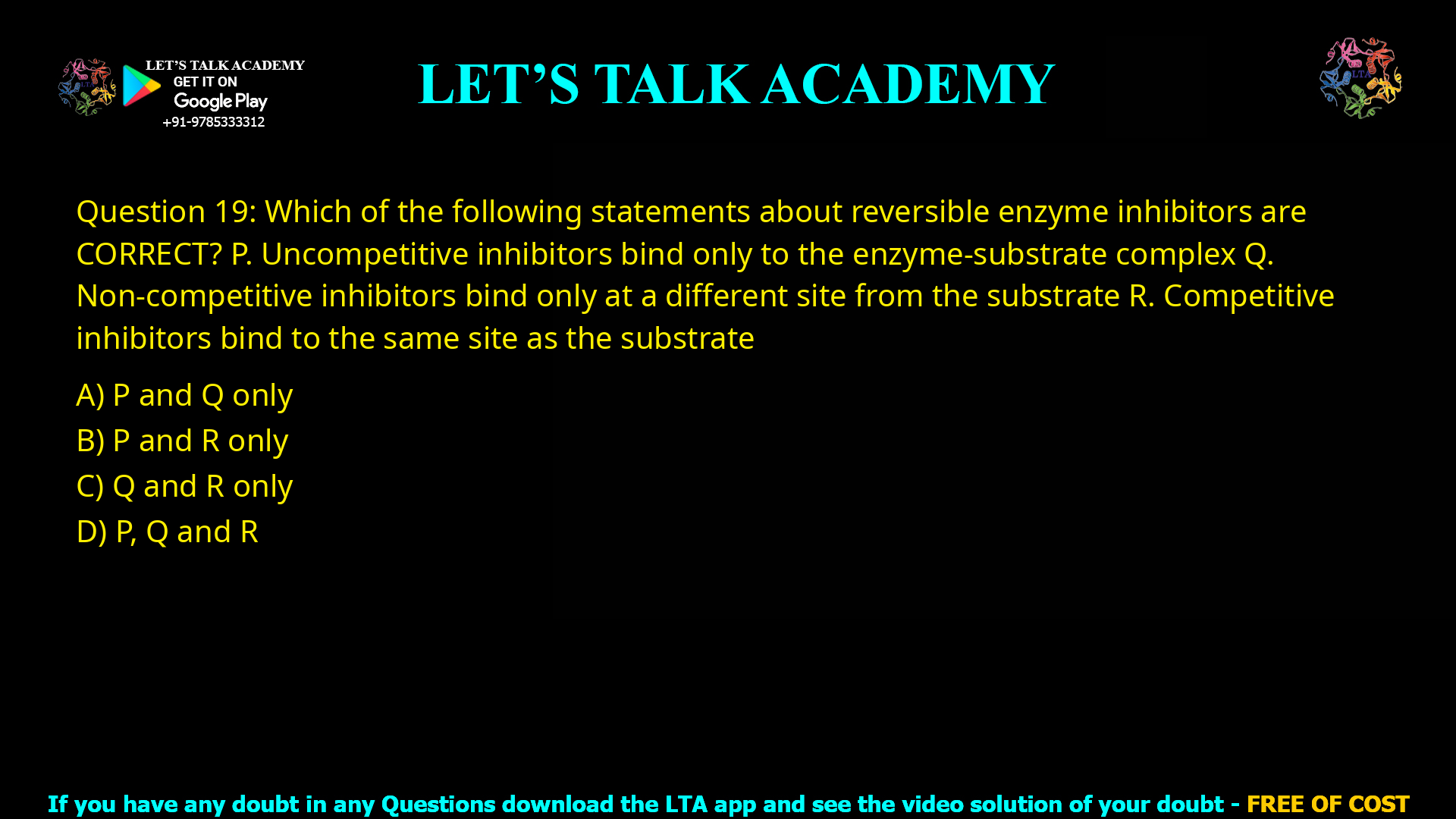
Q.19 Which of the following statements about reversible enzyme inhibitors are
CORRECT?
P. Uncompetitive inhibitors bind only to the enzyme-substrate complex
Q. Non-competitive inhibitors bind only at a different site from the
substrate
R. Competitive inhibitors bind to the same site as the substrate
(A) P and Q only
(B) P and R only
(C) Q and R only
(D) P, Q and R
Understanding Reversible Enzyme Inhibitors
Reversible enzyme inhibitors play a crucial role in regulating enzymatic activity in biological systems. This article breaks down a common multiple-choice question (MCQ) on the topic, identifies the correct answer, and explains each statement with biochemical principles.
Correct Answer
The correct option is (D) P, Q and R. All three statements accurately describe the binding behaviors of reversible enzyme inhibitors.
Statement P: Uncompetitive Inhibitors
Uncompetitive inhibitors bind exclusively to the enzyme-substrate (ES) complex, not the free enzyme. This interaction locks the complex in a non-productive state, lowering both Km and Vmax, as the inhibitor stabilizes the ES form and prevents product formation.
Statement Q: Non-Competitive Inhibitors
Non-competitive inhibitors attach to an allosteric site distinct from the substrate-binding site on either the free enzyme or the ES complex. Substrate binding remains unaffected, but catalysis is impaired, resulting in a decreased Vmax without altering Km.
Statement R: Competitive Inhibitors
Competitive inhibitors mimic the substrate and bind directly to the enzyme’s active site, blocking substrate access. This competition increases the apparent Km, but Vmax stays unchanged since higher substrate concentrations can displace the inhibitor.
Types Comparison
| Inhibitor Type | Binding Target | Effect on Km | Effect on Vmax |
|---|---|---|---|
| Uncompetitive (P) | ES complex only | Decreases | Decreases |
| Non-competitive (Q) | Allosteric site (E or ES) | No change | Decreases |
| Competitive (R) | Active site (E only) | Increases | No change |
These distinctions are essential for understanding enzyme kinetics in research, drug design, and biotechnology applications.


