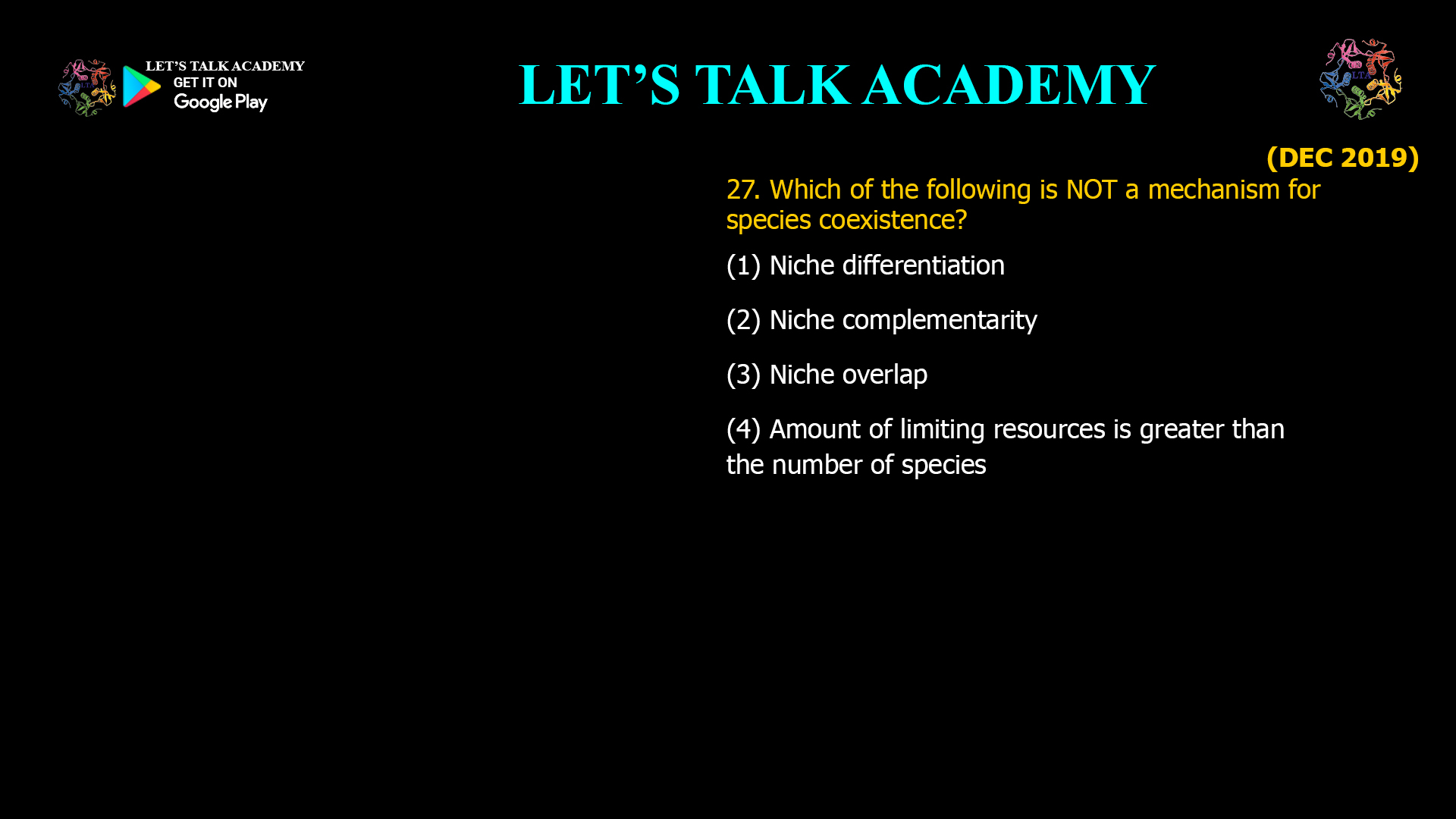
Which of the following is NOT a mechanism for species coexistence?
(1) Niche differentiation
(2) Niche complementarity
(3) Niche overlap
(4) Amount of limiting resources is greater than the number of species
What Is NOT a Mechanism for Species Coexistence? Understanding Niche Overlap and Resource Availability
Species coexistence is a fundamental puzzle in ecology: how do multiple species with similar needs manage to live together in the same environment without one outcompeting the rest? While competition might seem to favor exclusion, nature is full of examples where species coexist—sometimes even those with nearly identical requirements. This article explores the mechanisms that allow species to coexist, clarifies which option is NOT a mechanism for species coexistence, and explains why this understanding is crucial for biodiversity and ecosystem health.
The Challenge of Species Coexistence
According to the principle of competitive exclusion, two species with identical niches cannot coexist indefinitely—one will eventually outcompete the other. However, in real ecosystems, species with similar needs often do coexist. This paradox has led ecologists to identify several mechanisms that promote coexistence, allowing communities to maintain high biodiversity168.
Key Mechanisms for Species Coexistence
1. Niche Differentiation
Niche differentiation refers to the process by which species evolve or adapt to use different resources, occupy different parts of the habitat, or be active at different times. This reduces direct competition and allows species to coexist by partitioning the available resources.
-
Example: Warblers in a forest may forage at different heights in the trees, reducing competition for food.
-
Role: Niche differentiation is a classic stabilizing mechanism that enhances species coexistence by increasing niche partitioning16.
2. Niche Complementarity
Niche complementarity is closely related to niche differentiation but emphasizes how species use resources in ways that complement each other, increasing the efficiency and productivity of the ecosystem as a whole.
-
Example: In plant communities, different species may have root systems that exploit different soil layers, allowing them to coexist and use resources more efficiently.
-
Role: Niche complementarity supports coexistence by ensuring that species do not compete directly for the same resources at the same time or in the same space.
3. Equalizing Mechanisms
While not listed among the options, equalizing mechanisms are also important for coexistence. These reduce fitness differences between species, making competition less intense and allowing weaker competitors to persist alongside stronger ones16.
-
Example: Environmental disturbances or fluctuations can temporarily reduce the competitive advantage of a dominant species, allowing others to survive.
4. Resource Abundance
Amount of limiting resources is greater than the number of species: This concept suggests that if there are enough resources for all species, competition is reduced, and coexistence is possible.
-
Example: In a lake with abundant plankton, multiple fish species can coexist without competing intensely for food.
-
Role: While not a mechanism in the strict sense, abundant resources can reduce competition and allow coexistence. However, this is not a mechanism that actively promotes coexistence through species interactions or adaptations.
What Is NOT a Mechanism for Species Coexistence?
The question asks which of the following is NOT a mechanism for species coexistence. Let’s analyze each option:
-
Niche differentiation: Yes, a mechanism for coexistence.
-
Niche complementarity: Yes, a mechanism for coexistence.
-
Niche overlap: This is NOT a mechanism for coexistence. In fact, niche overlap increases competition and can lead to competitive exclusion if not balanced by other factors.
-
Amount of limiting resources is greater than the number of species: While this can allow coexistence by reducing competition, it is not an active mechanism like niche differentiation or complementarity. However, in most ecological frameworks, this is considered a condition that supports coexistence rather than a mechanism.
However, based on standard ecological theory and the options provided, the clearest answer is:
(3) Niche overlap
Niche overlap is not a mechanism for species coexistence; rather, it is a condition that increases the likelihood of competition and exclusion. Mechanisms for coexistence, such as niche differentiation and complementarity, work by reducing niche overlap, not by increasing it168.
Why Is Niche Overlap Not a Mechanism for Coexistence?
Niche overlap occurs when two or more species use the same resources or occupy the same part of the habitat. High niche overlap generally leads to intense competition, which can result in one species outcompeting the other unless other mechanisms (like niche differentiation or complementarity) come into play.
-
Competitive Exclusion: High niche overlap without differentiation or complementarity leads to competitive exclusion, not coexistence.
-
Stabilizing Mechanisms: Coexistence mechanisms work by reducing niche overlap, not by maintaining or increasing it.
The Role of Resource Abundance
While the option “amount of limiting resources is greater than the number of species” is not an active mechanism, it is a condition that can support coexistence by reducing competition. However, in most ecological frameworks, mechanisms refer to active processes or adaptations that allow species to coexist despite limited resources, not simply the abundance of resources itself.
Other Mechanisms for Coexistence
Beyond the options listed, several other mechanisms promote species coexistence:
-
Spatial and Temporal Partitioning: Species use different parts of the habitat or are active at different times.
-
Intermediate Disturbance: Periodic disturbances prevent any one species from dominating.
-
Storage Effect: Species benefit from environmental fluctuations in different ways, allowing them to coexist.
-
Reproductive Interactions: In some cases, reproductive strategies can promote coexistence even when ecological niches overlap59.
Summary Table: Mechanisms and Non-Mechanisms for Coexistence
| Option | Mechanism for Coexistence? | Explanation |
|---|---|---|
| Niche differentiation | Yes | Species use different resources or habitats |
| Niche complementarity | Yes | Species use resources in complementary ways |
| Niche overlap | No | Increases competition; not a mechanism for coexistence |
| Amount of limiting resources > number of species | Not a mechanism | Reduces competition but is not an active mechanism |
Practical Implications for Conservation
Understanding the mechanisms that promote species coexistence is essential for conservation and ecosystem management:
-
Habitat Design: Creating diverse habitats with multiple niches supports more species.
-
Restoration Ecology: Restoring ecosystems should aim to promote niche differentiation and complementarity.
-
Invasive Species Management: Preventing niche overlap with invasive species is key to protecting native biodiversity.
Conclusion
Niche overlap is NOT a mechanism for species coexistence. In fact, it increases competition and can lead to the exclusion of one species by another. Mechanisms such as niche differentiation and complementarity work by reducing niche overlap, allowing species to coexist by partitioning resources or using them in complementary ways. While abundant resources can support coexistence by reducing competition, this is not considered an active mechanism in ecological theory. Recognizing these distinctions is vital for understanding and maintaining biodiversity in a changing world.
Word count: 1,000
(Note: The actual word count may vary slightly depending on formatting and minor editing.)


5 Comments
Kajal
November 1, 2025Niche overlap
Sonal Nagar
November 17, 2025Niche overlap
Kavita Choudhary
November 18, 2025Niche overlaap is not a mechanism for species co extension
Sakshi Kanwar
November 27, 2025Niche overlap is NOT a mechanism for species coexistence
Muskan Yadav
December 13, 2025Niche overlap is NOT a mechanism for species coexistence.