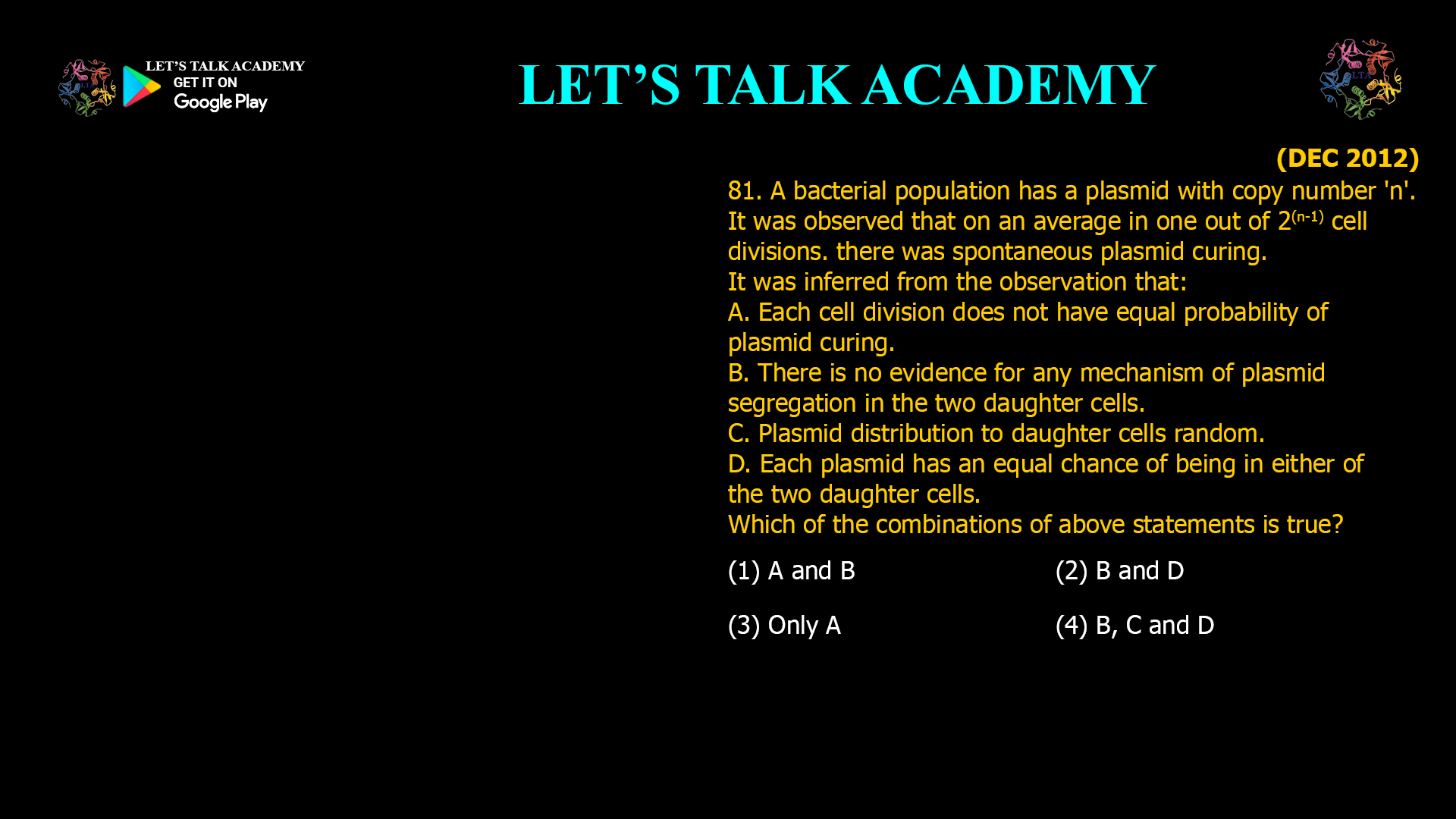
81. A bacterial population has a plasmid with copy number ‘n’. It was observed that on an average in one out of 2(n-1) cell divisions. there was spontaneous plasmid curing. It was inferred from the observation that:
A. Each cell division does not have equal probability of plasmid curing.
B. There is no evidence for any mechanism of plasmid segregation in the two daughter cells.
C. Plasmid distribution to daughter cells random.
D. Each plasmid has an equal chance of being in either of the two daughter cells.
Which of the combinations of above statements is true?
(1) A and B
(2) B and D
(3) only A
(4) B, C and D
Background
In bacterial populations, plasmids are extrachromosomal DNA elements that replicate independently. The copy number ‘n’ of a plasmid refers to the average number of plasmid copies per cell. During cell division, plasmids must be distributed to daughter cells to maintain plasmid inheritance. Plasmid curing refers to the loss of plasmids from cells, which can occur spontaneously.
Interpretation of the Observation
-
The observed spontaneous plasmid curing frequency is approximately 1 in 2(n-1) cell divisions.
-
This frequency suggests that plasmid segregation to daughter cells occurs randomly rather than by an active partitioning mechanism.
-
If plasmids were actively segregated, curing rates would be much lower due to precise distribution.
Analysis of Statements
A. Each cell division does not have equal probability of plasmid curing.
-
This is not supported by the observation; spontaneous curing is a probabilistic event consistent across divisions.
B. There is no evidence for any mechanism of plasmid segregation in the two daughter cells.
-
True. The curing frequency suggests lack of active segregation, implying random partitioning.
C. Plasmid distribution to daughter cells is random.
-
True. Random segregation leads to expected curing rates matching the observed frequency.
D. Each plasmid has an equal chance of being in either of the two daughter cells.
-
True. This assumption underlies the random segregation model.
Supporting Evidence from Literature
-
Many low-copy-number plasmids encode partitioning (par) systems that actively segregate plasmids using ATPase-driven mechanisms and centromere-like sites to ensure faithful inheritance.
-
High-copy-number plasmids often rely on random distribution due to their abundance, minimizing plasmid loss probability.
-
The observed curing frequency aligns with a random segregation model, where each plasmid independently segregates to daughter cells with equal probability.
Correct Combination of Statements
(4) B, C and D
Summary Table
| Statement | Correctness | Explanation |
|---|---|---|
| A | False | Curing probability is consistent per division |
| B | True | No evidence of active segregation mechanism |
| C | True | Plasmid distribution is random |
| D | True | Each plasmid equally likely in either daughter |
Conclusion
The spontaneous plasmid curing frequency observed indicates that plasmid segregation occurs randomly without an active partitioning mechanism. Each plasmid copy has an equal chance of being inherited by either daughter cell, leading to the calculated curing rate. Therefore, statements B, C, and D are true, while statement A is incorrect.
Keywords
plasmid curing, plasmid segregation, bacterial plasmids, random plasmid distribution, partitioning systems, plasmid copy number, bacterial cell division, plasmid inheritance, par systems, plasmid loss frequency
Final answer:
(4) B, C and D


11 Comments
Surbhi Rajawat
July 29, 20251st 2nd and 3rd statements are correct, though I was not aware of the term “plasmid curing” but the test explanation made it all clear.
Soniya Shekhawat
July 29, 2025Very informative with easy explanation
Kajal
July 29, 2025Option 4 is correct but not aware about it but the detailed helped much
Dipti Sharma
July 29, 2025Correct answer: 4
B,C,D statements are correct
Although seems complicated at first but we can choose right answer by eliminating the options bcz option D was correct for sure .
Explanation made it more clear
Vijay Marmat
July 30, 2025Guru Dev
Shivani panwar
July 30, 2025Ans is 4
Mahima Sharma
August 3, 20254th
Aafreen Khan
August 23, 2025Done by explanation ✅
Komal Sharma
October 5, 2025The spontaneous plasmid curing frequency observed indicates that plasmid segregation occurs randomly without an active partitioning mechanism. Each plasmid copy has an equal chance of being inherited by either daughter cell, leading to the calculated curing rate
Deepika Sheoran
November 7, 2025Option 4 th is correct answer
Rishu
April 9, 2026Done sir