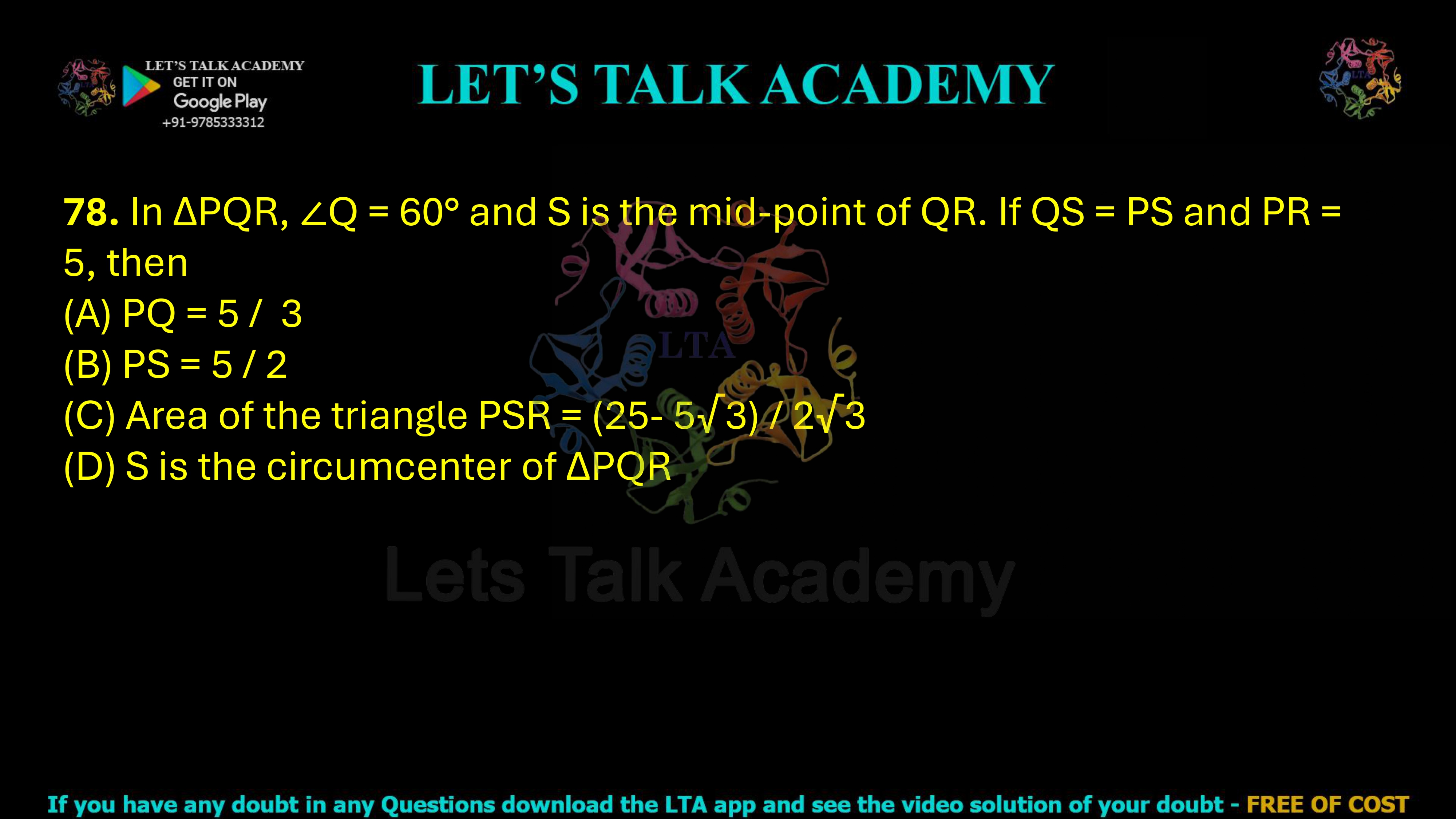
78. In ΔPQR, ∠Q = 60° and S is the midpoint of QR. If QS = PS and PR = 5, then
(A) PQ = 5√3/3
(B) PS = 5/2
(C) Area of ΔPSR = (25 − 5√3)/(2√3)
(D) S is the circumcenter of ΔPQR
Triangle Geometry with Midpoint and Equal Distances
At first glance, the question appears lengthy because it contains several conditions. However, by introducing a suitable coordinate system, the entire problem becomes straightforward. The given information that S is the midpoint of QR and that QS = PS provides a strong clue that coordinate geometry will simplify the calculations considerably.
Correct Answer
Options (A) and (D)
Understanding the Given Information
The problem gives four important pieces of information:
- ∠Q = 60°.
- S is the midpoint of QR.
- QS = PS.
- PR = 5.
The equality QS = PS immediately suggests that S is equidistant from Q and P. Since S is also the midpoint of QR, we already know that QS = SR. Therefore, if we can show these distances are equal, S will be equidistant from P, Q, and R, making it the circumcenter.
Step 1: Choose a Convenient Coordinate System
Let
Q = (0,0)
R = (2a,0)
Since S is the midpoint of QR,
S = (a,0).
Also,
QS = a.
Given that
PS = QS,
we have
PS = a.
Step 2: Use the 60° Angle
Since ∠Q = 60°, let
P = (t/2, √3t/2),
where t = PQ.
Now use the condition
PS = a.
Applying the distance formula,
(t/2 − a)² + (√3t/2)² = a².
Simplifying,
t² − at = 0.
Since t ≠ 0,
t = a.
Therefore,
PQ = a.
Step 3: Use the Cosine Rule
In triangle PQR,
PQ = a,
QR = 2a,
∠Q = 60°.
Applying the cosine rule,
PR² = PQ² + QR² − 2(PQ)(QR)cos60°
= a² + (2a)² − 2(a)(2a)(1/2)
= a² + 4a² − 2a²
= 3a².
Since
PR = 5,
we obtain
3a² = 25.
Therefore,
a = 5/√3 = 5√3/3.
Hence,
PQ = 5√3/3.
Thus, Option (A) is correct.
Step 4: Check the Remaining Options
Option (B): PS = 5/2
We found
PS = a = 5√3/3,
which is approximately 2.887.
Since
5/2 = 2.5,
the values are different.
Option (B) is incorrect.
Option (C): Area of ΔPSR
The base SR equals a.
The perpendicular height from P to SR equals
√3a/2.
Hence,
Area = (1/2)(a)(√3a/2)
= √3a²/4.
Since
a² = 25/3,
Area = 25√3/12.
This is not equal to
(25 − 5√3)/(2√3).
Option (C) is incorrect.
Option (D): S is the Circumcenter
We already know
QS = PS.
Since S is the midpoint of QR,
QS = SR.
Therefore,
SP = SQ = SR.
Thus, S is equidistant from all three vertices P, Q, and R.
By definition, the point equidistant from the three vertices of a triangle is its circumcenter.
Hence, Option (D) is correct.
Verification
PQ = 5√3/3 ✔
PS = 5√3/3 ✔
Area = 25√3/12 ✔
S is equidistant from P, Q, and R ✔
Therefore, only Options (A) and (D) satisfy all the given conditions.
Alternative Method
The problem can also be solved using classical Euclidean geometry by constructing the median QS, applying the cosine rule, and using properties of the circumcenter. However, the coordinate geometry approach is shorter, more systematic, and less prone to algebraic mistakes.
Key Takeaways
Whenever a problem involves a midpoint together with equal distances, consider introducing coordinates. This often converts geometric relationships into simple algebraic equations. Also remember that a point equidistant from the three vertices of a triangle is the circumcenter.
Final Answer
We obtain
PQ = 5√3/3
and
S is the circumcenter of ΔPQR.
Correct Options: (A) and (D)


