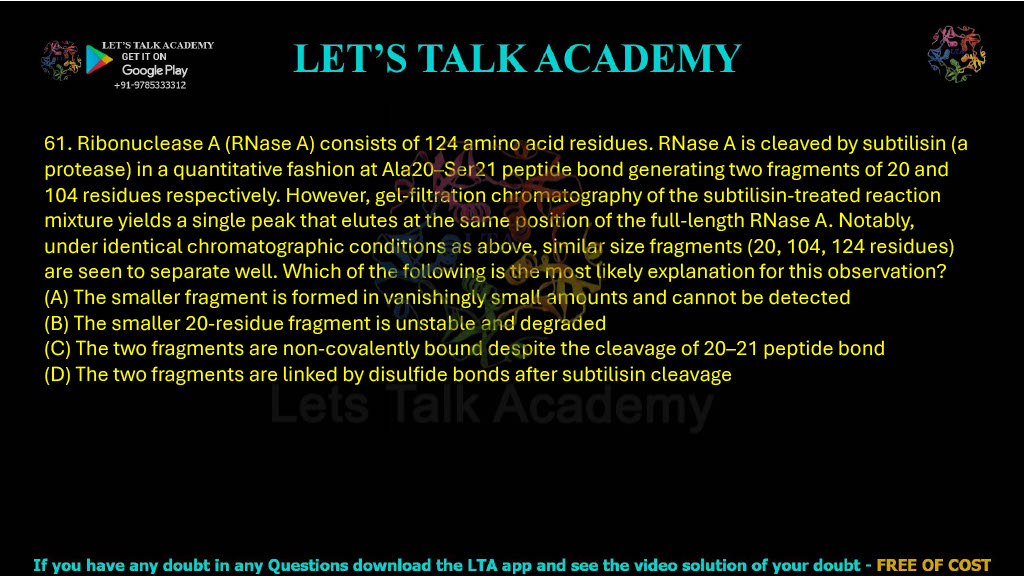
61. Ribonuclease A (RNase A) consists of 124 amino acid residues. RNase A is cleaved by subtilisin (a protease)
in a quantitative fashion at the Ala 20 – Ser 21 peptide bond generating two fragments of 20 and 104 residues respectively.
However, gel-filtration chromatography of the subtilisin-treated reaction mixture yields a single peak that elutes at the same
position as full-length RNase A. Notably, under identical chromatographic conditions as above, similar size fragments
(20, 104, 124 residues) are seen to separate well. Which of the following is the most likely explanation for this observation?
A. The smaller fragment is formed in vanishingly small amounts and cannot be detected
B. The 20-residue fragment is unstable and degraded
C. The two fragments are non-covalently bound despite the cleavage of the 20–21 peptide bond
D. The two fragments are linked by disulfide bonds after subtilisin cleavage
Correct Answer: D. The two fragments are linked by disulfide bonds after subtilisin cleavage
RNase A contains disulfide bonds that covalently link the N-terminal 20-residue fragment to the C-terminal 104-residue fragment despite peptide bond cleavage, maintaining identical hydrodynamic volume to intact protein in gel-filtration.
Option Analysis
A. The smaller fragment is formed in vanishingly small amounts and cannot be detected
Incorrect. Question states subtilisin cleaves RNase A “quantitatively,” guaranteeing substantial 20-residue fragment formation. Single peak rules out trace amounts.
B. The 20-residue fragment is unstable and degraded
Incorrect. Quantitative cleavage produces stable peptide fragment. Degradation would yield multiple smaller peaks, not single peak matching full-length RNase A.
C. The two fragments are non-covalently bound despite the cleavage
Incorrect. Non-covalent interactions typically weaken under gel-filtration conditions, producing separate peaks for 20 vs 104 residues (confirmed by control experiment).
D. The two fragments are linked by disulfide bonds (Correct)
RNase A has 4 disulfide bonds, including inter-fragment bridges (Cys26-Cys84, Cys40-Cys95, Cys58-Cys110, Cys65-Cys72). Subtilisin cleaves peptide bond only; disulfide bonds maintain covalent linkage, preserving native size/shape for identical elution.
RNase A fragments linked by disulfide bonds explains single gel-filtration peak despite quantitative subtilisin cleavage at Ala20-Ser21—classic biochemistry puzzle for GATE Life Sciences.
Disulfide Bond Mechanism
Subtilisin cleaves peptide backbone (124→20+104 residues) but RNase A’s 4 disulfide bridges covalently tether fragments. Hydrodynamic volume remains identical to intact protein (15.3 kDa), eluting as single peak unlike control fragments.
Option Elimination Table
| Option |
Peak Pattern |
Matches Observation? |
| A. Trace fragment |
Single peak |
No (quantitative cleavage) |
| B. Degradation |
Multiple peaks |
No |
| C. Non-covalent |
Two peaks |
No (control separates) |
| D. Disulfide bonds |
Single peak |
Yes |
GATE Relevance
Tests protein chemistry (disulfide mapping, protease specificity) and gel-filtration principles. RNase A = model protein for oxidation/reduction studies in biochemistry.


1 Comment
Kanica Sunwalka
June 27, 20262 fragments r linked by disuphide bonds