
1. Introduction
RNA is traditionally considered an intermediate molecule that carries genetic information from DNA to protein. However, in many organisms and cellular systems, the information present in RNA does not always remain identical to the sequence directly transcribed from DNA.
In RNA editing, the RNA molecule undergoes specific changes after transcription. These changes can alter individual nucleotides, introduce or remove nucleotides, or modify the information contained within the RNA.
As a result, the final RNA can differ from the original RNA transcript produced from the DNA template.
A simplified representation is:
DNA
↓
Transcription
↓
Primary RNA
↓
RNA Editing
↓
Edited RNA
↓
Translation or other cellular function
RNA editing therefore provides an additional layer of gene regulation and expands the functional information that can be generated from the genome.
2. Definition of RNA Editing
2.1 Basic Definition
RNA editing is a post-transcriptional process in which the nucleotide sequence or nucleotide identity of an RNA molecule is specifically altered after transcription.
The changes may involve:
- nucleotide substitution,
- nucleotide insertion,
- nucleotide deletion.
In some broader contexts, chemically modified nucleotides are also discussed in relation to RNA editing and post-transcriptional RNA modification, although the two concepts are not completely identical.
2.2 Fundamental Concept
The central idea can be represented as:
DNA sequence → RNA transcript → altered RNA sequence
Therefore, the final RNA may contain information that is not represented exactly in the original DNA template.
3. Discovery and Biological Concept
RNA editing was first recognized through observations in which mature RNA sequences did not match the corresponding DNA sequences.
One of the classic examples came from mitochondrial RNAs of kinetoplastid organisms, where uridine residues are inserted into or deleted from RNA after transcription.
Later, other forms of editing were identified in animals, plants, fungi, and other organisms.
These discoveries demonstrated that RNA can undergo controlled sequence changes after transcription.
4. Major Types of RNA Editing
RNA editing can broadly be divided into several categories.
4.1 Base Substitution Editing
One nucleotide base is converted into another.
Major examples include:
- A-to-I editing
- C-to-U editing
4.2 Insertion Editing
One or more nucleotides are inserted into the RNA after transcription.
4.3 Deletion Editing
One or more nucleotides are removed from the RNA after transcription.
4.4 Complex Editing
Some organisms contain RNA-editing systems involving multiple nucleotide insertions, deletions, and substitutions.
5. Base Substitution Editing

Base substitution editing changes the chemical identity of a nucleotide without necessarily adding or removing nucleotides.
Two important forms are:
A → I
and
C → U
These reactions are generally catalyzed by deaminase enzymes.
6. A-to-I RNA Editing
6.1 Definition
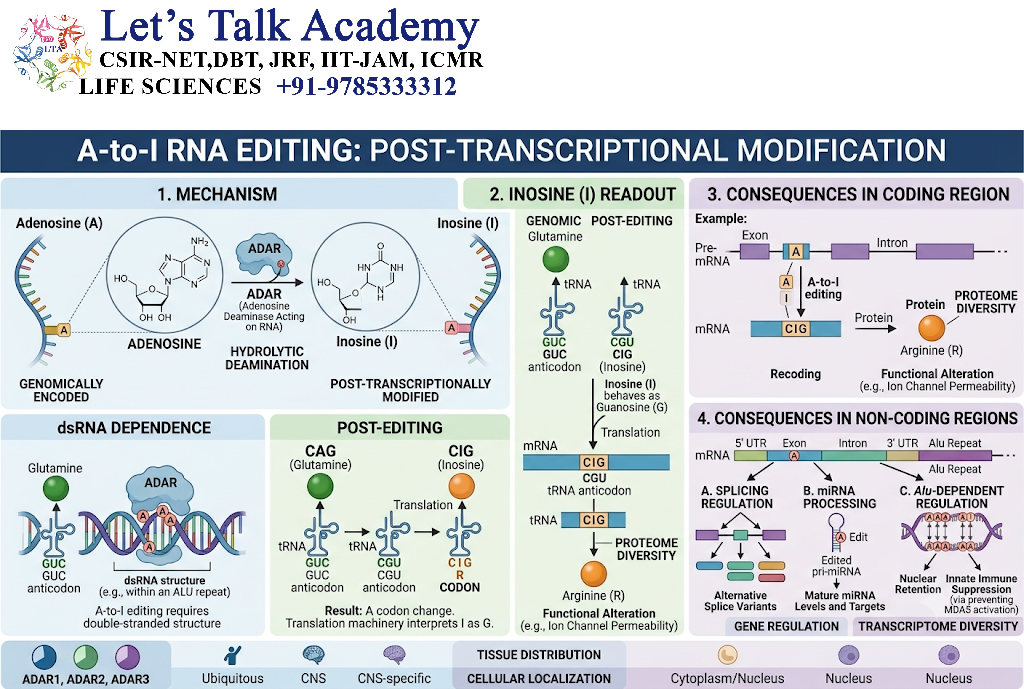
A-to-I RNA editing is the enzymatic conversion of adenosine to inosine within RNA.
The enzymes responsible belong to the:
ADAR — Adenosine Deaminase Acting on RNA
family.
The overall reaction is:
Adenosine → Inosine
6.2 Functional Interpretation of Inosine
Inosine has base-pairing properties that allow it to be interpreted similarly to guanosine during several cellular processes.
Therefore:
A → I
editing can functionally behave like:
A → G
at the RNA level.
This can change RNA coding information and regulatory properties.
7. ADAR Enzymes
7.1 Definition
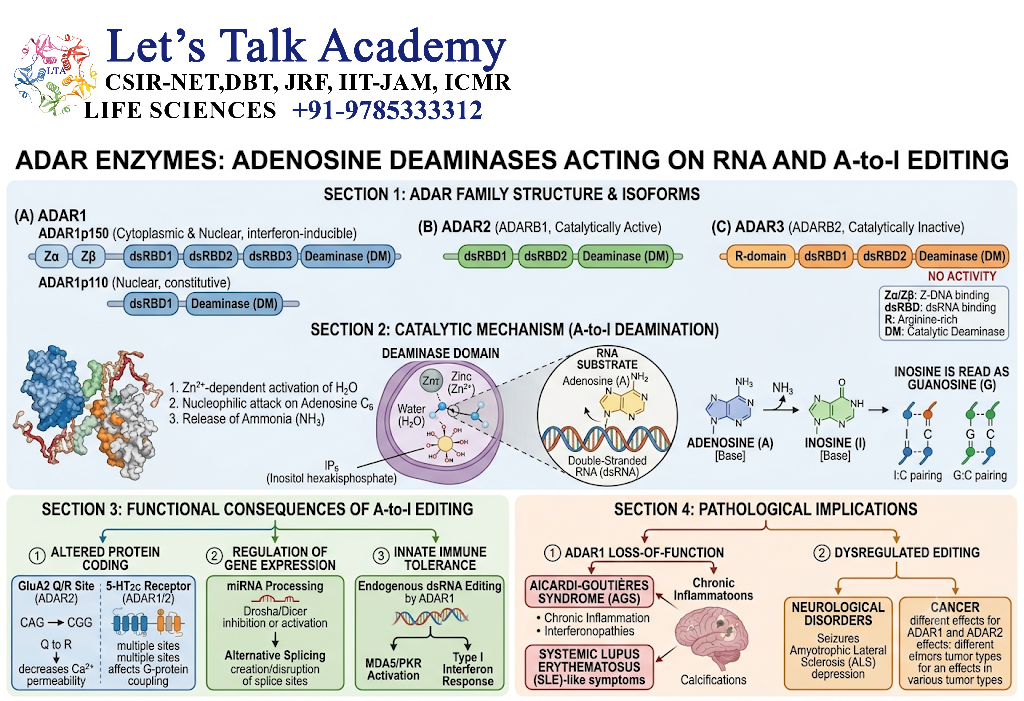
ADARs are enzymes that catalyze adenosine deamination within double-stranded or structured regions of RNA.
The major mammalian ADAR proteins include:
- ADAR1,
- ADAR2,
- ADAR3.
ADAR1 and ADAR2 have well-established catalytic editing functions, whereas ADAR3 is generally considered catalytically inactive or substantially less active under typical cellular conditions.
7.2 Catalytic Reaction
ADAR enzymes convert adenosine into inosine by a hydrolytic deamination reaction.
During the reaction:
Adenosine + H₂O → Inosine + NH₃
The exact catalytic chemistry involves a zinc-dependent deaminase mechanism.
8. Substrate Recognition by ADAR

ADAR enzymes generally recognize structured RNA regions, particularly double-stranded RNA structures.
These structures may arise when complementary sequences within the same RNA molecule base-pair with each other.
A simplified representation is:
RNA sequence
↓
Intramolecular base pairing
↓
Double-stranded RNA region
↓
ADAR binding
↓
A-to-I editing
The surrounding RNA sequence and structure influence which adenosine residues are edited.
9. Site-Selective A-to-I Editing

Not every adenosine in an RNA molecule is edited.
Editing can be:
- site-selective,
- transcript-specific,
- tissue-specific,
- developmentally regulated.
In some transcripts, a particular adenosine is strongly preferred as an editing site.
This allows the cell to generate precise RNA variants.
10. Coding-Region A-to-I Editing
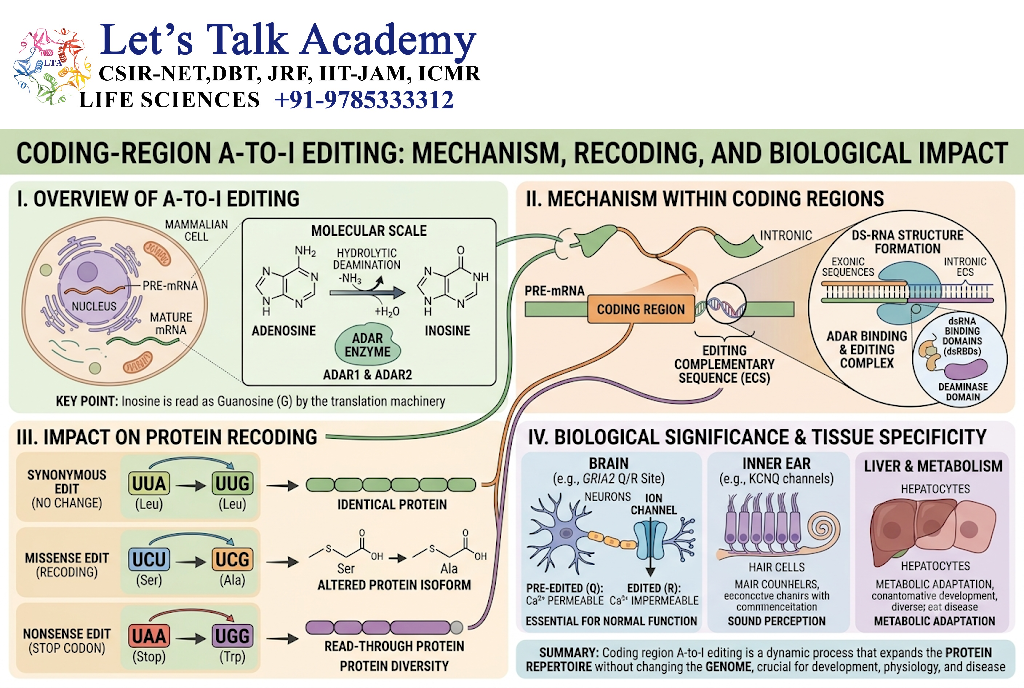
A-to-I editing can occur within protein-coding regions.
Because inosine can be interpreted as guanosine during decoding, editing can alter a codon.
For example, an RNA codon containing:
A
may be changed functionally through:
A → I
which can result in a different codon interpretation.
Consequently:
DNA → one RNA sequence → editing → alternative RNA sequence → different protein sequence
This can increase protein diversity.
11. Functional Example of A-to-I Editing
One important example occurs in transcripts encoding components of the nervous system.
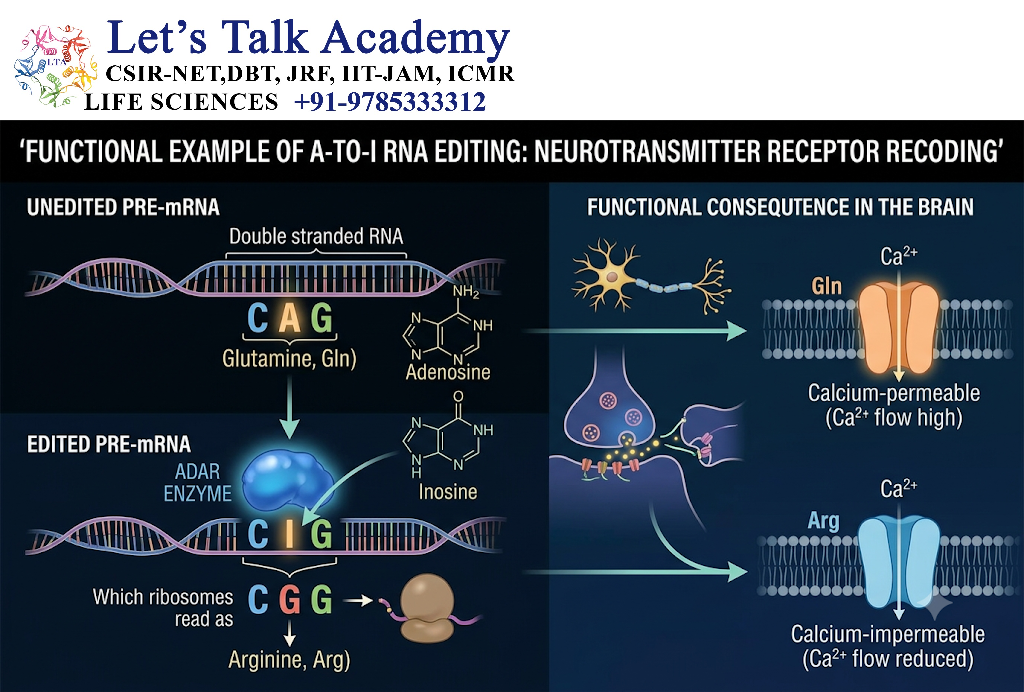
Editing of specific RNA transcripts can alter the amino acid sequence of ion-channel or receptor proteins.
A well-known example involves the GluA2 subunit of the AMPA-type glutamate receptor.
Editing at a specific site changes the encoded amino acid and has major effects on the physiological properties of the receptor.
This demonstrates that a single RNA editing event can have a significant functional consequence.
12. A-to-I Editing in the Nervous System

RNA editing is particularly important in the nervous system.
It can influence:
- ion channels,
- neurotransmitter receptors,
- synaptic proteins,
- neuronal signaling.
Because nervous-system function requires precise regulation of membrane proteins and signaling pathways, RNA editing provides an additional mechanism for generating functional diversity.
13. RNA Editing and Innate Immunity
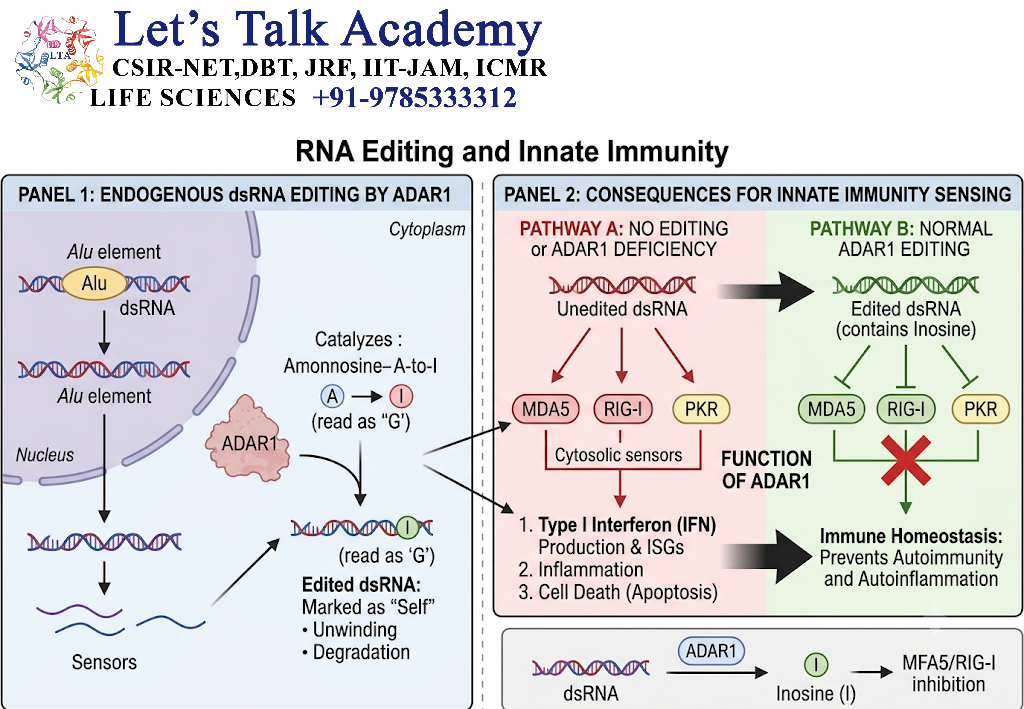
A-to-I editing also has an important role in innate immune regulation.
ADAR1 can modify endogenous double-stranded RNA structures.
This can reduce inappropriate recognition of cellular RNA by innate immune sensors.
Therefore, RNA editing contributes to the distinction between:
self RNA
and
potentially foreign RNA
This is particularly important in controlling excessive antiviral immune responses.
14. C-to-U RNA Editing

14.1 Definition
C-to-U RNA editing involves conversion of cytidine to uridine in an RNA molecule.
The reaction is catalyzed by cytidine deaminase-type enzymes.
The general reaction is:
Cytidine → Uridine
14.2 Mechanism
Cytidine undergoes hydrolytic deamination.
Simplified:
Cytidine + H₂O → Uridine + NH₃
15. APOBEC Family and RNA Editing
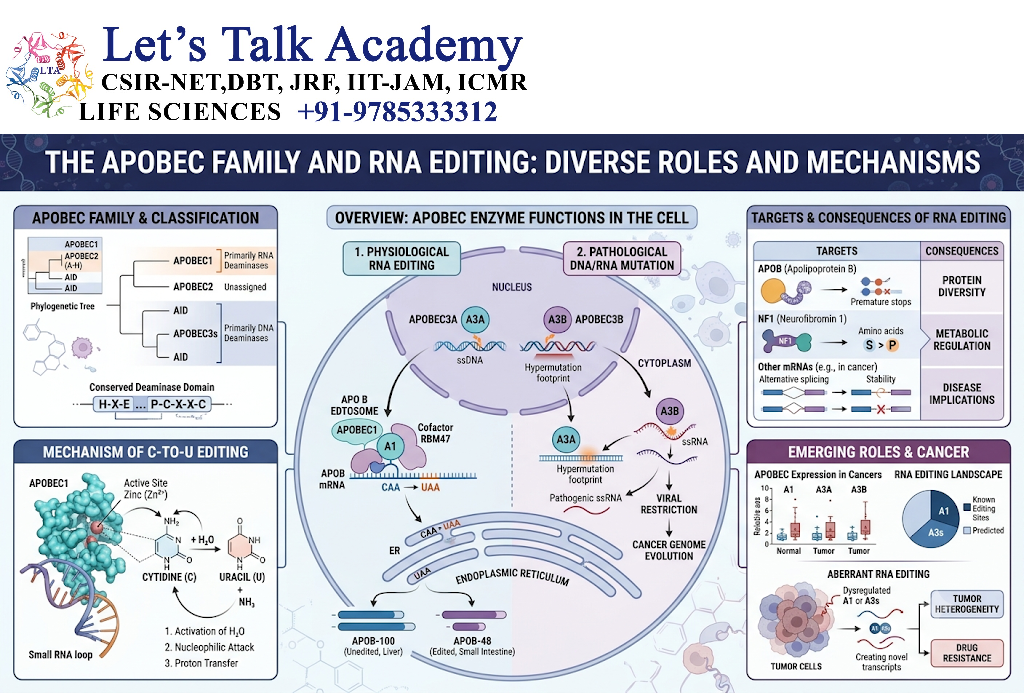
Members of the APOBEC family are cytidine deaminases.
Some APOBEC proteins can catalyze C-to-U editing in particular RNA contexts.
The exact substrate specificity and biological function depend on the enzyme and organism.
16. Functional Consequences of C-to-U Editing
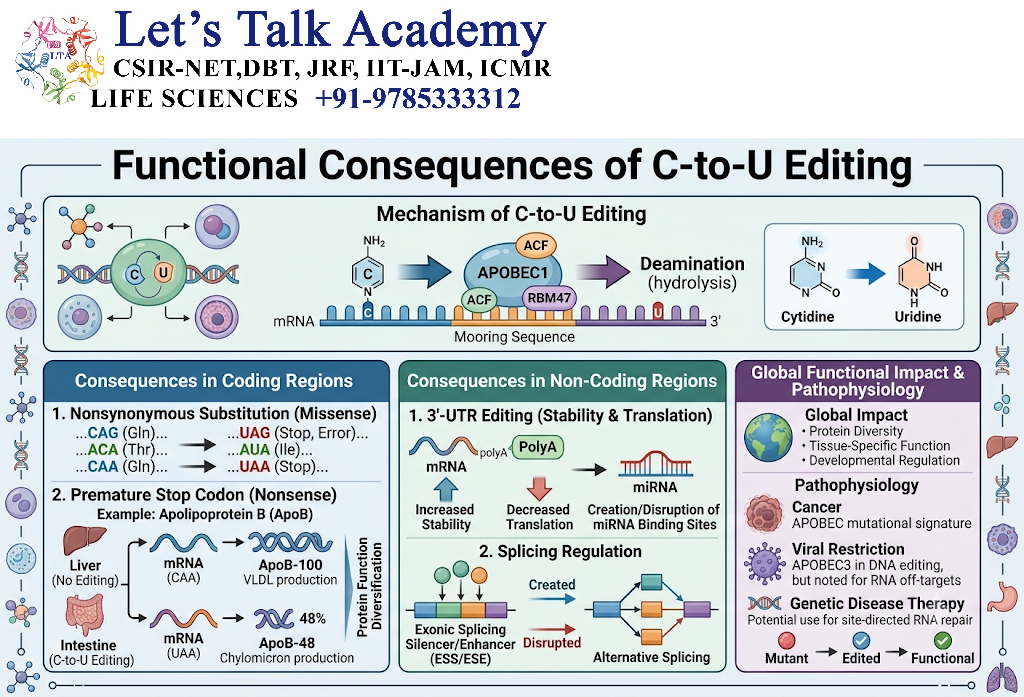
C-to-U editing can:
- alter codons,
- generate or remove stop codons,
- change RNA stability,
- affect RNA localization,
- modify regulatory sequences.
Therefore, even a single nucleotide substitution can have major consequences.
17. Insertion and Deletion Editing
17.1 Definition
Insertion and deletion editing involves the addition or removal of nucleotides from an RNA molecule after transcription.
This is fundamentally different from base substitution editing.
In substitution:
A → I
or
C → U
In insertion/deletion editing:
RNA sequence → additional or missing nucleotide(s)
18. Kinetoplastid RNA Editing
One of the best-known examples of insertion and deletion editing occurs in the mitochondrial RNA of kinetoplastids, such as trypanosomes.
These organisms contain mitochondrial DNA organized into specialized structures called kinetoplasts.
Many mitochondrial transcripts require extensive editing before they can function properly.
19. Guide RNAs
19.1 Definition
Guide RNAs (gRNAs) provide information that helps determine where nucleotides should be inserted or deleted during RNA editing.
The guide RNA contains sequence information that can base-pair with the target RNA.
This provides a template-like guide for editing.
19.2 Importance
Guide RNAs are therefore essential for determining the pattern of many insertion/deletion editing reactions in kinetoplastids.
20. Kinetoplastid RNA Editing Mechanism
A simplified mechanism is:
Pre-edited RNA
↓
Guide RNA pairing
↓
Identification of editing region
↓
Endonucleolytic cleavage
↓
Uridine insertion or deletion
↓
RNA ligation
↓
Progressive editing
↓
Mature edited RNA
Several proteins participate in this process.
21. Uridine Insertion and Deletion
In kinetoplastid mitochondria, the most characteristic editing event involves:
Uridine (U)
The editing machinery can:
- insert U residues,
- remove U residues.
These changes can restore or create the correct coding information.
22. Enzymes in Insertion/Deletion Editing
Important activities can include:
- endonuclease,
- terminal uridylyl transferase,
- 3′-5′ exonuclease,
- RNA ligase.
These enzymes work together as part of an RNA-editing complex.
23. RNA Editing Complex
Kinetoplastid RNA editing involves large protein complexes commonly referred to as:
Editosomes
Editosomes contain multiple proteins with different biochemical functions.
They coordinate:
- RNA recognition,
- cleavage,
- nucleotide addition or removal,
- RNA ligation.
24. Step-by-Step Kinetoplastid Editing
24.1 Step 1: Guide RNA Binding
The guide RNA pairs with the target pre-edited RNA.
24.2 Step 2: Mismatch Recognition
Incorrectly paired regions identify the location where editing is required.
24.3 Step 3: RNA Cleavage
The target RNA is cleaved near the editing site.
24.4 Step 4: Uridine Addition or Removal
Uridine residues are inserted or removed according to the information provided by the guide RNA.
24.5 Step 5: RNA Ligation
The edited RNA fragments are joined.
24.6 Step 6: Editing Progression
The guide RNA can direct additional rounds of editing until the mature transcript is produced.
25. RNA Editing in Plants
RNA editing is also widespread in plant organelles.
It occurs particularly in:
- chloroplast transcripts,
- mitochondrial transcripts.
A common form of plant organellar RNA editing involves:
C → U
In some plants, additional types of editing can also occur.
26. RNA Editing in Plant Organelles
Plant organellar RNA editing can influence:
- protein-coding sequences,
- RNA maturation,
- translation,
- organelle function.
Editing is therefore an important part of chloroplast and mitochondrial gene expression.
27. RNA Editing and Gene Expression
RNA editing provides a regulatory layer between transcription and translation.
The pathway can be represented as:
DNA
↓
Transcription
↓
Primary RNA
↓
RNA Editing
↓
Edited RNA
↓
Translation
Thus, the cell can modify genetic information after transcription without altering the DNA sequence.
28. RNA Editing and Protein Diversity
RNA editing can generate protein variants from the same gene.
For example:
One DNA sequence
↓
One primary RNA
↓
Different editing states
↓
Different mature RNAs
↓
Different protein products
This increases the functional diversity that can be generated from a limited genome.
29. RNA Editing and Alternative Gene Products
RNA editing can change:
- amino acid sequence,
- stop codons,
- RNA reading frame,
- regulatory elements.
Therefore, editing can create functionally different gene products.
30. RNA Editing and Stop Codons
Editing can sometimes create or eliminate a stop codon.
For example, a nucleotide substitution can convert a codon into a termination codon.
Alternatively, editing can remove a termination signal and allow translation to continue.
This provides a powerful mechanism for regulating protein length.
31. RNA Editing and Reading Frame
Insertion or deletion of nucleotides can alter the reading frame.
If one or two nucleotides are inserted or removed, the reading frame may shift.
This can dramatically change the resulting protein sequence.
In contrast, insertion or deletion of three nucleotides can preserve the reading frame while adding or removing an amino acid.
32. RNA Editing and RNA Stability
Editing can influence RNA stability.
Changes in RNA sequence or structure can alter interactions with:
- RNA-binding proteins,
- microRNAs,
- nucleases,
- RNA surveillance factors.
Therefore, editing can determine how long an RNA molecule remains stable.
33. RNA Editing and RNA Structure
RNA function often depends on secondary and tertiary structure.
Editing can change:
- base pairing,
- stem-loop structures,
- RNA-protein interactions,
- accessibility of regulatory sites.
Thus, RNA editing can influence RNA structure as well as sequence.
34. RNA Editing and RNA Localization
Some editing events can alter the interaction of RNA with cellular proteins.
This can influence where the RNA is transported or retained within the cell.
Possible locations include:
- nucleus,
- cytoplasm,
- mitochondria,
- neuronal compartments.
35. RNA Editing and Translation
Editing can influence translation in several ways.
It may:
- alter a codon,
- change protein sequence,
- create a stop codon,
- remove a stop codon,
- modify translation efficiency.
Therefore, RNA editing can directly affect protein production.
36. Regulation of RNA Editing
RNA editing is highly regulated.
Important determinants include:
- editing enzyme concentration,
- RNA sequence,
- RNA secondary structure,
- cellular localization,
- developmental stage,
- tissue type,
- signaling pathways,
- interacting proteins.
37. Tissue-Specific Editing
The same RNA may be edited differently in different tissues.
For example, an editing enzyme may be highly expressed in:
- nervous tissue,
while having lower activity in another tissue.
As a result, the final RNA products can differ between cell types.
38. Developmental Regulation
RNA editing patterns can change during development.
Changes in:
- enzyme expression,
- RNA-binding proteins,
- RNA structure,
can modify editing efficiency.
Thus, RNA editing can contribute to developmental regulation of gene expression.
39. Substrate Recognition
Editing enzymes must distinguish their target RNA from the large number of other RNA molecules in the cell.
Recognition can depend on:
- primary sequence,
- secondary structure,
- neighboring nucleotides,
- RNA-binding proteins,
- subcellular localization.
Therefore, RNA editing is generally a highly selective process.
40. RNA Editing Versus RNA Modification
RNA editing and RNA modification are related but distinct concepts.
40.1 RNA Editing
RNA editing changes the information represented by the RNA sequence.
Examples:
- A → I,
- C → U,
- nucleotide insertion,
- nucleotide deletion.
40.2 RNA Modification
RNA modification changes the chemical properties of a nucleotide without necessarily changing the sequence information in the same way.
Examples include:
- m⁶A,
- pseudouridine,
- 2′-O-methylation.
41. RNA Editing Versus RNA Splicing
| Feature | RNA Editing | RNA Splicing |
|---|---|---|
| Main event | RNA sequence alteration | Intron removal |
| Nucleotide changes | May occur | Usually no nucleotide identity change |
| Major mechanism | Deamination/insertion/deletion | Transesterification |
| Major machinery | Editing enzymes/complexes | Spliceosome |
| Main outcome | Altered RNA information | Joined exons |
42. RNA Editing Versus DNA Mutation
RNA editing occurs after transcription and generally does not permanently change the DNA sequence.
A DNA mutation, in contrast, changes the genetic material itself.
Therefore:
DNA mutation → change in genome
RNA editing → change in RNA
This distinction is fundamental.
43. RNA Editing and Epigenetic Regulation
RNA editing is not generally classified as a classical DNA-level epigenetic modification.
However, it represents an important post-transcriptional regulatory mechanism.
It allows the cell to regulate gene expression without changing the underlying DNA sequence.
44. RNA Editing and Non-Coding RNA
RNA editing can occur in non-coding RNAs as well as protein-coding RNAs.
Editing can influence:
- RNA structure,
- RNA-protein interactions,
- RNA stability,
- regulatory activity.
Therefore, the effects of RNA editing are not limited to protein production.
45. RNA Editing in microRNAs
Editing can occur within primary or mature microRNA pathways.
Changes in microRNA sequence can alter which target RNAs are recognized.
Therefore, RNA editing can potentially change the regulatory specificity of a microRNA.
46. RNA Editing and Immune Regulation
RNA editing can influence immune pathways through changes in RNA recognition.
ADAR1-mediated editing is particularly important because it can reduce inappropriate activation of innate immune sensors by endogenous double-stranded RNA.
Therefore:
RNA editing → altered RNA recognition → immune regulation
47. RNA Editing and Viral Infection
Viruses interact with host RNA-editing systems in complex ways.
RNA editing can:
- alter viral RNA,
- influence viral replication,
- affect host immune recognition,
- contribute to antiviral responses.
Some viruses may also evolve mechanisms that interfere with host RNA-editing pathways.
48. RNA Editing and Disease
Abnormal RNA editing has been associated with various biological disorders.
Changes can result from:
- altered editing enzyme expression,
- abnormal RNA structure,
- changes in regulatory factors,
- altered editing-site selection.
Disrupted RNA editing has been investigated in several conditions involving:
- nervous-system dysfunction,
- immune dysregulation,
- cancer,
- developmental abnormalities.
The exact contribution varies among diseases and specific editing pathways.
49. RNA Editing in Cancer
Altered RNA-editing patterns have been observed in various cancers.
Changes in ADAR activity and other editing pathways can influence:
- cell proliferation,
- survival,
- signaling,
- immune interactions,
- tumor progression.
RNA editing is therefore an important area of molecular and cellular research.
50. Biological Advantages of RNA Editing
RNA editing provides several potential advantages.
50.1 Increased Molecular Diversity
One gene can produce multiple RNA variants.
50.2 Tissue-Specific Regulation
Different tissues can generate different edited transcripts.
50.3 Developmental Regulation
Editing patterns can change during development.
50.4 Rapid Regulation
RNA can be modified without changing DNA.
50.5 Functional Adaptation
Editing can adjust RNA and protein function according to cellular conditions.
51. Limitations and Risks of RNA Editing
RNA editing must be tightly controlled.
Excessive or inappropriate editing may:
- alter essential proteins,
- disrupt RNA stability,
- change immune signaling,
- interfere with normal gene expression.
Therefore, editing enzymes and their target RNAs are subject to regulatory mechanisms.
52. Mechanistic Summary of A-to-I Editing
The basic mechanism is:
Double-stranded RNA region
↓
ADAR binding
↓
Target adenosine recognition
↓
Hydrolytic deamination
↓
Adenosine → Inosine
↓
Altered RNA structure or coding information
↓
Functional consequence
53. Mechanistic Summary of C-to-U Editing
The basic mechanism is:
Target RNA
↓
Cytidine deaminase recognition
↓
Cytidine deamination
↓
Cytidine → Uridine
↓
Altered RNA sequence
↓
Functional consequence
54. Mechanistic Summary of Insertion/Deletion Editing
The basic mechanism is:
Pre-edited RNA
↓
Guide RNA recognition
↓
Target RNA cleavage
↓
Nucleotide insertion/deletion
↓
RNA ligation
↓
Edited RNA
55. Major RNA Editing Systems
| Editing type | Major change | Representative machinery |
|---|---|---|
| A-to-I | Adenosine → Inosine | ADAR proteins |
| C-to-U | Cytidine → Uridine | Cytidine deaminase-type enzymes |
| U insertion | Addition of uridine | Editosome-associated machinery |
| U deletion | Removal of uridine | Editosome-associated machinery |
56. Comparison of Major Editing Types
| Feature | A-to-I | C-to-U | Insertion/Deletion |
|---|---|---|---|
| Basic change | Base conversion | Base conversion | Nucleotide addition/removal |
| Starting base | A | C | Depends on system |
| Product | I | U | Altered RNA length |
| Major mechanism | Deamination | Deamination | Cleavage, insertion/deletion, ligation |
| Important examples | Animal nervous system, immune regulation | Plant organelles and selected animal transcripts | Kinetoplastid mitochondria |


