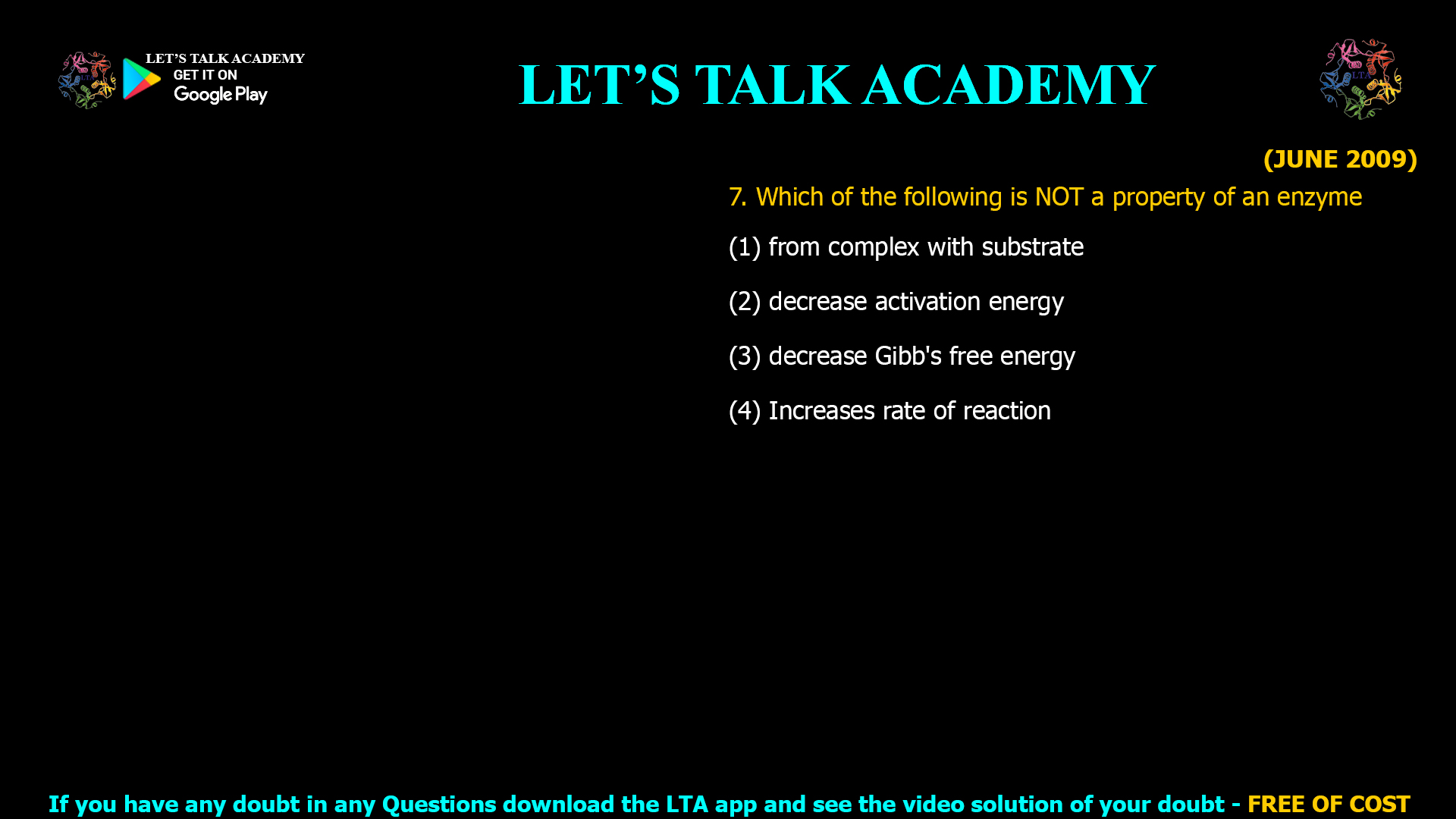
6. Which of the following is NOT a property of an enzyme
(1) from complex with substrate
(2) decrease activation energy
(3) decrease Gibb’s free energy
(4) Increases rate of reaction
Introduction
Enzymes are remarkable biological catalysts that play a critical role in life’s chemical processes by accelerating reaction rates without being consumed. They exhibit specific properties, such as forming complexes with substrates, lowering activation energy, and increasing the speed of reactions. However, one important aspect often misunderstood is their effect on Gibbs free energy (ΔG) of reactions. This article explores the key properties of enzymes, highlighting what enzymes can and cannot do, providing a comprehensive understanding suited for students and researchers in life sciences.
Enzyme Properties Explained
1. Formation of Enzyme-Substrate Complex
Enzymes are highly specific to their substrates and bind to them through a region called the active site. When a substrate binds, an enzyme-substrate (ES) complex forms as an intermediate step before the product is released. This complex stabilizes the substrate and facilitates the chemical reaction.
This property is fundamental because it ensures enzymes act only on specific molecules, controlling metabolic pathways precisely.
2. Decreasing Activation Energy
One of the defining roles of enzymes is to lower the activation energy (Ea) required for a reaction. Activation energy is the energy barrier that reactants must overcome to be transformed into products.
Enzymes stabilize the transition state, the highest energy intermediate, thus lowering this barrier. As a result, more substrate molecules can react at a given temperature, significantly increasing the reaction rate.
3. Increasing Rate of Reaction
By lowering activation energy, enzymes accelerate the rate at which reactions proceed. This increase enables biological processes to occur at speeds compatible with life.
Enzymes can enhance reaction rates by factors of millions or more compared to uncatalyzed reactions.
Why Enzymes Do Not Decrease Gibbs Free Energy (ΔG)
Gibbs free energy change (ΔG) of a reaction defines its spontaneity and equilibrium state:
-
ΔG<0: Reaction proceeds spontaneously.
-
ΔG=0: System at equilibrium.
-
ΔG>0: Reaction non-spontaneous as written.
Enzymes do not affect ΔG.
They only speed up the time it takes to reach equilibrium by enabling transformations via a different, lower-energy pathway but do not change:
-
The energy difference between reactants and products.
-
The position of equilibrium (relative concentrations at equilibrium).
-
The thermodynamic favorability of the reaction.
This means enzymes cannot make a non-spontaneous reaction spontaneous; they only hasten reactions that are already thermodynamically feasible.
Detailed Mechanism of Enzyme Action
-
Substrate Binding: The substrate fits into the enzyme’s active site, stabilized by hydrogen bonds, ionic interactions, and hydrophobic forces.
-
Transition State Stabilization: The enzyme alters the substrate binding to favor the transition state.
-
Catalysis: Chemical changes occur resulting in product formation.
-
Product Release: After the reaction, products dissociate, and the enzyme is free for new cycles.
This cycle accelerates the reaction but maintains the same overall ΔG.
Summary Table of Enzyme Properties
| Property | True for Enzymes? | Explanation |
|---|---|---|
| Form complex with substrate | Yes | Essential for substrate recognition and catalysis. |
| Decrease activation energy | Yes | Lowers the energy barrier for the reaction. |
| Increase reaction rate | Yes | Speeds up the reaction concentration changes. |
| Decrease Gibbs free energy | No | Does not affect thermodynamic spontaneity or equilibrium. |
Conclusion
Enzymes exhibit unique properties pivotal for biochemical reactions, including forming enzyme-substrate complexes, reducing activation energy, and increasing reaction rates. However, they do not affect the Gibbs free energy or the equilibrium state of the reactions they catalyze. Understanding these properties clarifies common misconceptions about enzyme function and highlights their role as efficient biological catalysts without altering reaction thermodynamics.
This knowledge is crucial for life sciences students, educators, and researchers studying biochemical pathways and catalysis.


