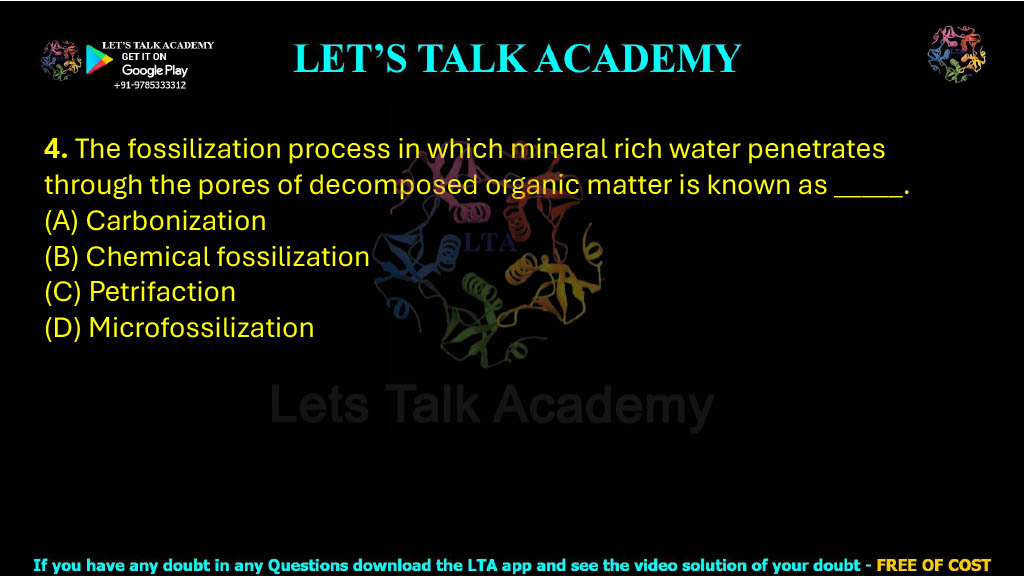
4. The fossilization process in which mineral rich water penetrates through the pores of decomposed organic matter is known as _____.
(A) Carbonization
(B) Chemical fossilization
(C) Petrifaction
(D) Microfossilization
Which Fossilization Process Occurs When Mineral-Rich Water Penetrates the Pores of Decomposed Organic Matter?
Correct Option: (C) Petrifaction
The fossilization process in which mineral-rich water penetrates the pores of decomposed organic matter is known as petrifaction. Therefore, Option (C) is the correct answer.
During petrifaction, groundwater containing dissolved minerals enters the microscopic spaces, pores, and cavities present in buried biological remains. The minerals gradually precipitate from the water and accumulate within these spaces. Over long periods of geological time, this process produces a hard, stone-like fossil while preserving important details of the original organism.
Petrifaction is particularly associated with the preservation of porous biological materials such as wood and bones. The famous formation of petrified wood is one of the clearest examples of this fossilization process.
What Is Petrifaction?
Petrifaction is a fossilization process in which the remains of an organism become hardened or stone-like because minerals are deposited within their tissues and spaces. The term is derived from the idea of organic material being transformed into a rock-like form.
After an organism dies, its remains may become rapidly buried under sediment. Burial helps protect the remains from scavengers, physical destruction, and complete decomposition. If mineral-rich groundwater later moves through the buried remains, dissolved minerals can enter the pores and internal cavities.
As environmental conditions change, the dissolved minerals precipitate from the water and become deposited inside the biological material. Repeated mineral deposition gradually strengthens and preserves the structure.
This process can preserve remarkably fine anatomical details, especially when mineral deposition occurs before the original structure has been completely destroyed.
Why Option (C) Petrifaction Is the Correct Answer
Mineral-Rich Water Penetrates the Pores of Organic Remains
The most important clue in the question is the phrase “mineral-rich water penetrates through the pores.” This directly describes the mechanism associated with petrifaction, particularly the process commonly called permineralization.
When buried remains are porous, groundwater can flow through them. This groundwater may contain dissolved minerals such as silica, calcium carbonate, iron compounds, or other mineral substances.
The water enters tiny spaces within the remains. When the minerals precipitate, they fill the pores and cavities. As more minerals accumulate, the remains become increasingly hard and resistant to decomposition.
The final fossil may retain the original external shape and even microscopic internal structures.
Therefore, the description given in the question most accurately corresponds to petrifaction.
How Does Petrifaction Occur?
Petrifaction is generally a gradual process that requires suitable burial conditions, mineral availability, and sufficient geological time.
First, an organism dies and its remains are buried by sediment. Rapid burial is particularly favorable because it reduces exposure to oxygen, scavengers, microorganisms, and physical damage.
The buried remains must contain pores or spaces through which water can move. Wood and bone are especially suitable because both contain internal spaces.
Mineral-rich groundwater then passes through the surrounding sediments and enters these pores. The water carries dissolved mineral substances.
As the chemical conditions change, the dissolved minerals precipitate and are deposited within the spaces. Repeated deposition gradually fills the pores and strengthens the biological material.
Over time, the remains become mineralized and stone-like, producing a petrified fossil.
Relationship Between Petrifaction and Permineralization
The description in the question is especially close to permineralization, a major mechanism involved in petrifaction.
Permineralization occurs when mineral-rich water enters the pores and cavities of biological material and deposits minerals within those spaces. The original structure may remain partly present while the empty spaces become filled with minerals.
This process differs from complete molecular replacement, in which the original material is gradually dissolved and replaced by minerals. However, both processes may contribute to the broader formation of petrified remains.
In many examination contexts, the term petrifaction is used for the general process by which organic remains become stone-like through mineral deposition. Since the question specifically describes mineral-rich water entering the pores of decomposed organic matter, Option (C) is clearly the intended answer.
Petrified Wood as an Example of Petrifaction
Petrified wood is one of the best-known examples of petrifaction.
When a tree falls and becomes rapidly buried under sediment or volcanic material, decomposition may be slowed. Mineral-rich groundwater can then move through the buried wood.
The cellular structure of wood contains numerous microscopic spaces. Dissolved minerals enter these spaces and gradually precipitate.
Silica is commonly involved in the formation of petrified wood, although other minerals may also contribute. The original microscopic organization of the wood can sometimes be preserved in remarkable detail.
As a result, the fossil retains the appearance and structure of wood but has a hard, rock-like composition.
This example clearly demonstrates why mineral-rich water penetrating porous organic material is associated with petrifaction.
Detailed Explanation of Option (A)
Carbonization
Option (A) is incorrect because carbonization does not primarily involve mineral-rich water filling the pores of organic matter.
Carbonization is a fossilization process in which an organism is buried and subjected to pressure over long periods. Volatile components and many chemical constituents are gradually lost, leaving behind a thin residue or film enriched in carbon.
This type of preservation is commonly associated with organisms or body parts containing significant organic material. Leaves, soft-bodied organisms, and plant remains may sometimes be preserved as carbon films.
The resulting fossil may appear as a dark outline or flattened impression on the surface of sedimentary rock.
The central process in carbonization is the loss of volatile substances and concentration of carbon. It is not defined by the penetration of mineral-rich groundwater into pores.
Therefore, Option (A) does not match the description given in the question.
Detailed Explanation of Option (B)
Chemical Fossilization
Option (B) is incorrect because chemical fossilization does not specifically describe mineral-rich water entering the pores of decomposed organic matter.
Chemical fossils, often called chemical fossils or molecular fossils, are preserved chemical traces of past life. Instead of preserving the complete body structure of an organism, they preserve characteristic organic molecules or chemical signatures.
Certain stable biological compounds can survive in altered forms for extremely long periods. These compounds can provide evidence about organisms that lived in the past, even when recognizable body fossils are absent.
For example, specific biological molecules or their stable derivatives may provide information about ancient microorganisms and past environments.
However, the question describes a physical mineralization process involving the movement of mineral-rich water through pores. That process is petrifaction rather than chemical fossilization.
Therefore, Option (B) is incorrect.
Detailed Explanation of Option (C)
Petrifaction
Option (C) is correct because petrifaction involves mineral deposition within biological remains, often through the movement of mineral-rich groundwater.
Porous organic remains allow groundwater to enter their internal spaces. Minerals dissolved in the water precipitate and accumulate within these pores and cavities.
This mineral deposition can preserve the three-dimensional form and internal structure of the original organism.
Wood and bone are particularly suitable for this type of preservation because they contain many internal spaces that can become filled with minerals.
The direct reference to mineral-rich water penetrating pores makes petrifaction the most accurate answer.
Detailed Explanation of Option (D)
Microfossilization
Option (D) is incorrect because microfossilization refers to the preservation or study of microscopic fossils rather than a specific process involving mineral-rich water.
Microfossils are fossils that are generally so small that microscopic examination is required for detailed study. They may include remains of microorganisms or microscopic parts of larger organisms.
Examples include fossil pollen, spores, foraminiferans, diatoms, radiolarians, and other microscopic biological remains.
Microfossils are extremely important in paleontology, evolutionary studies, environmental reconstruction, and geological dating. However, the term microfossilization does not describe the mechanism given in the question.
The size of a fossil and the process by which it becomes preserved are separate concepts. A microscopic fossil may be preserved by several different mechanisms.
Therefore, Option (D) is not the correct answer.
Difference Between Petrifaction and Carbonization
Petrifaction and carbonization are both fossilization processes, but they preserve organisms in very different ways.
In petrifaction, minerals enter the spaces within biological remains and create a hard, stone-like fossil. Three-dimensional structures may be preserved.
In carbonization, pressure and chemical changes remove many components of the organism and leave behind a thin carbon-rich film. The fossil is often flattened.
Therefore, the presence of mineral-rich groundwater and pore filling indicates petrifaction, whereas the formation of a carbon residue or carbon film indicates carbonization.
Why Mineral-Rich Water Is Important in Fossil Formation
Groundwater plays a major role in many fossilization processes because it can transport dissolved minerals through sediments and buried biological remains.
As water passes through rocks and sediments, it may dissolve mineral substances. When this water reaches buried organic material, it can enter pores, cellular spaces, and cavities.
Changes in temperature, pressure, pH, or chemical composition can cause the dissolved minerals to precipitate.
Repeated mineral deposition over long periods can preserve the original shape and internal organization of biological remains.
This is why porous structures such as wood and bone are commonly associated with mineralized fossils.
Importance of Petrifaction in Paleontology
Petrifaction is important because it can preserve detailed information about organisms that lived millions of years ago.
Petrified remains may retain external morphology, internal structures, tissue organization, and microscopic details. Scientists can use these features to study the anatomy, biology, and evolutionary relationships of extinct organisms.
Petrified wood can reveal information about ancient plant anatomy and past environments. Mineralized bones can provide evidence about extinct vertebrates.
Therefore, petrifaction contributes significantly to our understanding of the history of life on Earth.
Final Answer
The fossilization process described in the question involves mineral-rich water entering the pores of decomposed organic material. Dissolved minerals are deposited within these spaces, gradually producing a hard and stone-like fossil.
This process is known as petrifaction.
Correct Option: (C) Petrifaction


