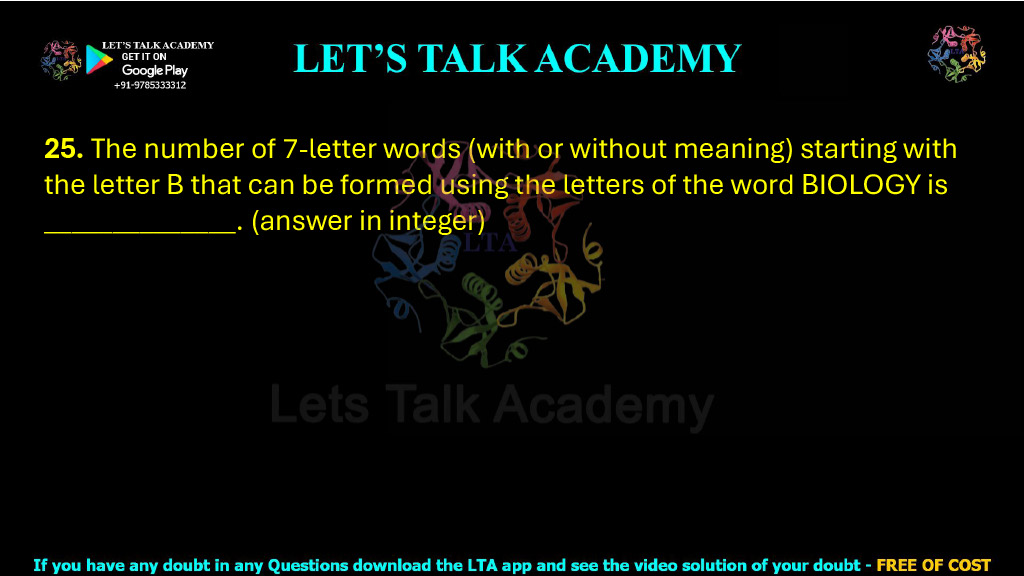
25. The number of 7-letter words (with or without meaning) starting with the letter B that can be formed using the letters of the word BIOLOGY is ______________. (answer in integer)
Number of 7-Letter Words Starting with B Using the Letters of BIOLOGY
Understanding the Given Permutation Problem
This question asks us to determine how many different 7-letter arrangements can be formed using the letters of the word BIOLOGY, with the additional condition that every arrangement must begin with the letter B. The words formed do not need to have any dictionary meaning, so every distinct arrangement satisfying the given condition must be counted.
The word BIOLOGY contains seven letters:
B, I, O, L, O, G, Y
A careful examination of these letters shows that most of them occur only once. However, the letter O appears twice. This repetition is important because exchanging the two identical O’s does not create a new word. Therefore, the ordinary permutation formula 7! cannot be used directly.
Another important condition is that every word must start with B. Since there is only one B in BIOLOGY, the first position is fixed. We only need to arrange the remaining six letters in the remaining six positions.
Identify the Letters and Their Frequencies
Before calculating the number of arrangements, it is useful to identify how many times each letter occurs in BIOLOGY.
The letters are:
B, I, O, L, O, G, Y
Their frequencies are:
B occurs 1 time
I occurs 1 time
O occurs 2 times
L occurs 1 time
G occurs 1 time
Y occurs 1 time
Thus, there are seven letters in total, but the two O’s are identical. The repetition of O must be included in the permutation calculation.
Step-by-Step Solution
Step 1: Fix the Letter B in the First Position
The question specifically states that every 7-letter word must start with B. Therefore, the first position is already occupied by B.
The arrangement can be represented as:
B _ _ _ _ _ _
There is only one possible choice for the first position because B must remain fixed. Therefore, fixing B does not introduce any multiplication factor greater than 1.
After placing B in the first position, the remaining letters are:
I, O, L, O, G, Y
These six letters must now be arranged in the remaining six positions.
Step 2: Examine the Remaining Six Letters
The six letters remaining after fixing B are:
I, O, L, O, G, Y
If all six letters were different, the total number of arrangements would be:
6!
However, the two O’s are identical. Interchanging one O with the other does not create a new arrangement. Therefore, simply calculating 6! would count every distinct word twice.
To correct this overcounting, we divide by 2!, which represents the number of ways the two identical O’s can be interchanged among themselves.
Step 3: Apply the Formula for Permutations with Repeated Letters
When n objects are arranged and some objects are identical, the number of distinct permutations is calculated using the formula:
Number of distinct permutations = n! / (p!q!r! …)
Here, n represents the total number of objects being arranged, while p, q, r, and so on represent the frequencies of repeated identical objects.
In the present problem, six letters are being arranged, and the letter O occurs twice. Therefore:
Number of arrangements = 6!/2!
Step 4: Evaluate the Factorials
The factorial of 6 is:
6! = 6 × 5 × 4 × 3 × 2 × 1
Therefore:
6! = 720
The factorial of 2 is:
2! = 2 × 1 = 2
Substituting these values into the permutation formula:
Number of arrangements = 720/2
Therefore:
Number of arrangements = 360
Step 5: State the Required Number of Words
Since B is fixed in the first position and the remaining letters I, O, L, O, G, and Y can be arranged in 360 distinct ways, the total number of 7-letter words starting with B is:
360
Why We Use 6! Instead of 7!
The complete word BIOLOGY contains seven letters, so without any restriction we would begin with arrangements of all seven positions. However, the question imposes the condition that every word must start with B.
Once B is fixed in the first position, it is no longer part of the arrangement process. Only the remaining six letters need to be rearranged.
Therefore, the number of objects being actively arranged is six, not seven. This is why the numerator of the permutation formula is 6! rather than 7!.
Why We Divide by 2!
The remaining six letters contain two identical O’s. Suppose we temporarily treated the two O’s as different, calling them O1 and O2. Then every arrangement containing O1 and O2 would be counted again when their positions were exchanged.
For example, consider an arrangement beginning as:
B I O L O G Y
Exchanging the two O’s does not produce a visibly different word because both letters are identical. Therefore, every unique arrangement is counted 2! times in the value 6!.
Dividing by 2! removes this repeated counting:
6!/2! = 360
Alternative Approach Using Position Selection
The same answer can be obtained using another counting method. After fixing B in the first position, there are six positions remaining.
First, choose two of these six positions for the two identical O’s. The number of ways to choose these positions is:
6C2 = 15
After placing the two O’s, four positions remain. The four distinct letters I, L, G, and Y can be arranged in these positions in:
4! = 24
Therefore, the total number of arrangements is:
15 × 24 = 360
This confirms the result obtained using the repeated-letter permutation formula.
Understanding the Phrase “With or Without Meaning”
The phrase “with or without meaning” tells us that the arrangements do not need to form valid English words. Any distinct sequence of the seven given letters is counted as a word in the mathematical sense, provided that it begins with B.
Therefore, meaningful arrangements and meaningless arrangements are treated equally. The problem is purely about the number of possible distinct arrangements rather than vocabulary or language.
Complete Calculation in Compact Form
The first letter must be B, so B is fixed:
B _ _ _ _ _ _
The remaining letters are:
I, O, L, O, G, Y
There are six letters in total, with O repeated twice. Therefore:
Number of distinct words = 6!/2!
= 720/2
= 360
Final Answer
The number of 7-letter words, with or without meaning, starting with B that can be formed using the letters of BIOLOGY is 360.
Answer: 360


