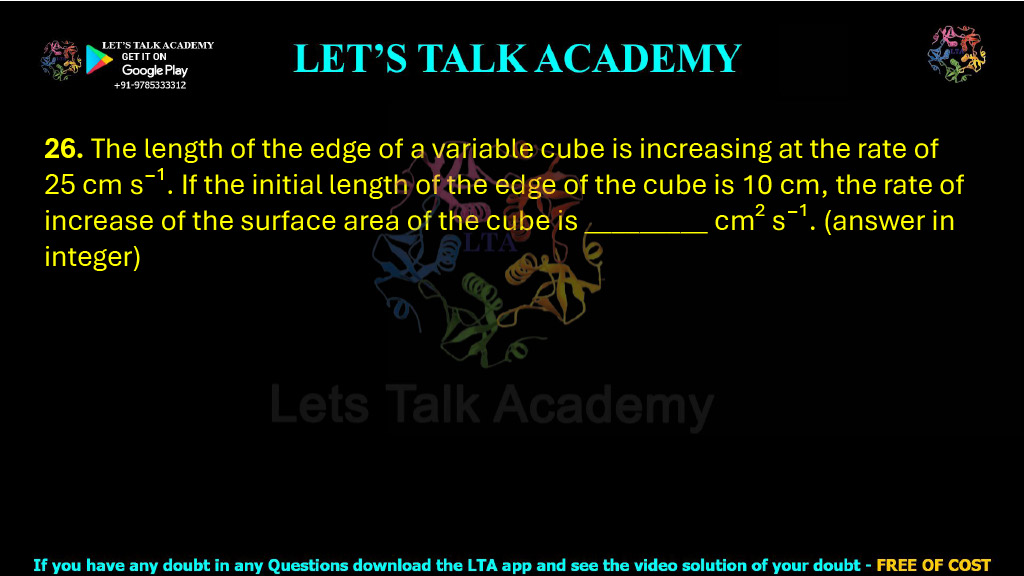
26. The length of the edge of a variable cube is increasing at the rate of 25 cm s⁻¹. If the initial length of the edge of the cube is 10 cm, the rate of increase of the surface area of the cube is _________ cm² s⁻¹. (answer in integer)
Rate of Increase of the Surface Area of a Cube When Its Edge Is Increasing
Understanding the Given Related Rates Problem
This question is based on the concept of related rates in differential calculus. The edge length of a cube is not constant; instead, it changes with time. As the edge becomes longer, the total surface area of the cube also increases. The problem asks us to determine how fast the surface area is increasing at the instant when the edge length is 10 cm.
The edge length is increasing at the rate:
dx/dt = 25 cm s−1
and the edge length at the required instant is:
x = 10 cm
We need to calculate the rate of change of the total surface area A with respect to time, represented by dA/dt.
What Is a Related Rates Problem?
A related rates problem involves two or more quantities that change with time and are connected through a mathematical equation. In this question, the edge length x and the surface area A both vary with time.
The relationship between these quantities is provided by the formula for the total surface area of a cube. By differentiating this formula with respect to time, we can connect the rate of change of the edge length with the rate of change of the surface area.
This approach is called implicit differentiation with respect to time because both x and A are functions of time.
Formula for the Surface Area of a Cube
Let the length of each edge of the cube be x. A cube has six identical square faces, and the area of one square face is:
x2
Since there are six faces, the total surface area A is:
A = 6x2
This equation establishes the relationship between the changing edge length and the changing surface area of the cube.
Step-by-Step Solution
Step 1: Write the Given Information
The edge length of the cube is increasing at the rate:
dx/dt = 25 cm s−1
At the instant for which the rate of increase of the surface area is required:
x = 10 cm
The quantity that must be calculated is:
dA/dt
where A represents the total surface area of the cube.
Step 2: Write the Surface Area Formula
The total surface area of a cube with edge length x is:
A = 6x2
Because x changes with time, the surface area A also changes with time. Therefore, both sides of the equation can be differentiated with respect to time t.
Step 3: Differentiate with Respect to Time
Differentiating the equation:
A = 6x2
with respect to time gives:
dA/dt = 6 × d(x2)/dt
Using the chain rule:
d(x2)/dt = 2x(dx/dt)
Therefore:
dA/dt = 6 × 2x × dx/dt
Hence:
dA/dt = 12x(dx/dt)
This is the required relationship between the rate of change of the surface area and the rate of change of the edge length.
Step 4: Substitute the Given Values
At the required instant:
x = 10 cm
and:
dx/dt = 25 cm s−1
Substituting these values into:
dA/dt = 12x(dx/dt)
we obtain:
dA/dt = 12 × 10 × 25
Therefore:
dA/dt = 120 × 25
Thus:
dA/dt = 3000 cm2 s−1
Step 5: State the Answer as an Integer
The question asks for the answer in integer form. The calculated rate is exactly 3000 cm2 s−1, so no rounding or further conversion is required.
Therefore:
Answer = 3000
Why Differentiation Is Required in This Problem
The formula A = 6x2 gives the surface area for a particular edge length, but the question does not ask for the surface area itself. It asks how quickly the surface area is changing with time.
Since the edge length changes continuously, the surface area also changes continuously. Differentiation converts the relationship between x and A into a relationship between their rates of change.
Starting with:
A = 6x2
and differentiating with respect to time gives:
dA/dt = 12x(dx/dt)
This formula directly connects the known edge growth rate, dx/dt, with the required surface area growth rate, dA/dt.
Understanding the Role of the Initial Edge Length
The rate of increase of the surface area depends not only on how fast the edge length is increasing but also on the current length of the edge.
The formula:
dA/dt = 12x(dx/dt)
shows that the rate of increase of the surface area is directly proportional to x. Therefore, even if the edge continues to increase at the constant rate of 25 cm s−1, the surface area will increase faster when the cube becomes larger.
In this question, the given edge length is 10 cm, so the required instantaneous rate is evaluated at x = 10 cm.
Verification Through the Six Faces of the Cube
The result can also be understood by considering each face separately. One face of the cube has area:
Aface = x2
Differentiating with respect to time:
dAface/dt = 2x(dx/dt)
At x = 10 cm and dx/dt = 25 cm s−1:
dAface/dt = 2 × 10 × 25
Therefore:
dAface/dt = 500 cm2 s−1
A cube has six identical faces. Therefore, the total rate of increase of surface area is:
6 × 500 = 3000 cm2 s−1
This confirms the result obtained using the direct differentiation method.
Dimensional Analysis of the Final Answer
The units also confirm that the calculation is consistent. In the formula:
dA/dt = 12x(dx/dt)
the edge length x has units of centimetres, while dx/dt has units of centimetres per second.
Therefore:
cm × cm s−1 = cm2 s−1
This is exactly the correct unit for the rate of change of an area with respect to time.
Complete Calculation in Compact Form
The surface area of a cube is:
A = 6x2
Differentiating with respect to time:
dA/dt = 12x(dx/dt)
Substituting x = 10 cm and dx/dt = 25 cm s−1:
dA/dt = 12 × 10 × 25
Therefore:
dA/dt = 3000 cm2 s−1
Final Answer
When the edge length of the cube is 10 cm and is increasing at 25 cm s−1, the surface area of the cube is increasing at 3000 cm2 s−1.
Answer: 3000


