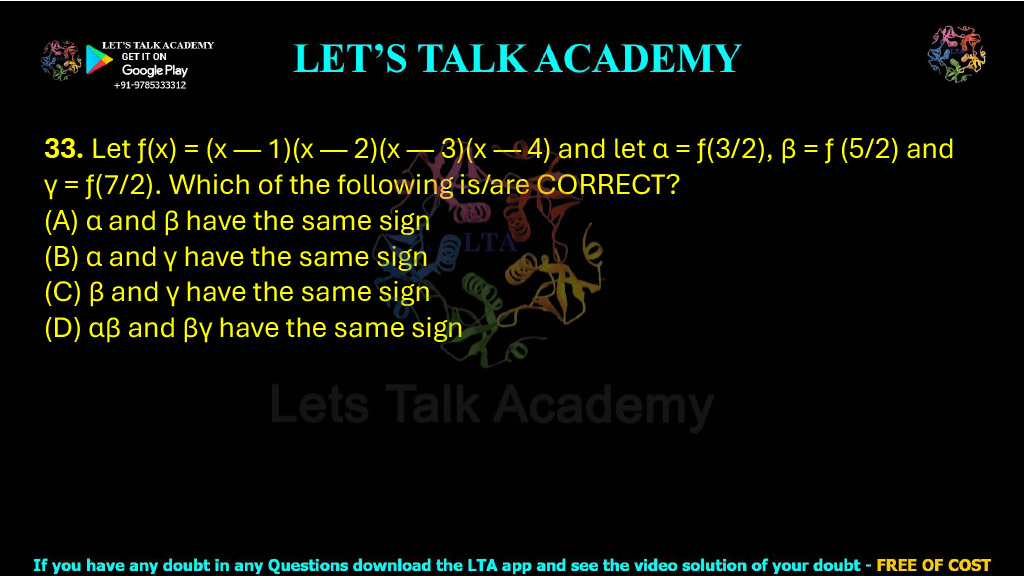
33. Let ƒ(x) = (x — 1)(x — 2)(x — 3)(x — 4) and let α = ƒ(3/2), β = ƒ (5/2) and γ = ƒ(7/2). Which of the following is/are CORRECT?
(A) α and β have the same sign
(B) α and γ have the same sign
(C) β and γ have the same sign
(D) αβ and βγ have the same sign
Find the Signs of α, β and γ for f(x) = (x − 1)(x − 2)(x − 3)(x − 4)
Understanding the Given Polynomial Sign Problem
This question is based on the sign of a polynomial at different points. The function is already written in completely factorized form:
f(x) = (x − 1)(x − 2)(x − 3)(x − 4)
We need to determine the signs of α, β, and γ, where the function is evaluated at x = 3/2, x = 5/2, and x = 7/2, respectively. After determining whether each value is positive or negative, we can compare their signs and examine every option.
The important point is that the question does not require only the exact numerical values of α, β, and γ. It mainly asks about their signs. Therefore, we can solve the problem efficiently by checking the signs of the individual factors in the polynomial.
However, for complete verification, we will also calculate the exact values of α, β, and γ. This will make the comparison of all four options completely clear.
Roots of the Polynomial and Their Importance
The polynomial is:
f(x) = (x − 1)(x − 2)(x − 3)(x − 4)
The value of the polynomial becomes zero whenever any one of its factors becomes zero. Therefore, the roots are:
x = 1, 2, 3, and 4
These four roots divide the real number line into five intervals:
x < 1
1 < x < 2
2 < x < 3
3 < x < 4
x > 4
The three given input values lie in three consecutive intervals:
3/2 lies between 1 and 2
5/2 lies between 2 and 3
7/2 lies between 3 and 4
Because each root has multiplicity one, the sign of the polynomial changes whenever x crosses one of these roots. This provides a useful way to understand why the signs of α, β, and γ alternate.
Step-by-Step Solution
Step 1: Find the Sign and Value of α = f(3/2)
We are given:
α = f(3/2)
Substituting x = 3/2 into the polynomial:
α = (3/2 − 1)(3/2 − 2)(3/2 − 3)(3/2 − 4)
Simplifying the four factors:
3/2 − 1 = 1/2
3/2 − 2 = −1/2
3/2 − 3 = −3/2
3/2 − 4 = −5/2
Therefore:
α = (1/2)(−1/2)(−3/2)(−5/2)
There are three negative factors in this product. The product of an odd number of negative factors is negative. Therefore:
α < 0
Calculating the exact value:
α = −15/16
Hence:
α = −15/16, so α is negative.
Step 2: Find the Sign and Value of β = f(5/2)
Now:
β = f(5/2)
Substituting x = 5/2:
β = (5/2 − 1)(5/2 − 2)(5/2 − 3)(5/2 − 4)
Simplifying the factors:
5/2 − 1 = 3/2
5/2 − 2 = 1/2
5/2 − 3 = −1/2
5/2 − 4 = −3/2
Therefore:
β = (3/2)(1/2)(−1/2)(−3/2)
This product contains two negative factors. The product of an even number of negative factors is positive. Therefore:
β > 0
Calculating the exact value:
β = 9/16
Hence:
β = 9/16, so β is positive.
Step 3: Find the Sign and Value of γ = f(7/2)
We have:
γ = f(7/2)
Substituting x = 7/2:
γ = (7/2 − 1)(7/2 − 2)(7/2 − 3)(7/2 − 4)
Simplifying the factors:
7/2 − 1 = 5/2
7/2 − 2 = 3/2
7/2 − 3 = 1/2
7/2 − 4 = −1/2
Therefore:
γ = (5/2)(3/2)(1/2)(−1/2)
There is exactly one negative factor. Therefore, the complete product is negative:
γ < 0
Calculating the exact value:
γ = −15/16
Hence:
γ = −15/16, so γ is negative.
Comparison of the Signs of α, β and γ
From the calculations above, we have:
α = −15/16 < 0
β = 9/16 > 0
γ = −15/16 < 0
Therefore, the sign pattern is:
α: Negative, β: Positive, γ: Negative
This immediately shows that α and γ have the same sign, while α and β have opposite signs and β and γ also have opposite signs.
Detailed Analysis of Each Option
Option (A): α and β Have the Same Sign
This option is incorrect. We have found that:
α < 0
while:
β > 0
Therefore, α is negative and β is positive. Since one value is negative and the other is positive, they have opposite signs.
Hence, Option (A) is incorrect.
Option (B): α and γ Have the Same Sign
This option is correct. We have:
α = −15/16
and:
γ = −15/16
Both α and γ are negative. In fact, their exact values are also equal. Therefore, α and γ certainly have the same sign.
Hence, Option (B) is correct.
Option (C): β and γ Have the Same Sign
This option is incorrect. The value β is positive:
β = 9/16 > 0
whereas γ is negative:
γ = −15/16 < 0
Therefore, β and γ have opposite signs.
Hence, Option (C) is incorrect.
Option (D): αβ and βγ Have the Same Sign
To check this statement, we examine the signs of the two products.
Since α is negative and β is positive:
αβ = Negative × Positive = Negative
Similarly, β is positive and γ is negative:
βγ = Positive × Negative = Negative
Therefore, both αβ and βγ are negative. Hence, they have the same sign.
We can also verify this using the exact values:
αβ = (−15/16)(9/16) = −135/256
and:
βγ = (9/16)(−15/16) = −135/256
Thus, the two products not only have the same sign but are also exactly equal.
Hence, Option (D) is correct.
Alternative Solution Using Only the Sign of Factors
The problem can be solved without calculating the exact fractional values. Since the polynomial is:
f(x) = (x − 1)(x − 2)(x − 3)(x − 4)
we only need to count the number of negative factors at each given value of x.
For x = 3/2, the first factor is positive while the remaining three factors are negative. Since there are three negative factors, f(3/2) is negative. Thus, α is negative.
For x = 5/2, the first two factors are positive and the last two factors are negative. Since there are two negative factors, f(5/2) is positive. Thus, β is positive.
For x = 7/2, the first three factors are positive and only the last factor is negative. Since there is one negative factor, f(7/2) is negative. Thus, γ is negative.
Therefore, the sign pattern is:
α < 0, β > 0, γ < 0
From this sign pattern, Options (B) and (D) follow directly.
Understanding the Sign Change Between Consecutive Roots
The polynomial has four distinct roots at 1, 2, 3, and 4. Each root occurs only once, so each root has odd multiplicity. A polynomial changes sign whenever it crosses a root of odd multiplicity.
For x > 4, all four factors are positive, so f(x) is positive. Moving left across x = 4 changes the sign to negative in the interval 3 < x < 4. Moving left across x = 3 changes the sign back to positive in the interval 2 < x < 3. Moving left across x = 2 changes the sign again to negative in the interval 1 < x < 2.
The three given values lie exactly in these intervals:
3/2 ∈ (1, 2), so α < 0
5/2 ∈ (2, 3), so β > 0
7/2 ∈ (3, 4), so γ < 0
This interval-based sign analysis gives the same conclusion as direct substitution.
Why α and γ Are Exactly Equal
An interesting feature of the polynomial is that it is symmetric around x = 5/2. This can be seen by pairing the factors:
f(x) = [(x − 1)(x − 4)][(x − 2)(x − 3)]
The values 3/2 and 7/2 are equally distant from 5/2. In fact:
5/2 − 3/2 = 1
and:
7/2 − 5/2 = 1
Because of the symmetry of the polynomial around x = 5/2:
f(3/2) = f(7/2)
Therefore:
α = γ = −15/16
This gives an additional confirmation that α and γ have the same sign and that αβ and βγ are also equal.
Complete Solution in Compact Form
For α:
α = f(3/2) = (1/2)(−1/2)(−3/2)(−5/2) = −15/16
Therefore:
α < 0
For β:
β = f(5/2) = (3/2)(1/2)(−1/2)(−3/2) = 9/16
Therefore:
β > 0
For γ:
γ = f(7/2) = (5/2)(3/2)(1/2)(−1/2) = −15/16
Therefore:
γ < 0
Thus, α and γ have the same negative sign. Also:
αβ < 0
and:
βγ < 0
Therefore, αβ and βγ also have the same sign.
Final Answer
The values satisfy α < 0, β > 0, and γ < 0. Therefore, α and γ have the same sign, and αβ and βγ also have the same sign.
Correct Options: (B) and (D)


