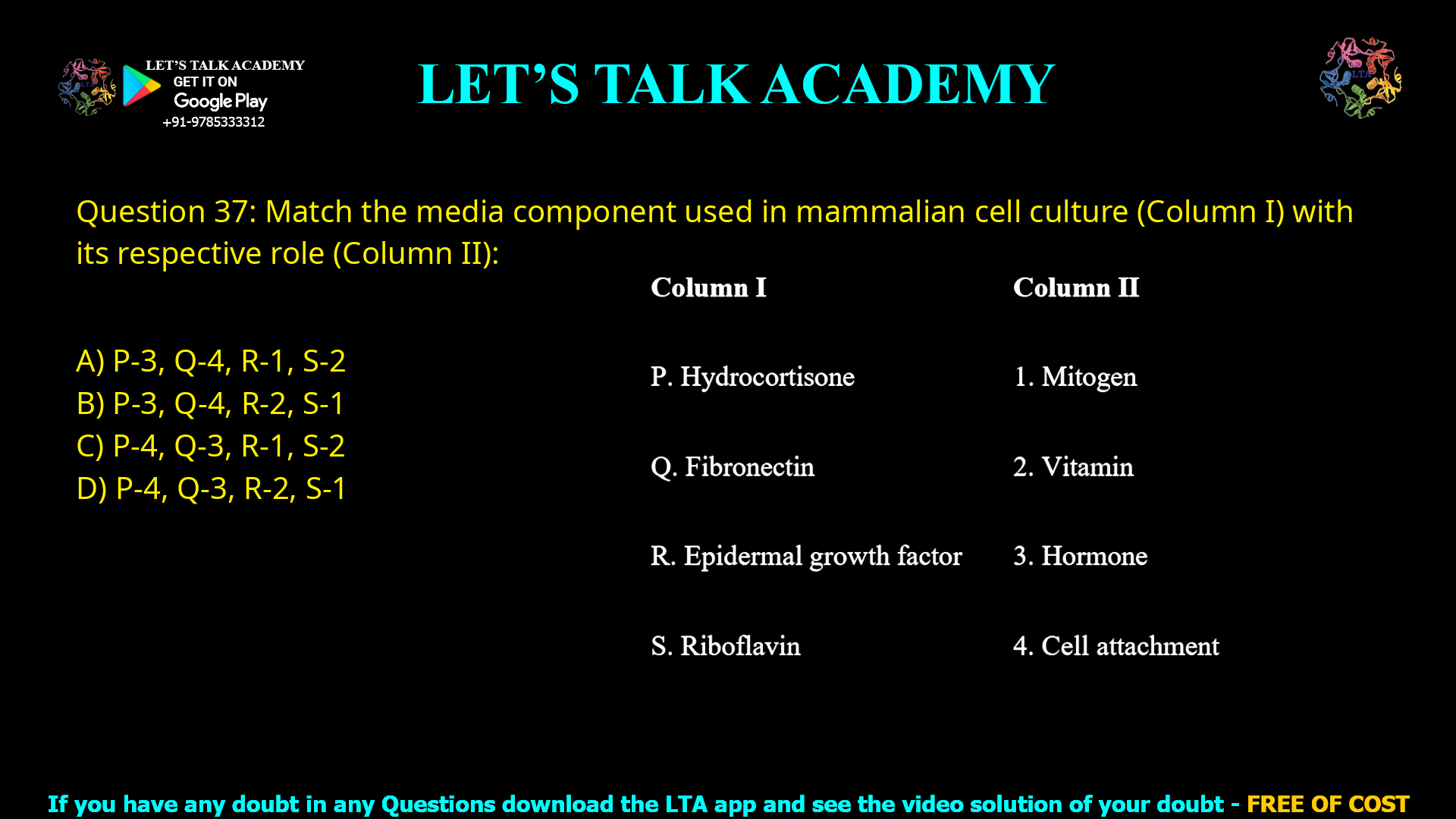
Q.37 Match the media component used in mammalian cell culture (Column I) with its
respective role (Column II).
Column I Column II
P. Hydrocortisone 1. Mitogen
Q. Fibronectin 2. Vitamin
R. Epidermal growth factor 3. Hormone
S. Riboflavin 4. Cell attachment
(A) P-3, Q-4, R-1, S-2
(B) P-3, Q-4, R-2, S-1
(C) P-4, Q-3, R-1, S-2
(D) P-4, Q-3, R-2, S-1
Mammalian cell culture relies on precisely formulated media to support cell growth, attachment, and proliferation. Components like hormones, growth factors, vitamins, and extracellular matrix proteins play specific roles. This article breaks down a common MCQ on matching these components (Column I) with their functions (Column II), provides the correct answer with detailed explanations, and analyzes all options for clarity.
In cell culture, media must mimic physiological conditions. Hydrocortisone acts as a steroid hormone, fibronectin promotes adhesion, epidermal growth factor (EGF) stimulates division as a mitogen, and riboflavin serves as a vital vitamin cofactor.
Correct Answer: (A) P-3, Q-4, R-1, S-2
Option (A) perfectly matches each component’s primary role in mammalian cell culture media.
Detailed Role Explanations
Here’s why each pairing in (A) is accurate, grounded in cell biology principles:
-
P. Hydrocortisone → 3. Hormone
Hydrocortisone is a glucocorticoid hormone that regulates metabolism, reduces inflammation, and stabilizes cell membranes in culture. It’s commonly added to media for epithelial or fibroblast cells to mimic adrenal cortex signaling. -
Q. Fibronectin → 4. Cell attachment
Fibronectin, an extracellular matrix glycoprotein, binds integrins on cell surfaces, enabling adhesion to culture substrates. Without it, anchorage-dependent mammalian cells (e.g., fibroblasts) fail to spread and proliferate. -
R. Epidermal growth factor → 1. Mitogen
EGF is a potent mitogen that binds EGFR receptors, triggering signaling cascades (e.g., MAPK/ERK pathway) for DNA synthesis and cell division. It’s essential in serum-free media for epithelial cell lines like keratinocytes. -
S. Riboflavin → 2. Vitamin
Riboflavin (vitamin B2) forms coenzymes like FAD and FMN, crucial for redox reactions in glycolysis and the electron transport chain. It’s a standard basal media additive for energy metabolism in cultured mammalian cells.
Why Other Options Are Incorrect
Let’s evaluate each wrong choice to highlight common pitfalls:
Option (B) P-3, Q-4, R-2, S-1
-
Correctly pairs hydrocortisone (hormone) and fibronectin (attachment).
-
Wrong: EGF as vitamin (it’s a peptide growth factor, not vitamin-like) and riboflavin as mitogen (vitamins don’t directly stimulate mitosis).
Option (C) P-4, Q-3, R-1, S-2
-
Correctly pairs EGF (mitogen) and riboflavin (vitamin).
-
Wrong: Hydrocortisone isn’t for cell attachment (that’s ECM proteins), and fibronectin isn’t a hormone (it’s a structural protein).
Option (D) P-4, Q-3, R-2, S-1
-
All pairings incorrect. Hydrocortisone and fibronectin swapped roles, EGF mislabeled as vitamin, riboflavin as mitogen—none align with biological functions.
These mismatches often trip up students confusing categories like hormones vs. attachment factors.
Applications in Mammalian Cell Culture
Understanding these roles optimizes media for biotech applications:
-
Serum-free formulations: EGF and fibronectin replace serum for defined cultures.
-
Primary cell isolation: Hydrocortisone supports steroid-sensitive cells like hepatocytes.
-
Vitamin balance: Riboflavin prevents metabolic deficiencies in long-term cultures.
For exams like CSIR NET or biotech coursework, mastering these distinctions boosts accuracy.


