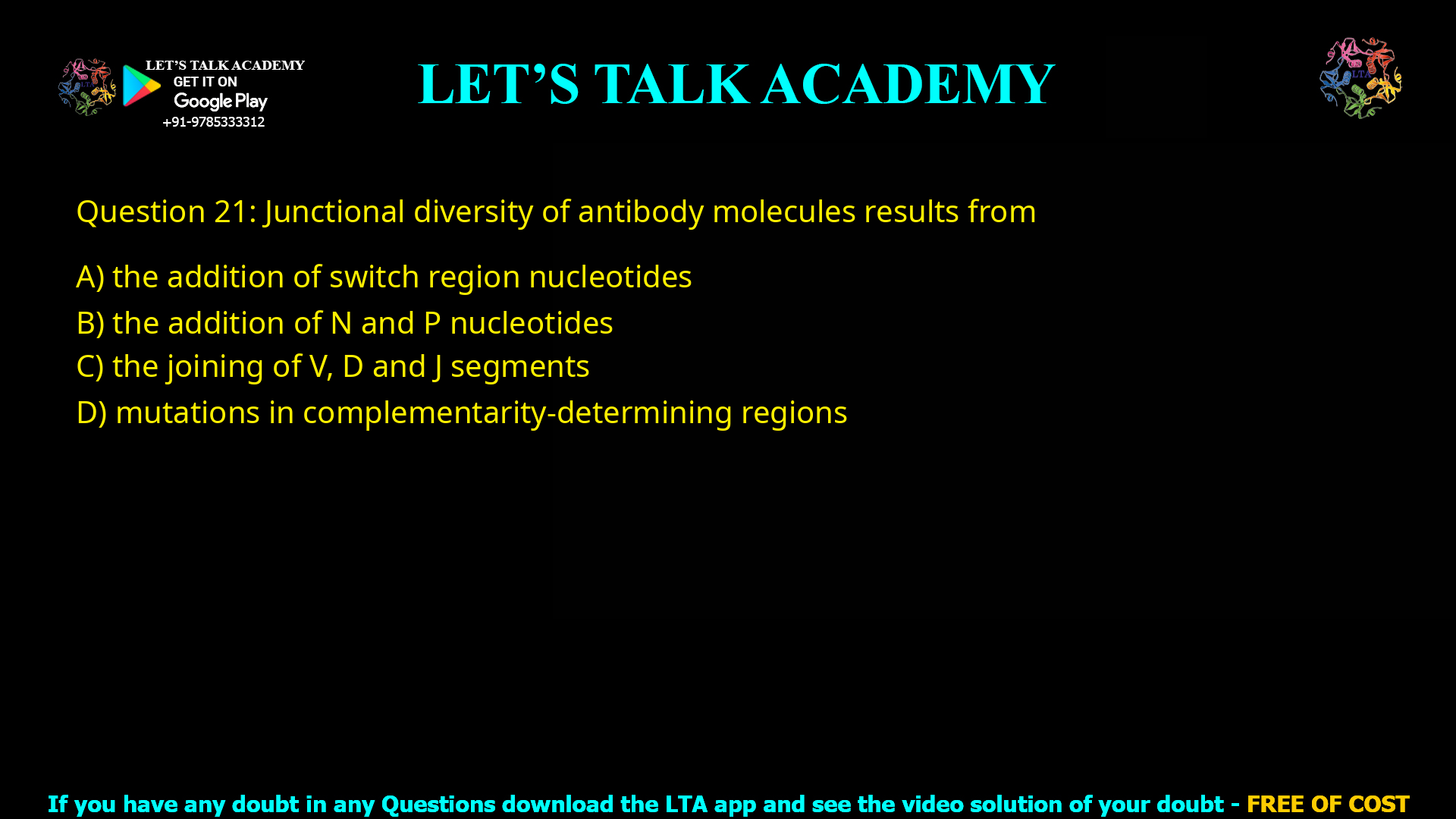
Q.21 Junctional diversity of antibody molecules results from
(A) the addition of switch region nucleotides
(B) the addition of N and P nucleotides
(C) the joining of V, D and J segments
(D) mutations in complementarity-determining regions
Junctional Diversity in Antibody Molecules: MCQ Solved
Junctional diversity enhances antibody variability during V(D)J recombination in B cells. The correct answer is (B) the addition of N and P nucleotides.
Option Analysis
Addition of switch region nucleotides (A): Switch regions drive class-switch recombination, altering antibody isotypes like IgM to IgG without affecting antigen specificity. This does not contribute to junctional diversity in variable regions.
Addition of N and P nucleotides (B): Correct. N-nucleotides are randomly added by terminal deoxynucleotidyl transferase (TdT) at V-D and D-J junctions; P-nucleotides form from hairpin loops during imprecise joining. This creates frameshifts in CDR3, vastly increasing diversity.
Joining of V, D, and J segments (C): This provides combinatorial diversity via segment selection, but junctional diversity specifically arises from nucleotide modifications at junctions.
Mutations in complementarity-determining regions (D): Somatic hypermutation introduces point mutations post-antigen exposure for affinity maturation, not during initial junctional events.
Junctional diversity of antibody molecules is a key mechanism in adaptive immunity, enabling vast antigen recognition. This process occurs at gene segment junctions during B-cell development, primarily through nucleotide additions that randomize CDR3 sequences.
Mechanisms of Junctional Diversity
V(D)J recombination joins variable (V), diversity (D—for heavy chains), and joining (J) segments. Exonuclease nibbling removes nucleotides; TdT adds non-templated N-nucleotides (up to 20); P-nucleotides arise from hairpin resolution. These changes yield ~10^6-fold diversity amplification beyond combinatorial joining.
-
Exonuclease activity: Trims segment ends variably.
-
P-addition: Palindromic sequences from loops.
-
N-addition: Random, TdT-dependent in pro/pre-B cells.
Role in Antibody Production
Heavy chain CDR3, formed at V-D-J junctions, is longest and most diverse, shaping the antigen-binding pocket. Light chains use V-J only. This ensures polyclonal responses to pathogens.
Clinical Relevance
Defects in TdT or RAG enzymes cause immunodeficiencies like SCID, reducing junctional diversity. Therapeutic antibodies exploit engineered diversity.
This junctional diversity of antibody molecules underpins humoral immunity, critical for vaccines and autoimmunity research.


