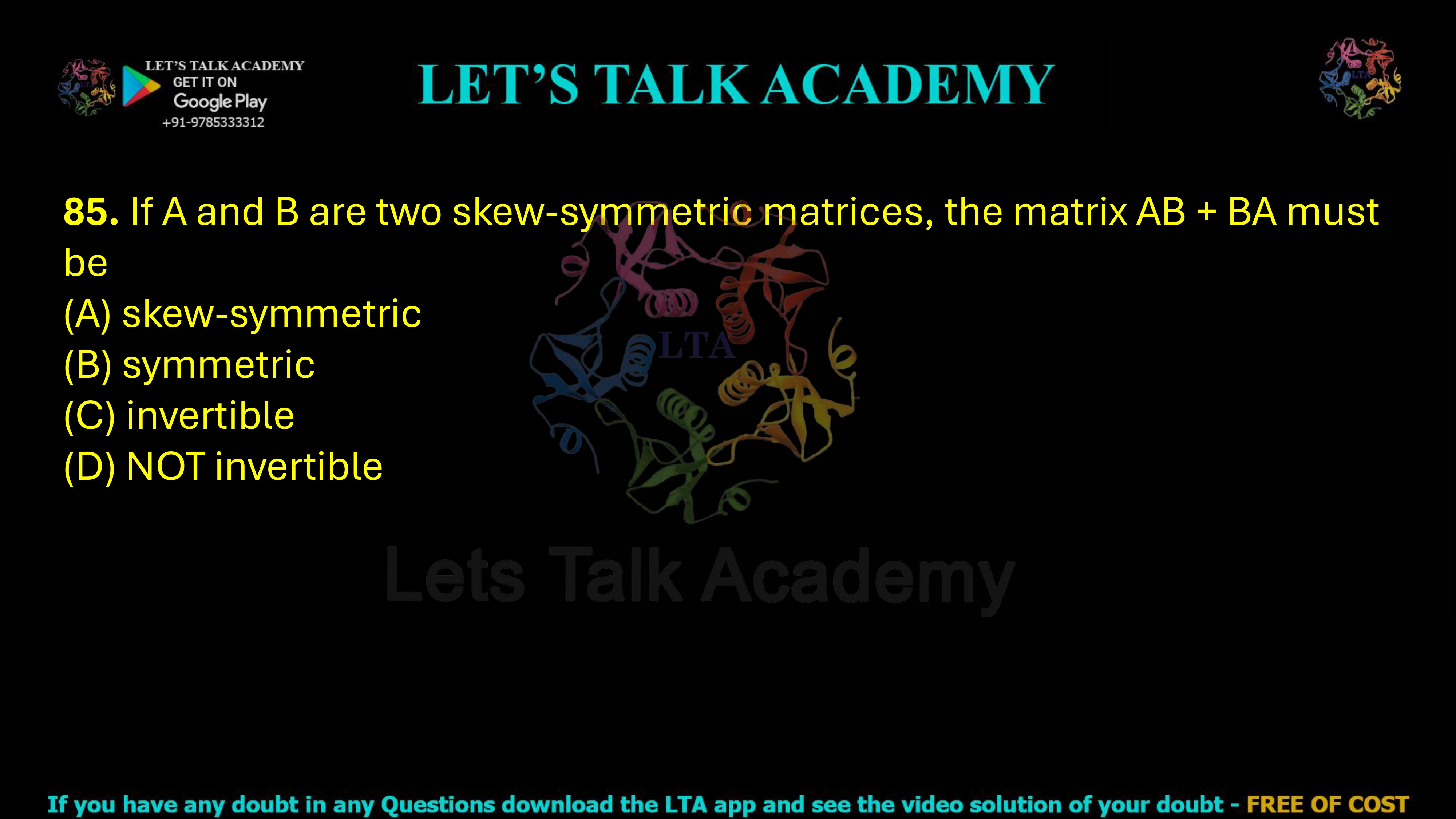
85. If A and B are two skew-symmetric matrices, the matrix AB + BA must be
(A) skew-symmetric
(B) symmetric
(C) invertible
(D) NOT invertible
If A and B are Two Skew-Symmetric Matrices, Then AB + BA Must Be Symmetric
Matrix algebra is one of the most frequently tested topics in competitive examinations such as CSIR NET, GATE, IIT JAM, SET, and university entrance examinations. Among the various concepts of linear algebra, understanding the properties of symmetric and skew-symmetric matrices is extremely important because many questions are solved simply by applying transpose rules instead of lengthy calculations.
The given question tests the relationship between two skew-symmetric matrices and the nature of the matrix obtained after adding their products in different orders. Instead of multiplying matrices directly, we can use the transpose property, making the solution elegant and much faster.
Correct Answer
Option (B): Symmetric
Understanding Skew-Symmetric Matrices
A matrix is called skew-symmetric if its transpose is equal to the negative of the original matrix. Mathematically, this property is written as
AT = −A
Similarly, since B is also skew-symmetric,
BT = −B
These identities are the key to solving the problem without performing any matrix multiplication.
Step-by-Step Mathematical Proof
Let
M = AB + BA
Now take the transpose of the entire matrix.
MT = (AB + BA)T
Using the transpose rule
(XY)T = YTXT
we obtain
MT = (AB)T + (BA)T
= BTAT + ATBT
Substitute the skew-symmetric properties
AT = −A
BT = −B
Therefore,
MT = (−B)(−A) + (−A)(−B)
= BA + AB
Since matrix addition is commutative,
BA + AB = AB + BA
Hence,
MT = M
A matrix whose transpose is equal to itself is called a symmetric matrix. Therefore, the matrix AB + BA is always symmetric.
Why the Other Options Are Incorrect
Option (A): Skew-Symmetric
This option is incorrect because a skew-symmetric matrix satisfies the condition MT = −M. In this problem, we proved that MT = M, which is exactly the definition of a symmetric matrix. Therefore, the resulting matrix cannot generally be skew-symmetric.
Option (B): Symmetric
This is the correct answer because the transpose of AB + BA equals the original matrix itself. The proof follows directly from the transpose rule for matrix multiplication together with the defining property of skew-symmetric matrices.
Option (C): Invertible
This statement is incorrect because symmetry alone does not guarantee invertibility. A symmetric matrix may be singular or nonsingular depending on its determinant. Therefore, no conclusion about invertibility can be drawn from the given information.
Option (D): NOT Invertible
This option is also incorrect because there is no theorem stating that AB + BA must always be singular. Some symmetric matrices are invertible, while others are not. Hence this statement is not universally true.
Key Linear Algebra Concepts Used
The solution depends on three fundamental properties of matrices. First, the transpose of a product reverses the order of multiplication, that is, (AB)T = BTAT. Second, a skew-symmetric matrix satisfies AT = −A. Finally, a matrix is symmetric if and only if its transpose equals itself. Combining these three properties immediately establishes the result without requiring any numerical computation.
Final Answer
Since
(AB + BA)T = AB + BA,
the matrix AB + BA is always a symmetric matrix.
Correct Option: (B) Symmetric


