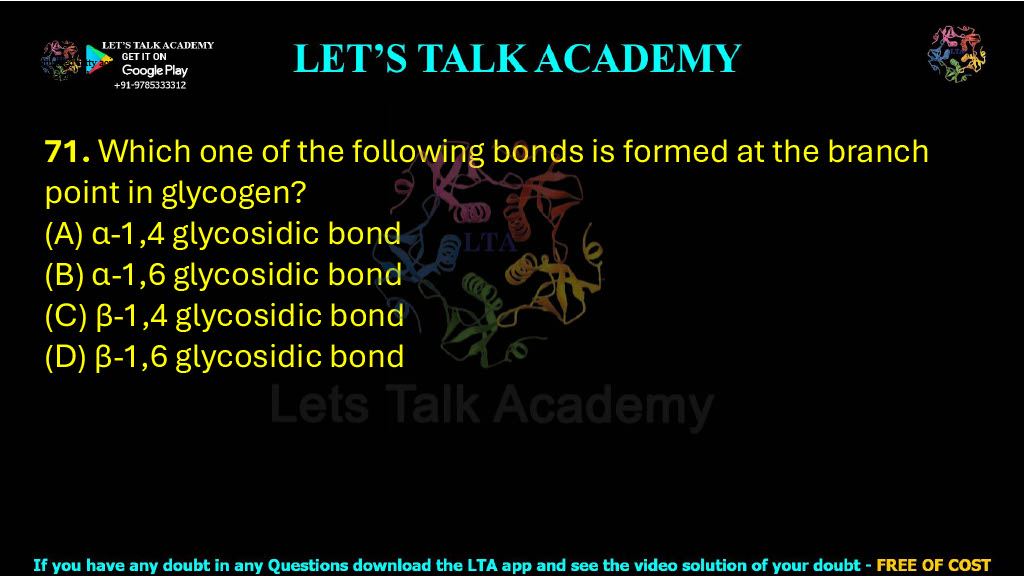
71. Which one of the following bonds is formed at the branch point in glycogen?
(A) α-1,4 glycosidic bond
(B) α-1,6 glycosidic bond
(C) β-1,4 glycosidic bond
(D) β-1,6 glycosidic bond
Which Glycosidic Bond Forms the Branch Point in Glycogen?
Correct Answer
(B) α-1,6 glycosidic bond
Introduction
Glycogen is the principal storage polysaccharide of animals and serves as a rapidly mobilizable reserve of glucose. It is predominantly stored in the liver, where it helps maintain blood glucose levels, and in skeletal muscles, where it provides an immediate source of energy during muscle contraction. Unlike linear polysaccharides, glycogen possesses a highly branched architecture that allows multiple enzymes to simultaneously synthesize and degrade glucose chains. This structural organization enables glycogen to release glucose much more rapidly than unbranched polysaccharides.
The branching pattern of glycogen is created by two distinct glycosidic linkages. The long linear chains are connected by α(1→4) glycosidic bonds, while the branch points are formed through α(1→6) glycosidic bonds. These branch points are introduced by the glycogen branching enzyme (amylo-(1,4→1,6)-transglycosylase) during glycogen synthesis.
Understanding the Concept Behind the Question
Glycogen consists of hundreds to thousands of glucose molecules arranged in a highly branched structure.
Two different glycosidic bonds are present:
- α(1→4) glycosidic bonds connect glucose molecules within the linear chains.
- α(1→6) glycosidic bonds create branch points approximately every 8–12 glucose residues.
Therefore, whenever a new branch originates from the main chain, the linkage formed is an α-1,6 glycosidic bond.
Analysis of Option (A)
α-1,4 Glycosidic Bond
This statement is incorrect.
The α-1,4 glycosidic bond forms the straight chains of glycogen by linking the C1 carbon of one glucose molecule with the C4 carbon of the next glucose molecule.
Although this is the most abundant linkage in glycogen, it does not produce branch points.
Therefore,
Option (A) is incorrect.
Analysis of Option (B)
α-1,6 Glycosidic Bond
This statement is correct.
Branching occurs when the glycogen branching enzyme transfers a short chain of glucose residues from a growing glycogen molecule to the C6 hydroxyl group of another glucose residue.
This reaction creates an α(1→6) glycosidic linkage, producing a new branch.
These branches increase the number of non-reducing ends, allowing rapid glycogen synthesis and degradation.
Therefore,
Option (B) is correct.
Analysis of Option (C)
β-1,4 Glycosidic Bond
This statement is incorrect.
The β(1→4) glycosidic bond is characteristic of cellulose, the major structural polysaccharide of plant cell walls.
Because of this β linkage, cellulose forms straight, rigid fibers that humans cannot digest due to the absence of cellulase.
Glycogen never contains β-1,4 linkages.
Therefore,
Option (C) is incorrect.
Analysis of Option (D)
β-1,6 Glycosidic Bond
This statement is incorrect.
β-1,6 glycosidic bonds are not present in glycogen.
Animal glycogen exclusively contains α-type glycosidic linkages, namely α(1→4) in the linear regions and α(1→6) at branch points.
Therefore,
Option (D) is incorrect.
Structure of Glycogen
The architecture of glycogen can be summarized as follows:
- Linear chains: α(1→4) glycosidic bonds
- Branch points: α(1→6) glycosidic bonds
- Branch frequency: Approximately every 8–12 glucose residues
- Reducing end: One
- Non-reducing ends: Many
The presence of numerous non-reducing ends allows several glycogen phosphorylase molecules to degrade glycogen simultaneously, enabling rapid glucose release.
Difference Between Glycogen, Starch, and Cellulose
| Polysaccharide | Main Linkage | Branch Linkage | Nature |
|---|---|---|---|
| Glycogen | α(1→4) | α(1→6) | Highly branched |
| Amylopectin | α(1→4) | α(1→6) | Moderately branched |
| Amylose | α(1→4) | None | Linear |
| Cellulose | β(1→4) | None | Linear and structural |
This comparison highlights that glycogen and amylopectin share the same branch linkage, whereas cellulose possesses an entirely different β linkage.
Biological Importance
The extensive branching of glycogen provides several physiological advantages. It greatly increases solubility, prevents crystallization, and creates numerous non-reducing ends from which glycogen phosphorylase and glycogen synthase can simultaneously act. Consequently, glucose can be released rapidly during exercise or fasting and stored efficiently after meals. The enzyme responsible for branch formation, glycogen branching enzyme, is essential for normal glycogen metabolism, and defects in this enzyme lead to Glycogen Storage Disease Type IV (Andersen disease).
High-Yield Points
- Glycogen is the storage polysaccharide of animals.
- Linear chains contain α(1→4) glycosidic bonds.
- Branch points contain α(1→6) glycosidic bonds.
- Branches occur approximately every 8–12 glucose residues.
- Branching enzyme creates α(1→6) linkages.
- Glycogen phosphorylase removes glucose from non-reducing ends.
- Cellulose contains β(1→4) linkages and is not branched.
Frequently Asked Questions
Why are α-1,6 glycosidic bonds important?
They generate branch points that increase the number of non-reducing ends, allowing rapid glycogen synthesis and degradation.
Which enzyme forms α-1,6 glycosidic bonds?
The glycogen branching enzyme (amylo-(1,4→1,6)-transglycosylase) introduces α-1,6 branches during glycogen synthesis.
What is the difference between α-1,4 and α-1,6 bonds?
α-1,4 bonds form the linear backbone, whereas α-1,6 bonds produce the branch points in glycogen.
Key Takeaways
Glycogen is a highly branched glucose polymer that serves as the primary carbohydrate storage molecule in animals. Its linear chains are connected by α(1→4) glycosidic bonds, while branch points are formed through α(1→6) glycosidic bonds introduced by the glycogen branching enzyme. These branches enhance glycogen solubility and enable rapid mobilization of glucose by creating numerous non-reducing ends. Because branch formation always involves an α-1,6 glycosidic linkage, the correct answer is Option (B).
Final Answer
Correct Option: (B) α-1,6 glycosidic bond
Explanation
Glycogen consists of linear glucose chains connected by α(1→4) glycosidic bonds and branch points formed by α(1→6) glycosidic bonds. During glycogen synthesis, the glycogen branching enzyme transfers a short segment of glucose residues to the C6 hydroxyl group of another glucose molecule, producing an α-1,6 linkage. This highly branched organization increases the number of non-reducing ends, allowing rapid glycogen synthesis and degradation. Therefore, the bond present at the branch point of glycogen is the α-1,6 glycosidic bond, making Option (B) the correct answer.


